
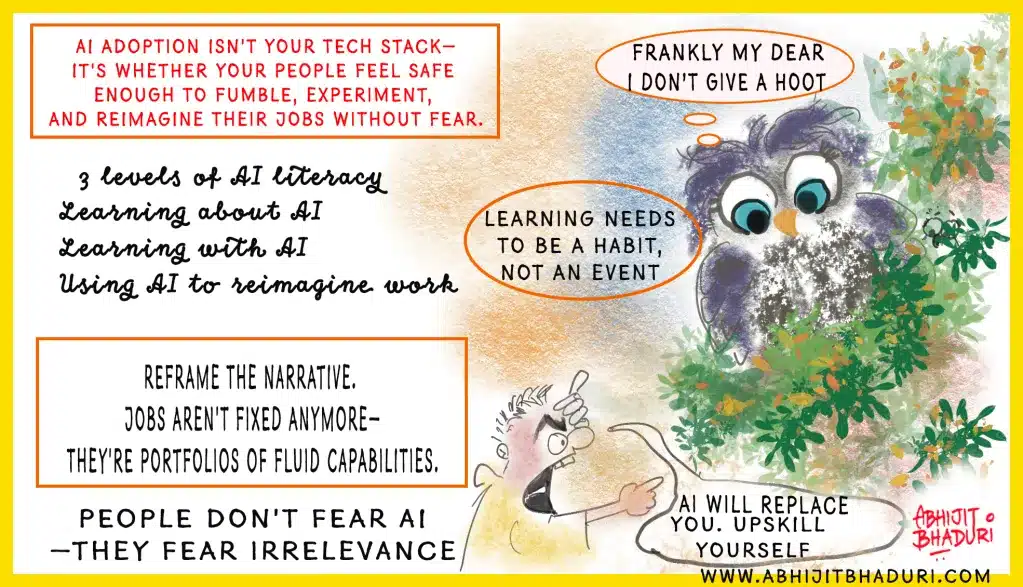
The real barrier to AI adoption isn’t the tech stack—it’s whether your people feel safe enough to fumble, experiment, and reimagine their jobs without fear.

Panel at TechWeek US 2025
UpGrad had sponsored this panel. Srikanth Iyengar, CEO of UpGrad Enterprise was on my podcast and here is a glimpse of what he recommended
- James Young — General Manager, Slalom • LinkedIn. The consulting firm Slalom’s strategic vision is to be the first in the industry to lead with bringing more and delivering outcomes as we work to become the world’s most customer-obsessed and employee-empowered services.
- Saurabh Sharma — Chief Product Officer, You.com • LinkedIn Even with rapid technological advances, foundational models still fall short of enterprise demands — limiting businesses from realising the full benefits of AI.
- Dharma Rajagopalan — SVP, Growth, Automation Anywhere • LinkedIn Automation Anywhere provides enterprise automation software that uses AI-powered bots to handle repetitive business tasks like data entry, invoice processing, and customer service workflows.
- Yours truly was representing the L&D plus talent strategy side of the house!
So we had an awesome panel and an audience that was ready with questions as Michele Griffin who spent seven years at Andreesen Horowitz, the Platinum sponsors of the event. Michele is now building PremierGTM.com. The panel revealed an uncomfortable truth: most companies are losing the AI race not because they picked the wrong tools, but because they’re treating a people problem like a software problem.
Companies are spending billions on AI tools and training, but employees aren’t using them. The reason isn’t the technology—it’s that nobody’s preparing people for the identity crisis AI creates at work.
The Training Paradox Nobody’s Talking About
Here’s a fact that should alarm every executive: UpGrad surveyed 3,000 American workers and found that 70% receive regular AI training, yet 41% say it has nothing to do with their actual job. Even more telling—77% admit they’d only complete training if it directly affected their performance review or promotion chances.
Think about that. Companies are running mandatory AI workshops while employees are mentally checking out, thinking “this doesn’t apply to me.” It’s like teaching someone to drive by showing them engine schematics instead of putting them behind the wheel.
Srikanth Iyengar, CEO of upGrad Enterprise, sees three patterns separating winners from losers in AI adoption.
First, culture must change before technology arrives—not after.
Second, AI can’t be a six-month efficiency project; it needs to be woven into three-to-five-year strategic plans. T
Third, measuring AI’s return on investment requires collaboration across departments because benefits pop up in unexpected places.
When Your Job Identity Meets AI, Sparks Fly
Imagine you’ve spent 15 years perfecting your marketing intuition. You can smell a winning campaign. Then AI generates better email subject lines in 10 seconds than you could in a week. That’s not just a workflow change—it’s an existential threat to who you think you are professionally.
Behavioral scientists call this the SCARF model: Status, Certainty, Autonomy, Relatedness, and Fairness. AI potentially undermines all five at once. A loan officer who took pride in assessing credit risk now watches an algorithm do it faster. Where’s the status? The certainty about their future? The autonomy in decision-making?
Dharmendra Sethi from GlobalLogic, watching from the SF Tech Week audience, nailed it: “Learning needs to be a habit, not an event.” He argues that organizations must redesign entire workflows around AI, not just train people on buttons to click.
AI Agents: From Cost-Cutters to Money-Makers
AI agents are like having a really capable intern who never sleeps—they observe what’s happening, make decisions based on rules you’ve set, and take action without you babysitting them every second.
“What excites me most about agentic automation is that it’s no longer just about cost savings,” says Dharma Rajagopalan of Automation Anywhere. “We’re entering a new era where automation becomes a revenue driver—fueling growth, accelerating innovation, and helping teams deliver real, measurable impact.”
That reframing changes everything. When leaders sell AI as “cutting costs,” employees hear “cutting jobs.” When they position it as “amplifying your impact,” suddenly you’re talking about making people more valuable, not replaceable.
James Young from Slalom sees this shift happening: “The most future-ready organizations are prioritizing AI enablement with layered and sustained strategies that build capability at every level.” He adds that AI enables “just-in-time, personalized learning experiences at a scale previously not possible.”
The Brutal Truth: Stop Doing This, Start Doing That
Stop: Generic “AI 101” courses measured by completion rates. Stop treating learning like a content library where you check boxes.
Start: Building role-specific learning paths where a sales rep learns AI for pipeline forecasting, while a designer learns AI for rapid prototyping. Create peer circles where people share what works. Most critically, link training completion directly to career advancement—since 80% say that’s what would actually motivate them.
The companies winning at AI aren’t the ones with the fanciest tools. They’re the ones whose people feel brave enough to experiment badly at first, and curious enough to keep improving.Retry
Three Levels Nobody’s Teaching (And How L&D Should Respond)
Most training stops at “here’s how to use ChatGPT.” But there are actually three levels to AI proficiency:
- Learning about AI (understanding what it can/can’t do)
- Learning with AI (using it as a thinking partner)
- Using AI to reimagine work (redesigning entire workflows)
That third level? That’s where the magic happens—and where most L&D strategies completely fail.
Action #1: Map learning pathways to actual job transformations, not tool features. Instead of “Introduction to Generative AI,” create modules like “How Customer Service Roles Evolve with AI” or “Reimagining Marketing Campaign Development.” Each level should show real before-and-after workflows from people in similar roles. Level 1 might explain what AI-powered customer insights can detect. Level 2 shows how to have a conversation with AI to refine those insights. Level 3 demonstrates how teams are reorganizing around AI-generated insights to make strategic decisions faster.
Action #2: Build practice sandboxes tied to real work, not toy examples. Create safe environments where people work on actual company challenges using AI tools—with coaching and peer learning built in. A finance team learning AI shouldn’t practice on generic datasets; they should experiment with your actual forecasting models in a non-production environment. The learning happens when they make mistakes, see consequences, iterate, and improve. This requires L&D to partner closely with department heads to identify suitable practice problems and protect time for experimentation.
The Netflix Problem in Corporate Learning
Your employees consume content created by Hollywood-level production teams in their personal lives. Then they show up to work and you hand them a 47-slide PowerPoint deck narrated by someone from IT. The gap is jarring.
What works instead: curate role-based learning paths, build peer circles, and create spaces where people practice together. As Neha observed, customized, micro-learning pathways tailored to actual roles unlock true potential. Make L&D a living, collaborative system—not a content graveyard. This is what it means to put learners at the center with community around them.
Start Here Tomorrow
James’s insight about layered, sustained strategies is your roadmap. Stop thinking tactical (efficiency gains) and go strategic (mid-to-long-term capability building). Neha’s right that measuring ROI requires cross-functional collaboration—but first, you need cross-functional buy-in.
The most future-ready organizations are prioritizing AI enablement at every level, not just among technical teams. They’re building cultures where continuous learning is expected and psychological safety is non-negotiable.
The bottom line? AI adoption is a cultural transformation disguised as a tech project. Build psychological safety. Make learning continuous and contextual. Let people stumble in public. Celebrate interesting failures alongside wins.
Because the companies that win won’t be the ones with the fanciest AI tools. They’ll be the ones whose people feel brave enough to use them badly at first—and curious enough to keep getting better.
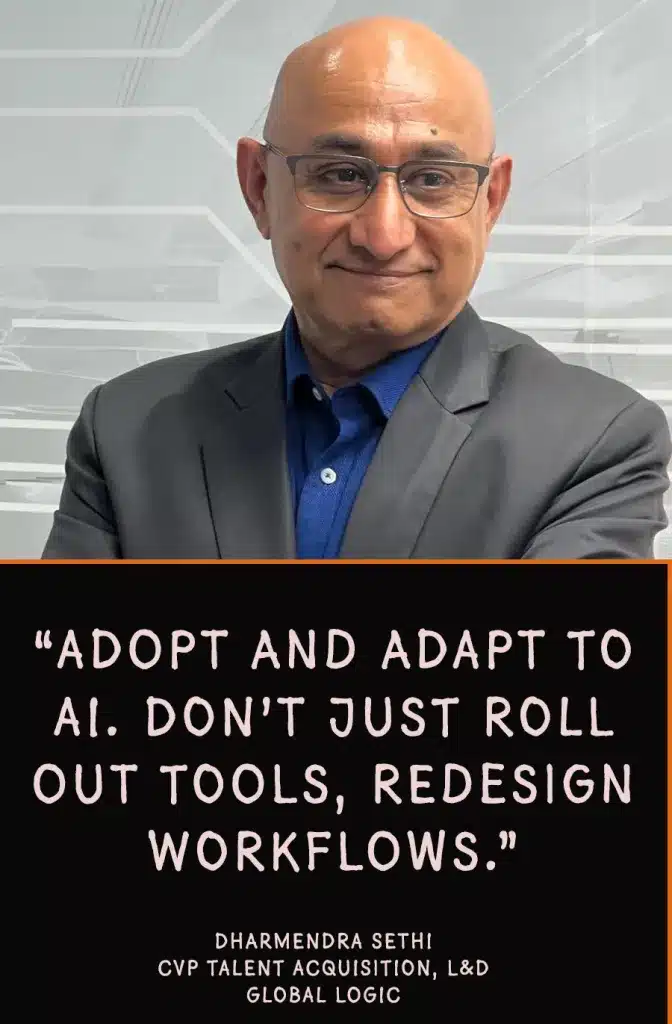
When asked about his biggest takeaway, Dharmendra Sethi, CVP of Talent Acquisition and L&D at GlobalLogic said, “Cultural and mindset shift are critical — successful AI adoption and scale require organization-wide cultural change and a mindset shift at the employee level. AI transformation should be strategic, not tactical — leaders need to integrate AI initiatives into their mid- to long-term strategic plans rather than treating them purely as short-term efficiency exercises.”
What percentage of your team is actually using the AI tools you’ve rolled out? And what do you think is really holding them back?