
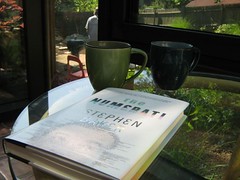
 Who says Math nerds are cool? I do. Stephen Baker‘s book turned even me into a raging fan of The Numerati – math geeks for the layperson. For many years I grew up being traumatised by Math and teachers of that dreaded subject. My relationship with that subject was pretty much like that of a fellow commuter riding the elevator during rush hour. You may stand in close proximity, but you never say hello to each other and certainly do not recognize each other at the supermarket as you trawl for discounts. In short I am the most unlikely contender to review a book on Math and Technology. So why am I recommending that you read The Numerati by Stephen Baker. It takes the complex world of Math and puts it in a manner that makes it easy for numerophobic people like me to understand. The book makes Math an almost attractive subject. It made me wish I had paid more attention to Math and Stat in school and college. Stephen certainly makes the Math nerd look cool. The blurb promises the book to be “A captivating look at how a global math elite is predicting and altering our behavior — at work, at the mall, and in bed.” While doing the post on Predictive Analytics for HR Atanu had recommended that read this book and sent me the link on Businessweek on The Rise of The NumeratiJust how do they do it? The premise is simple. Past behavior patterns forms a basis to predict what you are likely to do in future. The premise works on getting hold of huge masses of data that can be analyzed to look for trends and patterns. Every day we produce loads of data about ourselves simply by living in the modern world: we click web pages, flip channels, drive through automatic toll booths, shop with credit cards, and make cell phone calls. Now, in one of the greatest undertakings of the twenty-first century, a savvy group of mathematicians and computer scientists (The Numerati really) is beginning to sift through this data to dissect us and map out our next steps. Their goal? To manipulate our behavior — what we buy, how we vote — without our even realizing it.” As you swipe a credit card to pay for purchases, pay at the toll booth through a pre-paid tag, blog or leave a comment on a website, visit the dentist or even write an email or sms a friend, you are creating a big electronic footprint that says something about you. When any such data is collected over time some patterns begin to emerge. When this mass of data is analyzed to look for patterns, it builds up the probability of behavior patterns. You got to hear Stephen Baker explain how this book happened in this video before I share my interview with the man who brought the word Numerati into mainstream.The photo of Stephen Baker with his cat Rock Sand is courtesy the private collection of Jalaire Craver.Here is how my interview with him went:AB:. Who is the reader you wrote The Numerati for? What impact did you hope to create in the reader? Do you think your book has made the Math nerd cool?Stephen Baker: I wrote the Numerati for people like myself. They don’t think much about math or computers, but are interested in the forces shaping the history of our times. I knew as I wrote it that the book might disappoint the true Numerati, that they would likely look to it for a level of detail and technical insight that it lacks. But most of them have been surprisingly generous in their responses. More than one has told me that his mother can finally understand what he does.I can only hope I helped people to understand how cool math nerds are, and how fascinating their work is.AB: You have mentioned the work the Numerati are doing in various areas like Marketing, Politics, Healthcare, Blogging, fighting terrorism etc. Where are we most ahead of the game?
 Stephen Baker: The Numerati are by far the most advanced in marketing and advertising. These are areas where they can afford to experiment widely, and make lots of mistakes at a very low cost. If you think about it, Google has built a empire on educated guesses.AB: You have been exploring the concept of Friendship for sometime. What is the best measure of friendship – the secrets we share? The ones we yearn to meet again and again? The one who shares our deepest secrets?.Has the social media made it tougher to have the sense of privacy that builds depth in a relationship? So much so for having 300+ friends on Facebook.Stephen Baker: I think the best measure of friendship, as you say, are the secrets you confide in your closest friends. (Of course, we have ways of dividing different secrets among different friends.) Maybe it’s taking some people time to figure out the nature of online friendships. But I think the younger generation will teach us all how to protect the fragments of privacy that add depth to our friendships. Privacy itself, though, is a shifting value, and it always has been, through history and cultures. It will continue to evolve.AB: You have been a journalist for 20+ years, a published author for a year and a very widely followed blogger* for a few. Why have corporate blogs not been as successful as you predicted in your cover story in Businessweek.Stephen Baker: The power of a blog, as in so many other endeavors, is tied related the amount of control one cedes. Successful corporate blogs, and there are very few, give full and unfettered voice to the public. They interact with it, and learn from it. And that conversation attracts more people. The problem with corporations is that they want to control the message. They control comments and publish press releases. Usually the result is a dreadful bore.In my defense, I don’t think I predicted that corporate blogs would be such tremendous successes. The most important point for corporations, from my view, was to take blogs seriously, to monitor and interact with them.This has to do not just with blogs, but all of the other grass-roots activities of networked people. Think about it: The Obama campaign, Linux, YouTube, Facebook. This is a huge story of this decade. (And all of these phenomena produce mountains of data for the Numerati to analyze.)Read more about The Numerati at http://thenumerati.net/*Stephen Baker’s blog was rated by NY Times as one of the Top 50 blogs to watch

Demystifying “START”: More Than Just a Beginning
The word “START” appears in many contexts, from international treaties to early childhood education. Let’s explore some of the diverse