
Indians had their first internet experience through a smartphone, never having owned a desktop computer or landline phone. Leapfrogging is what India did. Time to do it again
AI is a seismic shift. India can’t afford to play catch-up.It’s time to move from being a nation of coders to a nation of AI creators. We have the talent. We have the entrepreneurial spirit. Now, we need to upgrade our ambition.
Bharat AI – Build for Impact
India transformed its digital economy with India Stack—a public digital infrastructure that revolutionized payments (UPI), identity verification (Aadhaar), and financial inclusion.
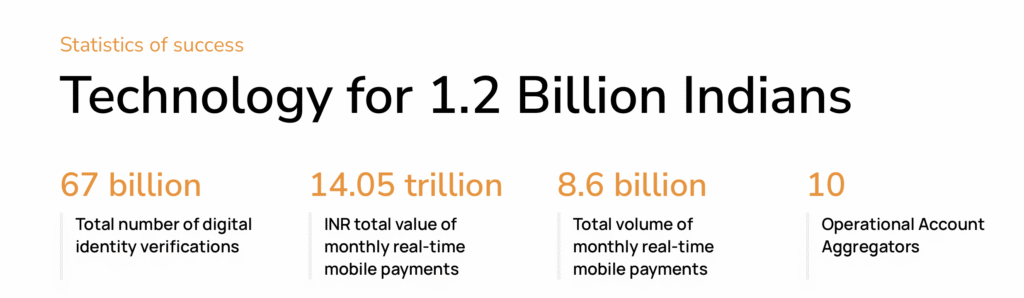
To understand the India Stack and what a technological marvel it is, watch Nandan Nilekani explain the details
AI demands the same thinking. Instead of training engineers to fine-tune foreign AI models, we need to own the AI stack—from algorithms to computing infrastructure to AI-first products.
The question isn’t whether India should pivot to AI. The question is how fast we can do it.
From Code Factories to Deep Tech Labs
Think of India’s IT industry is a $250 billion coding factory where millions of engineers writing code, solving problems, keeping global systems running.
But AI isn’t a factory. It’s a research lab—where breakthroughs drive the next billion-dollar innovations. So we need to develop world-class AI companies at home. Build front end solutions.
Bharat AI – Build in India for the Global Market
India doesn’t need to abandon its software services strengths but must evolve beyond cost arbitrage to AI-driven value creation.
1. AI-Augmented Software Services – Infuse AI into enterprise solutions rather than just providing coding manpower. Example: AI-driven cybersecurity, predictive maintenance, and workflow automation.
2. AI Consulting & Implementation – Position Indian firms as leaders in AI transformation for global enterprises. Example: Helping legacy businesses implement AI-first strategies.
3. Data-Driven AI Offerings – India has large, diverse datasets (healthcare, agriculture, financial transactions) that can be leveraged to create proprietary AI solutions.
AI as a Service
India must build an AI-as-a-Service Industry, where Indian firms create modular, on-demand AI solutions for global businesses, much like SaaS but AI-powered. The software services must pivot to AI-powered solutions. We need to massively upskill the young workforce in AI & ML so that we create niche, India-specific LLMs. Create a “National AI Grid”, a shared computing and data infrastructure linking research labs, universities, and startups. This would reduce barriers for small players to develop AI at scale.
India doesn’t need to abandon its software-services strengths but must evolve to a AI-driven value creation
Launch “AI Fellowships” – Paid AI apprenticeships where students get hands-on training on real-world projects in government, healthcare, and finance. Leverage the Indian diaspora’s tech talent to mentor these AI Fellows and Labs.
We need a 10-year, multi-billion-dollar investment to
- Build a public AI infrastructure (compute, datasets, AI cloud).
- Develop 5-10 strategic AI unicorns in critical sectors.
- Create global AI talent pipelines with world-class PhD programs and fellowships.
- Incentivize Indian startups to lead in AI-driven industrial automation.
- Fast track the use of AI in governance—automating administrative tasks to improve public services.
Data and demography
India has vast and diverse data sets spanning healthcare, agriculture, and financial transactions (see India Stack details above) that give it a major advantage. These could be leveraged to create proprietary AI solutions tailored to global markets
India has a demographic advantage, but it needs a structured approach to upskill at scale:
a) AI from School Level – Introduce AI and computational thinking in K-12 education, with hands-on projects and gamified AI learning.
b) AI-Industry Collaborations – Set up applied AI labs where students work on industry problems alongside professionals.
c) AI Certification Stack – A nationally recognized AI certification framework (like AWS or Google Cloud certs) that provides stackable credentials from entry-level to expert.
d) Regional-Language AI Training – AI courses in local languages to democratize access beyond English-speaking elites.

We need to leapfrog

The classic Western tech adoption sequence was to move from the landline (’50s and ’60s) to TV (’60s to ’70s) to desktop (’80s and ’90s) and then the mobile from 2000. India uniquely jumped almost directly to mobile, skipping the heavy investment in earlier infrastructure that the West made over 50+ years.
Time to leapfrog again.
South China Morning Post asked me how India could take the DeepSeek moment to pivot.
What I said