

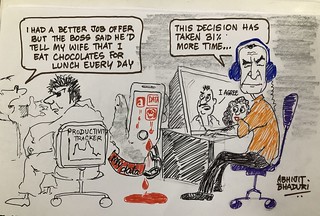
 Various connected devices, wearables and sensors are beginning to churn out data in real-time. Data is the new oil. What happens if there is a oil-spill? We have accepted getting nudged to buy more. But we resent being nudged into voting for a particular party through fake news.
A hyperconnected world
As most of the world is going online, we are leaving digital footprints each time we click a website or buy something or read something that catches our attention. By piecing together these clues, it is possible to create a possible to create a psychographic profile of the consumer. So how is this different from market research that companies have done for years?If you were to be asked about your movie going habits, some males may feel embarrassed to admit that they watch soft romantic movies. That goes against the societal norms. But Netflix knows how many movies you watch in a month, how long you watch, how many breaks you take and what kind of movies you claim to like but give up after a few minutes. Netflix thus knows your taste in movies better than your friends do.While marketing has always worked with the hopes and fears of consumers to sell them stuff, in a hyperconnected world, we can go a step further. Even with employees.What if the same approach is used to in acquiring talent and then play on their vulnerabilities to prevent them from leaving. For that I have to tell you how Cambridge Analytica has actually done this.
Psychology plus algorithms…
 The company claims to “measurably improve your brand’s marketing effectiveness by changing consumer behavior.” They scrape data collected from social media profiles of consumers. A global periodical publisher decided to measure the market size for the current target as well as measure the market of subscribers who could potentially become subscribers.The company in question is Cambridge Analytica. When the global periodical publisher engaged them, Cambridge Analytica’s profiled socio-demographics, political engagement, geography and personality and found that the psychographics of the consumers of that periodical would be people who are analytical and likely to be working in finance. They would be highly neurotic, conscientious, and low in openness. The communication would have to be crafted keeping that profile in mind. According to their website
Cambridge Analytica’s behavioral communications experts recommended messaging that began with a negative initial stimulus followed by a reassuring solution. The tone should be analytical, detailed, direct and concrete with word choices that should include ‘trusted’, ‘prepare’, ‘determined’ and ‘solid.’
Hyper-personalized messages you have to believe
 Online political advertising is becoming the most important way to win elections. With more than 2 billion (that is right) monthly active users, it is a platform that everyone has to leverage. Approximately half of India’s 1.2 billion people are under the age of 26, and by 2020, it is forecast to be the youngest country in the world, with a median age of 29. By 2025, almost 20% of the world’s working population lives in India. And between Facebook, Instagram, WhatsApp and the Facebook Messenger you have the youth covered. It is easy to doctor images and create fake websites to give credibility to the propaganda that a political rival can unleash. Yes, those forwards on WhatsApp maybe part of a plan to get you to hate or love an ideology or political party or person or …Cambridge Analytica describes its work as, “Combining the precision of data analytics with the insights of behavioral psychology and the best of individually addressable advertising technology, you can run a truly end-to-end campaign.” (The highlights are mine.)Imagine how effective that could be for your competitor who could put paid ads (fake news is a better term perhaps) to spread misinformation about your company and its leaders. These ads show up in the form of videos that appear on your Facebook feed and on WhatsApp forwards that come from your friends and relatives. That would make it easy for you to be unhappy and disengaged. Then a subtle campaign about the goodness of your rival would ensure that when the phone rings, you would be happy to go for a meeting with the competitor you have now started admiring.
Hyperconnected employees (and potential employees)
So how does it all work? Already there are several companies that offer to scrape data from the social media feed of prospective candidates. For example, knowing that a prospective candidate believes in star signs (how often they read the forecasts for their zodiac sign) and unhappiness with the present employer (through negative comments made on specific sites) can be used to craft a personalized message.The message could be in the form of a weekly forecast that says that this week is your lucky week to find a new job. So when the head-hunter’s phone rings you are already primed to go for the interview. Knowing that the candidate is competent can help predict success on the job. Knowing what motivates the person is a big predictor of how well the employee will fit into the firm’s culture. Traditional psychometrics uses the “Big Five” traits to understand personality. The five factors have been defined as Openness, Conscientiousness, Extraversion, Agreeableness and Neuroticism. These are powerful predictors of behavior. In case of Cambridge Analytica, they got additional data by slipping in questions about “sensational interests” eg interest in occult, militarism, intellectual activities etc. It offered insights on the kind of issues that may polarise the electorate to craft individualized messages.The HR department had the reputation of taking decisions based on intuitions and emotions. Today most of them use analytics and data. Workday, a software firm, crunches around 60 factors to predict which employees will leave. Humanyze, a startup, sells smart ID badges that can track employees around the office and reveal how well they interact with colleagues. So if you are taking too many tea breaks, then beware…
But many are using it
Asking people is ineffective. Have you ever met someone who got hired after stating that they are not good in working with others? So if no one has that problem, why do firms spend money to run team building programs? If everyone knows what their job description says, why do firms need to motivate their employees and keep measuring their engagement scores?According to psychologist Adam Grant, “people consistently overestimate their intelligence, a pattern that seems to be more pronounced among men than women. It’s also why people overestimate their generosity: It’s a desirable trait.”Gathering real time data gives us many more data points to measure. HireVue blends artificial intelligence psychology to build video interview software platform. As the person speaks into the camera, the software is mapping the interviewee’s non-verbal behavior to assess the person’s suitability for the role. Arctic Shores uses game-based assessments that deliver meaningful, job relevant insights about candidates. Textio, a startup that uses AI to improve job descriptions, has found that “women are likelier to respond to a job that mentions “developing” a team rather than “managing” one. So go right back and change that job description.”Several organizations are adopting algorithm driven processes to create a more unbiased selection process. Blind auditions (where judges did not see the candidate) produced more hires that were women or minorities. So it seems to reduce one kind of bias. But when a candidate gets repeatedly rejected, they cannot figure what got them rejected. They can never fix that problem and will possibly get stuck in that loop.
Right to privacy must be a human right
Data is the new oil. Various connected devices, wearables and sensors are beginning to churn out data in real-time. Amazon patented wristbands that could connect with equipment in warehouses and nudging employees via vibrations if, for example, they were about to place items in the wrong bins. That could improve the customer experience. But the armband can also tell the employer if the employee is taking restroom breaks that are too long.But in a world where the legal limits on gathering and using people’s data remain largely undefined, use of such devices could quickly turn nefarious. When an employer hands out Fitbits to its employees to help them track their exercise levels, it also gains access to the habits of employees. The employer could track just how much slower an employee is moving. That could have an impact on hiring practices. This data inherently ensures that older employees will never get hired.The employer might say that the employees have the right to opt out of these programs. Do they? Peer pressure will nudge an employee to sign up for data sharing. What happens to the data should the employee decide to move to join a competitor? Can the employee exercise a “right to forget” when they part ways with the employer?Employers use finger prints and other biometrics to provide access to their facilities. When an employer uses retinal scans to allow entry to a secure facility, and retinal scans can indicate diabetes. Should the employee be told about the disease?What about sensitive data getting hacked? When Sony Films got hacked in Dec 2014, bosses’ salaries and employees’ social security information and email exchanges started circulating. Gender based pay discrimination came to light when the world learned that Amy Adams and Jennifer Lawrence were paid less than their male co-stars. Producer Scott Rudin described Angelina Jolie as a “minimally talented spoiled brat”. What would the world know if your employee database got hacked?What if the employee was let go on charges that were never proven? Or the data on performance was to be floating freely on the internet? Would you worry? Imagine the equivalent of Wikileaks happening with your firm.If data is the new oil – how prepared is the C-Suite to deal with such oil spills?