 Groundswell means a broad deep undulation of the ocean, often caused by a distant storm or an earthquake. It could also mean a sudden gathering of force, as of public opinion. In this book, the emergence of social media is probably the equivalent of an earthquake that is shaking up organizations and individuals. The authors defined this as a spontaneous movement of people using online tools to connect, take charge of their experience and get what they need from each other – support, technology, ideas etc. This has been hard for companies to deal with and hard for brands to manage.Organizations have realized the power of social media to enhance or break their reputation.In 2008, a singer Dave Carroll witnessed United Airlines baggage handlers throwing and breaking his $3,500 guitar. After being told he would not be compensated for the damage, he vowed to write three songs, make music videos and publish them online to get revenge. In July 2009 when he posted the video, the video got 150,000 hits in a day.It crossed 10 million viewers in six months. Not too many singers can claim such viewing for their best efforts. Today people routinely use sites to make decisions based on what other consumers have said about the product or service. You can read reviews of books, films, electronics goods and what have you to take a more informed decision.So why should companies use social media?1. Listening: Use it to get customer insights for marketing and development2. Talking: Spread messages about your company and blend it with your digital marketing initiatives.3. Energizing: If your company has evangelists, their endorsement can reach others. But be prepared for dissenting voices as well. Else it sounds like a paid channel.4. Supporting: Companies let advanced users solve the problems for the beginners.5. Embracing: If you are already using social media for the other four purposes, leverage the customers to co-create new products and innovations based on your product, service or brand.
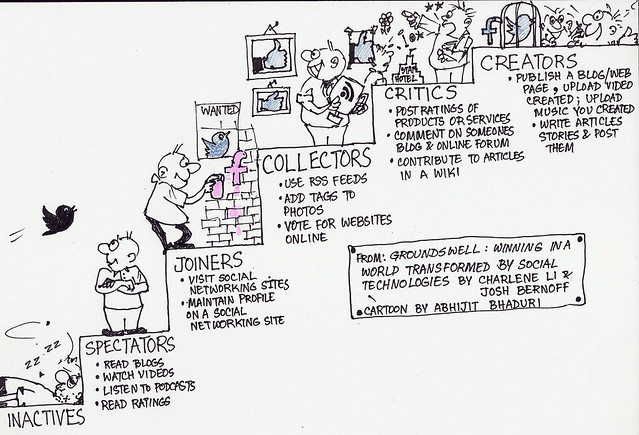 The book has introduced some interesting terminology – the Social Technographics Ladder. I found that very interesting. So I have created a cartoon for you to see where you see yourself. Are a spectator? You ceratinly can’t be in the “Inactive” category. You wouldn’t be visiting this page, in that case. But are you a “Spectator” – in which case you won’t comment on this post. If you have a Facebook or Twitter account, then you are a “Joiner”. If you are a “Collector”, you have added the RSS feed of this site (well, I am going to plug my own site, isn’t it?) or other interesting sites? You can sign up for the updates on my site too and become a “Collector”. If you share your comments and have a debate about this article based on comments from the other readers, you are a “critic”. And if you link to this article when you post your next article on your website, you are a “Creator”. Congratulations. You are in the highest state of evolution of the Social Tech Ladder. The equivalent of Homo Sapiens on the evolutionary ladder. That would make you Homo Socion or something like that.The other acronym I liked in the book is POST – interesting term and very appropriate too. That talks about the four step approach a company could take in embracing social media. The way to use P-O-S-T is :1. People: Assess the social activities of the people you are selling to aka customers :)2. Objectives: Decide what you want to accomplish3. Strategy: Think through how the relationship with the customer will change.4. Technology: Decide which social technologies to use.Back to the book.This book got published a while back. So they are still referring to Twitter as emerging technology that shows promise. There is no mention of Instagram or Pinterest. That is because I have read this book only now. That I am sure will find mention in the next edition. I recommend using the book as a handy guide for anyone who is not a “Creator”. There are lots of case studies on how b2b businesses have used social media. The most common examples are of companies that sell to the customers directly. The ideas can be used for people to build their personal brand. The principles are the same, whether a brand chooses to engage with its customers or it is the lone ranger trying to change the world with his ideas.Go ahead and read it. Let me know what you think of the book.——–

Demystifying “START”: More Than Just a Beginning
The word “START” appears in many contexts, from international treaties to early childhood education. Let’s explore some of the diverse