 In a world where machines are competing with humans to find work, what will be left for humans?Expect to see changes in 2018. Human beings are no strangers to changes in their work-setting. From about 1760 to 1840, the First Industrial Revolution saw humans making the transition to share space with machines. Steam power, the development of machine tools and the rise of the factory system were all by-products of the first major shift. The Second Industrial Revolution started soon after and this time, it was all about mass production.
The two revolutions saw the creation of blue-collar workers who were supervised. This, in turn, gave rise to scientific management. Taylor published “The Principles of Scientific Management” in 1909 and started the foundations of modern management philosophy and practices. The two World Wars further refined the management and leadership development. But it did not stop there.
With each new method of work, the equation between employers and employees changes.
Man and Machines in 2018
In April 2012, The Economist described the Third Industrial Revolution by saying, “The digitization of manufacturing will transform the way goods are made — and change the politics of jobs too”. The lines between manufacturing and services blurred. The third wave of changes in work brought digital capabilities to billions of people and businesses. Rolls-Royce no longer sold jet engines; it sold the uptime of the engine.
Every new business model changes the power equations. New skills are needed. Some jobs get replaced with others. We were in the age of the Knowledge Worker. And then that too changed.
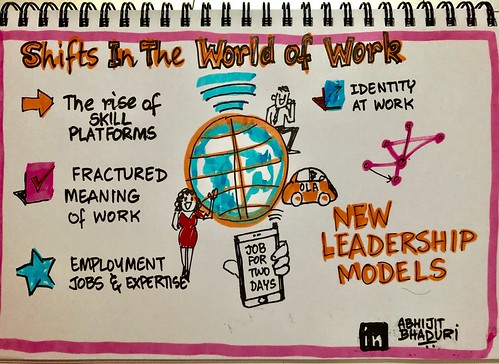
 Shifts in the world of work
 Shifts in the world of work
- The rise of skills platforms: Companies are slowly becoming platforms where skills can be bought and sold. The gig economy is increasingly driven by a skills-on-demand model. Uber, Etsy, Upwork etc. are all such platforms. Employers no longer need to keep “employees” on rolls. It also means that employees no longer have access to health care support or even training for new skills etc.
- Fractured meaning of work: Technology allows us to slice and dice work into smaller components that can be farmed out to independent contractors. When the work does not get completed in a shared (preferably co-located workspace), it is hard for individuals to understand how their contribution fits into the overall scheme of things. We find meaning in our work when we know it is making a difference to someone somewhere. The gig economy is taking away that meaning.
- Employment, Jobs & Expertise: Employment is no longer a pre-condition to get hired to do a job. Workers are becoming like a movie crew. They are all freelancers. A team of freelancers with different skills is pulled together for a project. The degree of expertise determines the earning power of the freelancer. On-demand skills are weakening the symbiotic relationship between the employer and the employee.
- Identity at work: In a collectivist society like ours, work is a source of meaning and identity. The employer brand also shapes the identity of the employee’s family. It is not just a mere source of income. When an employee becomes redundant, the family’s identity too gets affected. How will that get impacted when employees do not have a steady source of work?
- New models of leadership: The hyper-connected workforce needs leaders who are communicating in real-time with customers and employees. Authenticity is becoming the currency of every leader. They have to stay equally connected to the employees as they do to the customers — in real time. They need to tune in to the world outside to pick up weak signals.
People, machines, and experiences
 The Fourth Industrial Revolution is bringing in new technologies that are fusing the physical, digital and biological worlds, impacting all disciplines, economies, and industries. This time, the change in the world of work is enormous. Adobe pulled together a ‘Think Tank’ recently to discuss the Future of Work. The diverse set of thinkers ranged from neuroscientists to futurists and experience designers. They categorized the impact of work in three areas in a world where machines are competing with humans to find work, what will be left for humans. The changes will be felt at three levels – people, machines and experiences.
People – define a generation by way of skills: We have so far looked at the generations in terms of age. What happens if the generations are looked at in terms of skills? Maybe the next generation should be known as the gig generation. Humans have never experienced skill-redundancies at the rate they currently are. Telecom, IT and Retail are three sectors that in the eye of the storm right now. New opportunities will need new skills. The future belongs to the continuous learner.
Machines – redefining what work means for people: At first, machines helped us to augment our strength – our hands. Today, AI is helping us augment our cognitive abilities. Recently, the machine stunned us all by learning every chess move ever created in just four hours and then crushed its human opponent. The future of work that is left for humans is deeply human. It will see the rise of the relationship worker.
 Experiences – what will collaboration experiences be like? Humans have always collaborated with each other without machines intervening. That is changing. Customers and employees no longer can be engaged in seamless transactions. They expect to be wooed by magical experiences. How can we leverage technology to design deep immersive experiences that not only let us work but also provide meaning and more?
Work, skills and education
Technological convergence and societal shifts are together driving significant changes in the world of work. Employer-employee relations are getting reimagined. Getting work done in bits and pieces may be efficient, but it comes at a cost. It is taking away the meaning that we derive from work.
The new products and service will create new roles and new work opportunities. But they will need people to learn new skills. While talent is fairly uniformly distributed, opportunities are not. The impact of job redundancies impacts people at the bottom of the pyramid far more sharply than those who are well cushioned. Where do we begin to prepare ourselves for the future? Education is a good place to start. This time, education will have to be far more than a way to land a job. It has to prepare us to think of others and not just ourselves. The future of work has to be designed not just as a tech solution but also as an ethical choice.
Do you believe that all technical solutions must eventually be addressed as ethical choices as well? Should entrepreneurs be held accountable for the consequences of their own inventions? Do leave your responses in the comments below.
=========