It takes time to form a habit. Changing a habit is harder. You button your shirt in the same sequence. You wear the same shoe first. We are HEARD animals. If others are doing it, we follow. It is our default setting.
If you have not read the Episode 1 of this new series, here it is
The default settings of HR are broken
I’ve been using an iPhone for over a decade. It works beautifully. But if I’m honest—I’ve never changed the ringtone or the default alarm. I still use the default browser.
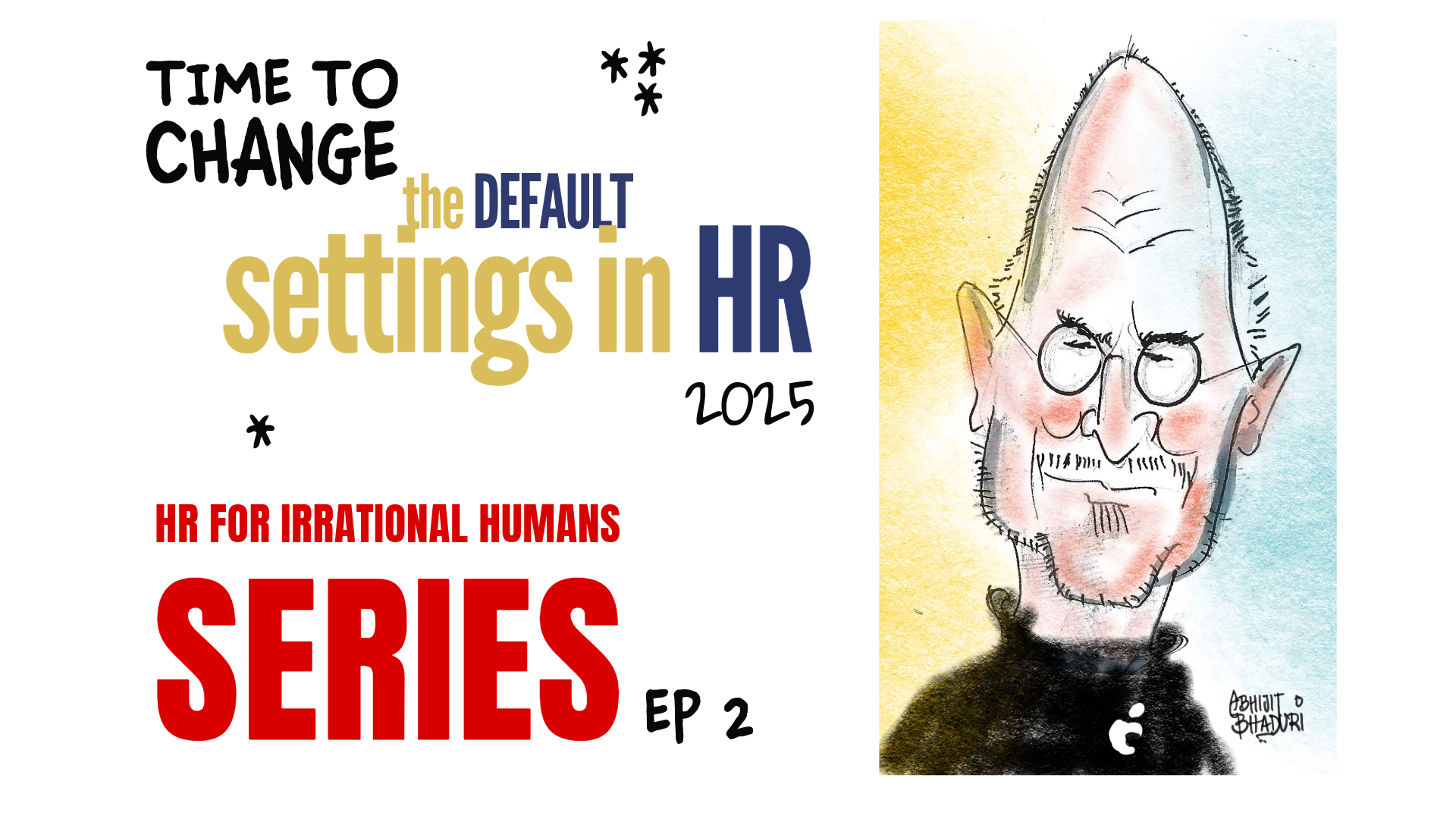
Not because I love these settings. But because they were already there. And that’s the thing about default settings—they quietly shape our choices. Steve Jobs understood this. He didn’t just build products. He designed behavior. He knew that if something was the default, most of us would leave it alone.

Which brings me to a question I can’t stop thinking about – why do we not question the default settings of the workplace.
Many HR systems were designed for a different workforce
More than 50% of the global workforce is now millennial or Gen Z, yet many HR systems still assume a one-size-fits-all approach to motivation. Women’s workforce participation is rising—but caregiving policies remain outdated. In India, over 90% of workers are in the informal sector, yet most engagement tools are built for office-based employees. Skills now have a shelf life of less than three years, but performance reviews still run on annual cycles. The workforce has changed—but our defaults haven’t.
So many things have changed around us in the last few years. That means we need to update the data, opinions and assumptions. Here are a few shifts that stumped me. Can you guess the country with the highest proportion of women engineers? And while you are at it, guess which country has 55% women in the entire science & engineering workforce? In the next five years 1-2% of India’s total workforce (ie 23 MILLION people) will be gig workers. Women ages 15–35 make up approx 52% workforce in India. The workforce has changed. How we work, when and where we work has changed. (Answers at the end of the newsletter)
How are old assumptions even valid?
In the last five years, we had a pandemic, geopolitical balances have changed, the climate problems are showing up everywhere and yes the girl child is being welcomed in more societies. The Economist dated June 7-2025 says there are many reasons why that shift is happening. 93% of the jail inmates are men and in rich countries 54% of women are getting a tertiary education while only 41% men are studying that far. But we keep HR systems designed for the old world we inherited.
Check how many of these changes you have tracked.
1. What is the literacy rate in India as of 2024 (age 15+ who can read and write)?
A. 68%
B. 74%
C. 82%
D. 91%
2. Which Indian state sends the highest number of migrant workers abroad?
A. Punjab
B. Uttar Pradesh
C. Kerala
D. Tamil Nadu
3. What percentage of all global software engineers does India contribute?
A. 12%
B. 18%
C. 25%
D. 33%
4. Which country received the highest remittances in 2023?
A. China
B. India
C. Mexico
D. Philippines
5. What is the leading cause of stomach ulcers globally today?
A. Spicy food
B. Stress
C. Bacterial infection
D. Excessive alcohol
See answers at the bottom of the post
Many of today’s HR practices were designed decades ago—some more than a century back.
They were built for a world where:
- Jobs were permanent
- People stayed for 30 years
- Careers moved only upward
- Learning was an event
- Feedback came once a year
The Workforce Has Changed, Not The Default Assumptions
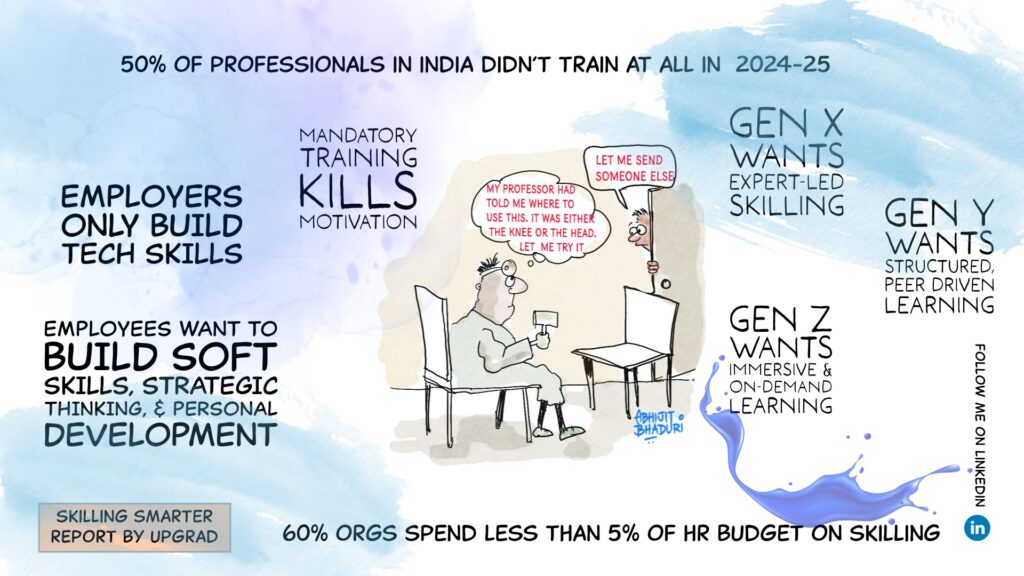
Research shows us that mandatory training is a guaranteed way to kill the joy of learning. Or that most LMS systems are poorly designed. Or that most organizations have no opportunity to do research on their workforce needs. The employees want to build soft skills and strategic thinking. But the employers don’t think so.
Read UpGrad’s Report on Skilling in 2025
1. Women Now Constitute Over Half of the U.S. Workforce
2. There is a shift in retirement patterns and workforce demographics. 11 million workers in US are more than 65 years old
3. Gig Economy in India will be approx 23.5 mn in 2029-30
4. Job-Hopping is a career advancement strategy
5. Skills Lifespan Shortening Rapidly
Yet many HR systems still run on defaults that haven’t been questioned in decades.
If we want more engaged, agile, and resilient workforces, we can’t keep relying on systems that assume:
- Everyone will log into the LMS on their own
- Managers will ask for feedback without being nudged
- Employees will apply for internal roles they’ve never seen
- People will grow just by waiting
These aren’t talent gaps.
They’re default design failures.
Instead of waiting for people to act, we must build systems that assume participation—then give them the freedom to opt out. For example: Auto-enroll in a default learning path every week. Then share how the peers have progressed.
Let career conversations trigger at 12-month intervals. Let AI prompt the right next step. Because when you update your defaults, you upgrade your outcomes.
The default settings in HR are no longer neutral.
They are holding people back.
#HRforIrrationalHumans #TalentDesign #BehavioralScience #FutureOfWork #OrganizationalDesign #EmployeeExperience #TalentStrategy
Check your answers to the quiz above and see how many match the answers below.
You probably guessed some of those wrong—and you’re not alone.
Take this: the leading cause of stomach ulcers today isn’t stress or spicy food, but a bacterial infection—Helicobacter pylori (Option C). Most people still attribute ulcers to tension, even though science has moved on.
Similarly, India is now home to 33% of the world’s software engineers (Option D), a number that surprises even seasoned tech professionals. Bengaluru alone produces more tech talent than the entire UK annually.
Kerala, despite being a smaller state, continues to top the list for international migrant workers (Option C) and plays a major role in India’s massive $125 billion remittance inflow—the highest globally (Option B).
Meanwhile, India’s literacy rate for adults (15+) now stands at 82% (Option C), defying stereotypes and closing gender and regional gaps, though challenges remain.
India received $125 billion in remittances in 2023—the highest in the world—for the second consecutive year. This inflow outpaces foreign direct investment.
The reason most people guess wrong? The world is changing faster than our assumptions can keep up. Demographics, education, workforce participation, and global mobility have all shifted dramatically—especially in the last five years. If your mental model of the workplace is still shaped by pre-pandemic norms or old HR playbooks, you’re not behind—you’re just human.
Three default settings that need to change
1. Onboarding Content Still Frozen in the Past
- What’s outdated: Many onboarding decks and e-learning modules still refer to COVID protocols, outdated office floor plans, or previous leadership teams.
- What’s missing: Current hybrid work norms, updated business priorities, and recent leadership transitions.
2. Performance Reviews Built for Another Era
- What’s outdated: Annual reviews based on static goals, with outdated competency models.
- What’s missing: Real-time feedback loops, AI-assisted coaching nudges, recognition of gig/remote/contract work contributions, and team-based assessments.
3. Learning Content Is Stale or Irrelevant
- What’s outdated: LMS platforms miss updating content that builds AI fluency or climate impact awareness.
- What’s missing: Speed of response. Content aligned to new leadership, updated company values, business strategy shifts, or emerging technologies like GenAI. And it is not built with velocity.
And that’s exactly why we need to keep updating not just our skills, but our understanding of people. Because talent strategies built on yesterday’s assumptions simply won’t work for today’s irrational, changing, and wonderfully complex humans.
Why We Stick to the Default: Status Quo Bias and How It Shapes Talent Decisions
Now think about signing up for a newsletter. If the box is pre-checked to receive updates (opt-out), most people stay subscribed. If the box is empty and you have to tick it yourself (opt-in), far fewer people do. That’s the power of choice architecture: the way options are presented nudges our decisions.
In talent management, status quo bias shows up when companies reuse outdated performance forms or keep learning content unchanged for years. Managers stick with last year’s goals or ratings, simply because “that’s how we’ve always done it.” New ideas get trapped behind optional links or voluntary workshops.

To break this bias, design talent systems that default to progress. Make peer feedback a default step in reviews. Auto-enroll new hires into mentoring programs, with the option to opt out. The structure of the choice—not just the quality of the offer—can determine whether people grow or stay stuck.