Category: Podcasts

  • Types, Fonts, Rifts and Charts

    Types, Fonts, Rifts and Charts

    COLLAGE.jpg

    1. Charting the story

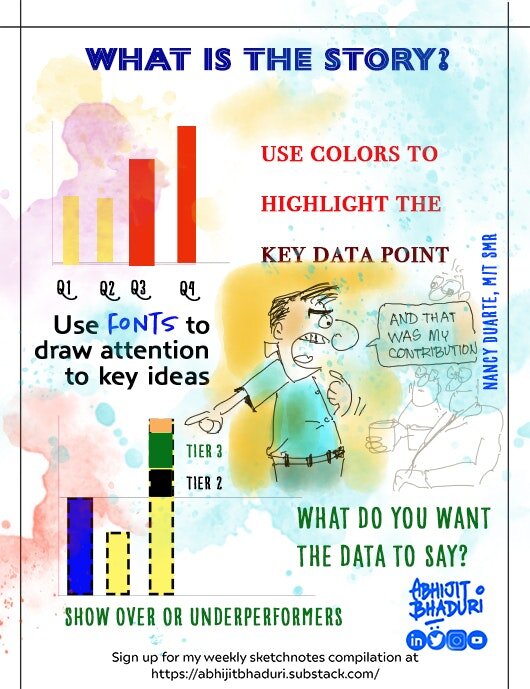
    I sometimes browse through job ads to understand business trends. GM was recently looking for a 3D Senior Visualisation Artist for their User Experience (UX) team. Automotive UX is a great place for artists who can use visuals on customer facing displays. (Want to apply for the role? Click this)Visualisation skills can be used to make our presentations interesting. Business presentations use graphs, charts and data in the meetings. Pro tip: After you make the charts, pause to annotate them. Think of them as a whisper in the ear of the decision maker.Nancy Duarte who has written a fabulous book on presentation skills, says,

    ‘Complex charts are good for exploring data, but classic charts (that is, a bar chart, line chart, and pie chart) are better for communicating data.’
    Abhijit's Sketchnotes No 20

    Abhijit’s Sketchnotes No 20

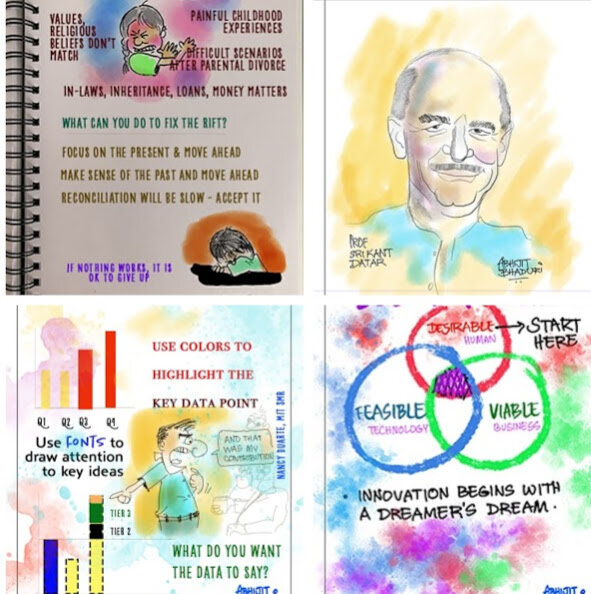
    Contrasting the information is a great way to annotate your charts. Using colours or fonts to highlight information is a smart way to annotate your charts. Bold fonts can be used to draw attention to critical information. Annotations can be used to show under performers and high achievers.Your data must become visually consumable. Dig deeperIf you have not read her book about presentations, learn moreHere is a sketch note on how to annotate the graph by using fonts, colours and lines

    2. Fractured families & how to mend them
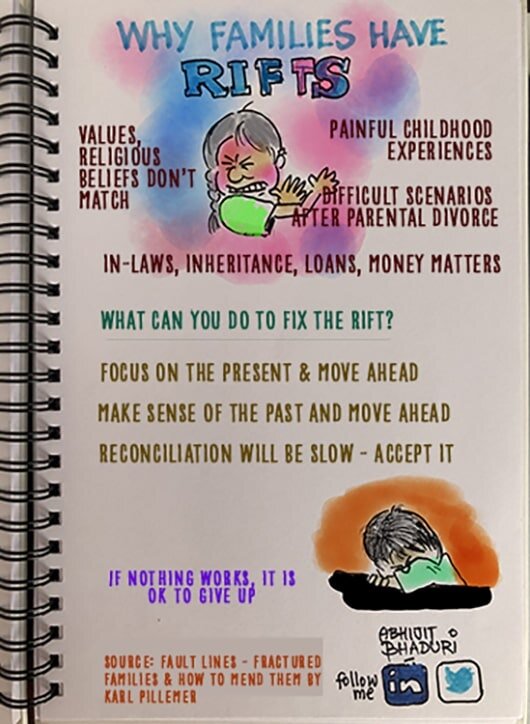
    Why-Families-have-rifts.jpeg

    “Happy families are all alike; every unhappy family is unhappy in its own way.” That was how one reader (who requested anonymity) began her email. Karl Pillemer’s book Fault Lines: Fractured Families and How To Mend Them explores the multiple reasons why families have rifts. The reasons can range from hurt to feelings of being let down by a loved one. Sometimes the scenarios are beyond the control of any person. What can you do to mend the situation?

    • The past cannot be mended, so it is best to move ahead.

    • In moving ahead, remember, you may have also contributed to the rift unknowingly. Reconciliation can be a powerful moment of personal growth.

    • If it is too toxic and painful, it is OK to not reconcile.

    If you want to read some more, here it is ($)

    3. “Bubble Tourism”

    Abhijit's Sketchnotes No 20

    Abhijit’s Sketchnotes No 20

    Their enterprise used to take 9 to 17 year olds to camps and treks. Satindra and his partners offeredoptions that ranged from trekking, rock climbing, mountain biking , ropes courses, rafting and some self contained expeditions. With his experience in executive education, the business grew rapidly. By 2019, they were operating in 15 locations and almost 20 activities that participants could choose from. And then COVID-19 happened. The tap ran dry. That is usually a signal that it is time to think of a pivot. That is when “Bubble Tourism” was born.He realised that people were feeling suffocated after months of being copped up indoors, but health and safety were prime factors before people would travel. This the idea of “bubble tourism“… where you can travel in your own bubble, stay in tents / rooms that are a distance away from your neighbours and enjoy the pristine wilderness of these locations. Enjoy the white waters in Rishikesh, or go angling in the Tirthan river, enjoy a hike thru the coffee plantations in Coorg or laze around while enjoying the view of snow capped peaks from Sitlakhet. Being an entrepreneur is all about being creative. “Bubble Tourism” is such an example.Find out more

    4. I am not that ‘type’

    Abhijit's Sketchnotes No 20

    Abhijit’s Sketchnotes No 20

    Abhijit's Sketchnotes No 20

    While working at the Eicher Goodearth factory, I got a chance to edit the house-magazine. I spent many an evening, with the owners and staff of the printing press, getting educated about fonts and typefaces. The elderly gentleman at the press would not hesitate to scold me for using “typeface” when what I meant was the “font”. Times is a font family, whereas Times Roman, Times Italic and Times Bold are individual fonts making up the Times family. ‘Serifs’ are those little ‘shoes’ at the extreme end of the font.The typeface can convey the idea that the product or service is exclusive or a premium category (watch how The Oberoi Group conveys the notion of luxury).Here are 64 typefaces for you to browse through if you wish to convey that you offer something aspirational.As Rajiv Bhalla, a reader who helped clarify the mystery says, “Typeface is like an album and fonts are like the songs”. A font is what you use, a typeface is what you see.Many of us know Satyajit Ray as one of India’s most acclaimed film directors. He was also an award-winning typeface designer. The two typefaces ‘Ray Roman’ and ‘Ray Bizarre’ won international awards in 1971. Daphnis and Holiday Script were also Ray creations. Read more about Ray’s calligraphy. <dig deeper>Netflix has a serial about design. Paula Scher is the high priestess of this art. She says, “Typography is painting with words.” I absolutely recommend this video below.https://youtu.be/LCfBYE97rFkI could go on and on. I am very font of this subject.

    5. Harvard gets a design thinking expert as Dean
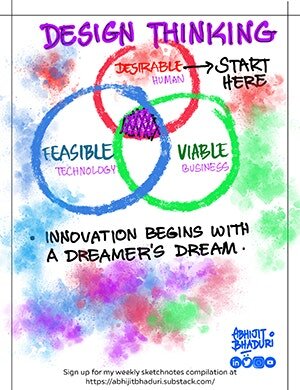
    Design-Thinking.jpeg

    Prof-Srikant-Datar.jpeg

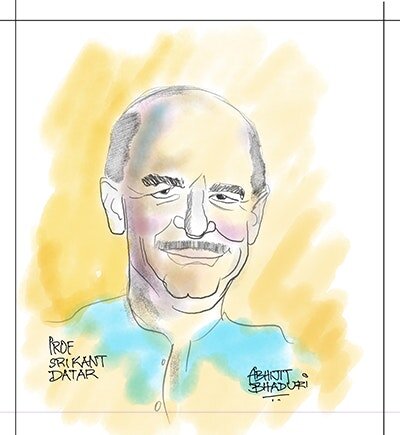
    Srikant Datar is going to be the next Dean of Harvard Business School. The 11th Dean will take over from Nitin Nohria. Srikant Datar is known for his work in Design Thinking.He is a Chartered Accountant who went on to do his MBA from IIM Ahmedabad. He was the gold medallist of his batch at IIM-A. He fell in love with the world of ideas and decided to pursue academics. He holds a Masters degrees in Statistics (he has Data built into his last name, remember) and then did a second Masters degree in Economics, both from Stanford. He stayed on at Stanford to do his Ph.D. in business. Thought I would do a quick sketch of the man.Harvard is lucky to have someone of his calibre, to rethink its offering at a time, when businesses are seeing convulsive changes. In a book published in 2010, called Rethinking the MBA: Business Education At The CrossroadsSrikant had suggested two opportunities: 

    1. The MBA programs aren’t giving students the heightened cultural awareness and global perspectives they need.

    2. Newly minted MBAs lack essential leadership skills. Creative and critical thinking demand far more attention.

    This conversation below may give you a view of the man behind the achievement and it generates hope in me. Would you agree?https://youtu.be/S0QdKkc16oQ

    6. Talent Acquisition during a hiring freeze

    What do recruiters do during a hiring freeze? That is what many talent acquisition teams struggled with. Many of them struggled, but some did a pivot. They decided to stay connected with the talent pool. Many job descriptions need to be questioned.Dig deeperHey, do you believe that ‘job descriptions’ are a thing of the past? In the latest issue of Unabashed, the weekly podcast about all things talent, listen to the biggest opportunity that the Talent Acquisition team has during a hiring freeze.Listen to the conversationIf you have enjoyed reading this, do help us grow by recommending us and leaving your comments on the substack site. Thank you. Stay curious and stay connected.
  • Watermelons, book covers & 4 year olds

    Watermelons, book covers & 4 year olds

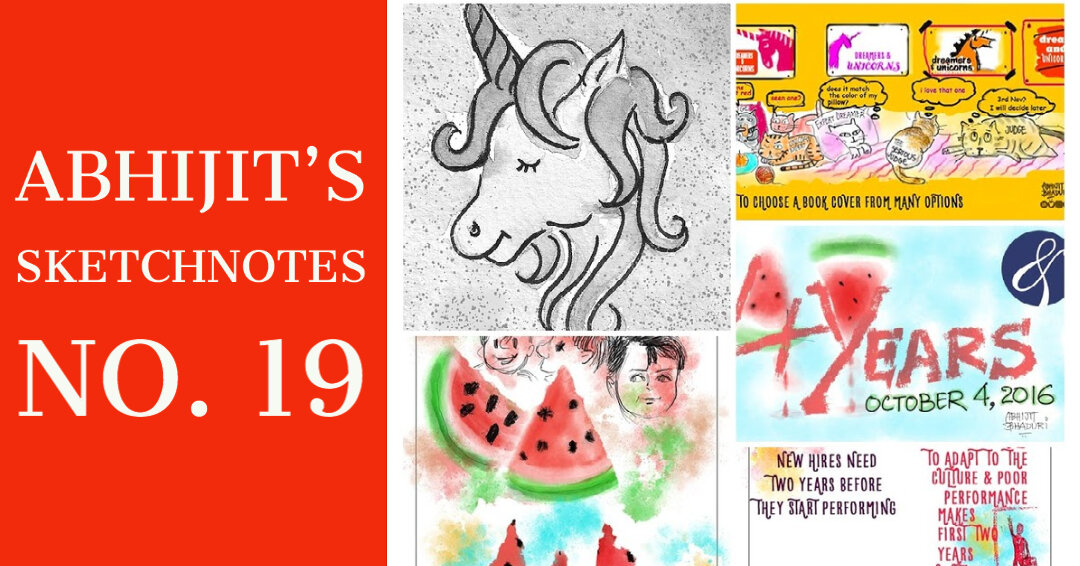
    Abhijits-sketchnotes-no.-19.jpg

    1. Watermelons and succession planning

    Watermelon.jpeg

    How are watermelons and succession planning linked? I have a watermelon story for you that will answer the question.Old timers in every organisation resent the big bucks that their employer is willing to pay when they bring in external hires. It is much more effective to invest in growing your own talent. Investing in developing leadership talent takes time. With each passing year of investment, the leadership bench of a company gets bigger and better. Should you invest in developing people when business is slow? Or should you hire for the future since the market is flooded with talent now. What would you advise? Leave your opinion below:I read this story about watermelons in the Founding Fuelnewsletter. The story was narrated by Manohar Parrikar, the late Chief Minister of Goa.“When I was a child, the farmers of Parra, (a village in Goa famous for its watermelons) would organise a watermelon-eating contest at the end of the harvest season in May. All the kids would be invited to eat as many watermelons as they wanted. The farmer would ask us to spit out the seeds into a bowl. We were told not to bite into the seeds. He was collecting the seeds for his next crop. He kept his best watermelons for the contest and he got the best seeds which would yield even bigger watermelons the next year.I went back to my village after 6.5 years and went to the market looking for watermelons. They were all gone. The ones that were there were so small.“His son was continuing the tradition of the watermelon-eating contest but there was a difference. His son realised that the larger watermelons would fetch more money in the market so he sold the larger ones and kept the smaller ones for the contest. The next year, the watermelons were smaller, the year later even small. In seven years, Parra’s best watermelons were finished.”There are only two times you must think about developing your employees – when you are doing well (because you have the luxury of money) and when you are not doing well (you have the luxury of time).

    Abhijit's Sketchnotes No 19

    Abhijit’s Sketchnotes No 19

    2. Do you judge a book by its cover?

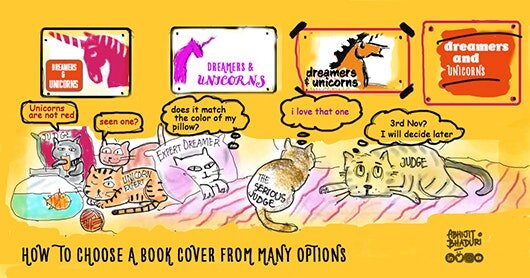
    Yes, you do. It creates the first impulse in the buyer to pick up the book and browse/buy. For my upcoming book Dreamers and Unicorns, I thought I would design the book cover. In the process I learned a thing or two about cover design. Hint: It is not just an exercise in creativity.Here are a few things designers will ask before they start designing:

    1. The author’s brand: The font, the colour combination and look must amplify what the author stands for. The first book of an author will merit a different look and feel than someone who is a much-published author.

    2. Ask the sales teams in bookstores: I wanted to place this unicorn on the cover. But when the cover was shown to a few sales people from some of the leading bookstores, they loved it and said that children love stories about unicorns. I hurriedly recalled that option for my book cover.

    3. The elements that need to be emphasised: What percentage of the book cover must be occupied by the title? Should you put the author’s photo on the front cover or at the back? Should you put a celebrity’s endorsement on the cover or should you add a newspaper’s comment? Each one of these is a possibility. And each choice is complex.

    Abhijit's Sketchnotes No 19

    Abhijit’s Sketchnotes No 19

    You may want all this and more, but finally what matters is – what does the printer need? 99 designs explains about book cover design in this blogI also crowdsourced designs for my upcoming book’s cover. We wanted to run a contest for a few weeks before taking the call to shortlist one or two ideas. We landed up getting flooded with ideas from the readers.Here is a view of how I think judges will decide the winning design. And yes, we will reveal the final cover on 3rd Nov 2020 and launch the book on 16th Nov 2020 (which happens to be my birthday too).

    External-Hires.jpeg

    3. External hires – are they better?

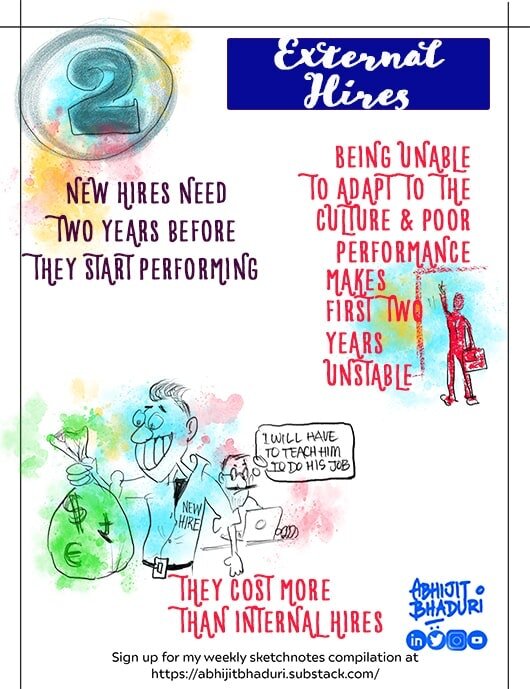
    According to Wharton management professor Matthew Bidwell, “external hires” get significantly lower performance evaluations for their first two years on the job than internal workers who are promoted into similar jobs. They also have higher exit rates, even though they are paid 18% to 20% more. External hires were 61 percent more likely to be fired from their new jobs than were those who had been promoted from within the firm. There is a greater risk of failure which can result in termination and generate more hiring process costs.Dig deeperOn the plus side for these external hires, if they stay beyond two years, they get promoted faster than those who are promoted internally. It takes people almost two years to build relationships and navigate the company culture.Let me ask you, what makes companies obsessed with hiring from outside? Leave your comments below by clicking the red button

    4. We turned 4 on 4th Oct 2020

    4-years.jpeg

    Abhijit Bhaduri & Associates started on 4th October 2016. Our logo is the ampersand symbol that we see all around.‘&’ shows the partnership we have with our associates. We bring our strengths & weaknesses to the workplace. While I am the face of the organisation, the associates are the creative energy behind the business. The magic happens with the Associates & me. The ‘&’ reminds me of that.& shows the polarities we all deal with – the challenges inside the organisation & outside.& shows the partnerships we have with our clients. We work with them & CO-create our solutions.& is the symbol of creativity & possibilities.Here’s to 4 Fruitful years & 4ever more ❤️

    Boom-in-housing.jpeg

    5. People are buying bigger houses

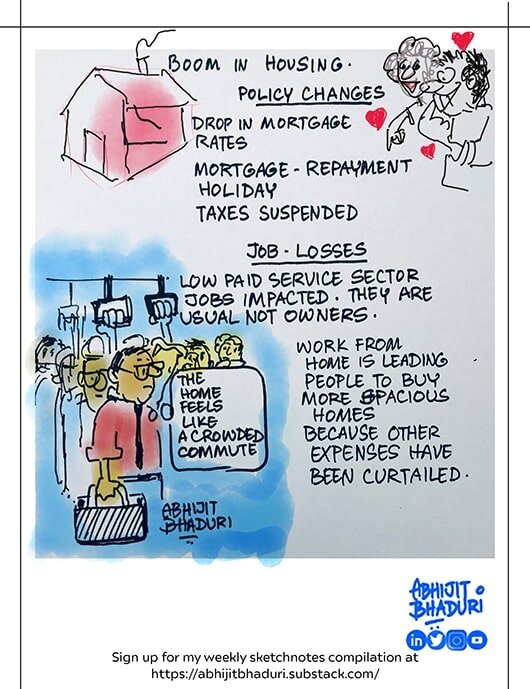
    America’s house prices are up 5% on a year ago. Germany’s are 11% higher. Britain’s hit an all-time high, in nominal terms, in August. In many countries, the central bank is making housing loans available for lower interest rates.With everyone working (and studying from home) and people not spending on other expenses (like travel), people are ready to indulge themselves by moving into bigger spaces. Dig deeperDo you think, India is seeing a different trend in housing? Leave a comment and tell us what you have observed

    6. If you could go back to college, what would you change?

    In this episode of Unabashed, my co-host Neha and I discuss what we would like our college experience to be, if we could go back in time. Neha would like to become a student of Adam Grant to learn Psychology. When I remind Neha that would mean having to join Wharton (that is where Adam Grant teaches), she wonders about an interesting possibility.Listen to that suggestion hereI would like every class in college to be taught by an academic, a practitioner and a student who may have taken the classes earlier. Listen to thisHave a question or a suggestion: email me abhijitbhaduri@live.comFollow me on Twitter, Instagram and LinkedIn @AbhijitBhaduri

  • Earners-learners & rejection

    Earners-learners & rejection

    Collage.jpg

    1. All earners are not learners

    Learning-Online.jpeg

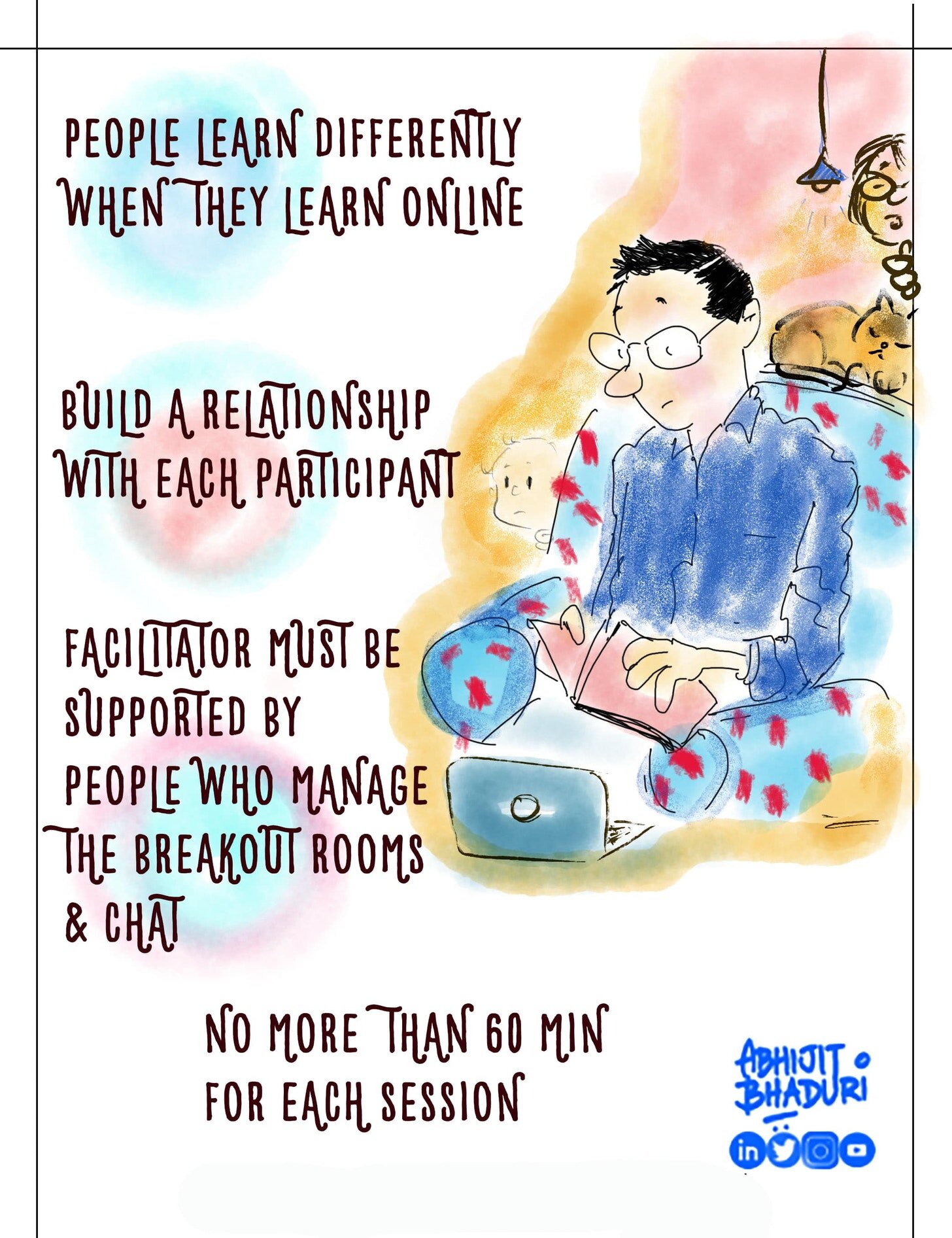
    Harvard has an endowment fund of $40bn. They are offering online classes. A year of undergrad education at Harvard will cost you $72,000 ie $280,000 (for 4 years) to call yourself an undergraduate. To get an MBA from Harvard costs you $225,204 and the classes will be online. Would you value the learning experience higher or lower if classes are not on campus for a college like Harvard with $40bn in the bank?What it means is that the learner and the faculty need to look at 3 big shifts

    1. The learner is distracted and often struggling to stay focused.

    2. The facilitators have never been taught about how to make online learning work. They have to design the learning experience.

    3. In importance of creating content that amplifies what you are teaching (I build my slides using Adobe Photoshop. This is the summary slide from my presentation).If you want to learn more, here is a free session being offered at the HRTechFestival in Singapore on 30 Sep from 9:30am to 10:30am India Time <Click here to Register. 2. Ability alone does not define talentReally successful people tend to have higher levels of ability, likability, and desire to achieve even after they have reached the top. Ability is in part domain-specific as it involves the technical expertise and knowledge that people have acquired in a field. Most people underestimate the value of likability in their career. When you make a mistake, people are likely to give you a second chance if they like you. Else they will pull out a rule book and tell you why you have not done what you must.“The key component of ability is learnability or the capacity to learn new things – it is a function of IQ and curiosity. Likability is mainly about emotional intelligence and people-skills, and these are pivotal to success no matter what field you are in. Finally, drive is the dispositional level of ambition – a person’s general desire to compete and the ability to remain dissatisfied with one’s achievements.” Dig deeperWhen we say someone is ‘talented’, we usually forget that likability (people skills/ Emotional Intelligence etc) and ambition (desire to keep improving when after being successful) make up two-third of the talent equation. Ability (knowledge, skills etc.) is the minimum requirement for any job. Having a degree in engineering is the minimum requirement to be an engineer, is table stakes for most people. Between likability and motivation which one would you recommend as a superpower?

    3. Stuff to read or watch

    Spring.jpeg

    There is no one here who has not experienced rejection. From Oscar award winners to entrepreneurs, everyone experiences rejections multiple times before they succeed and even after they experience success. Some people crumble when they get rejected. Others bounce back from the same scenario. When I was looking for a publisher for my 1st book (Mediocre But Arrogant), the manuscript got rejected by every possible publisher. Even Harper Collins who later published 3 of my books had rejected the manuscript. An unknown publisher took a bet on the manuscript.Ambi Parmeswaran, the author, is an adman and author. He talks about how to handle the inner critic once you get rejected. Silencing your inner critic will probably take more work than you think. Ambi’s book talks about how to build a great ‘rejection processing system’ for yourself that allows you to spring back from the rejection without feeling that you have to give up. Having experienced rejection countless times, I found the book very useful. It takes examples from sports, business, academics, entrepreneurship and more to tell you that you are not the only one who has got rejected. Creative people often lack Creative Confidence. If you are one of them I would absolutely recommend reading this review to learn how to build your creative confidence. I put three neat ideas here <read it>Do you like this sketch? Please leave a comment and tell me. It will boost my creative confidence. Serious.Watch his TED talk that has been viewed more than 5 million timeshttps://www.ted.com/talks/david_kelley_how_to_build_your_creative_confidence?utm_campaign=tedspread&utm_medium=referral&utm_source=tedcomshare One of the subscribers Rashi brings out a newsletter calledDecks and DiapersShe is a consultant and a new mom. That accounts for the blog name. One post, in particular, caught my attention: If a newly married woman’s wedding ring (or mangalsutra) is prominently visible during a job interview, does it lower her chances of getting selection? Here is the answer <read it> Does it lower the chances? Have you experienced this first hand? Leave a comment and share your experience.

    4. Will informal learning replace formal learning?

    Unabashed.jpeg

    In this episode of the podcast Unabashed, Neha Pant, senior knowledge advisor at SHRM and I discuss whether there is something that might change the way we view learning in the corporate world. Is informal learning the under-leveraged learning opportunity? What needs to work before self-directed learning goes mainstream.How to take your learning strategy to the digital world <Read this>Listen to this clip <listen here>This article is one of the most downloaded from abhijit2.spidertrainers.com. It has 25 ideas for informal learning that you can use today – at home and at work. <Find out which ones you have not tried>Listen to the podcast and find out <Click this to listen>Stay curious. Stay connected.@AbhijitBhaduri

  • Employer brands, benchmarking and writing

    Employer brands, benchmarking and writing

    Sketchnote-No.-17.jpg

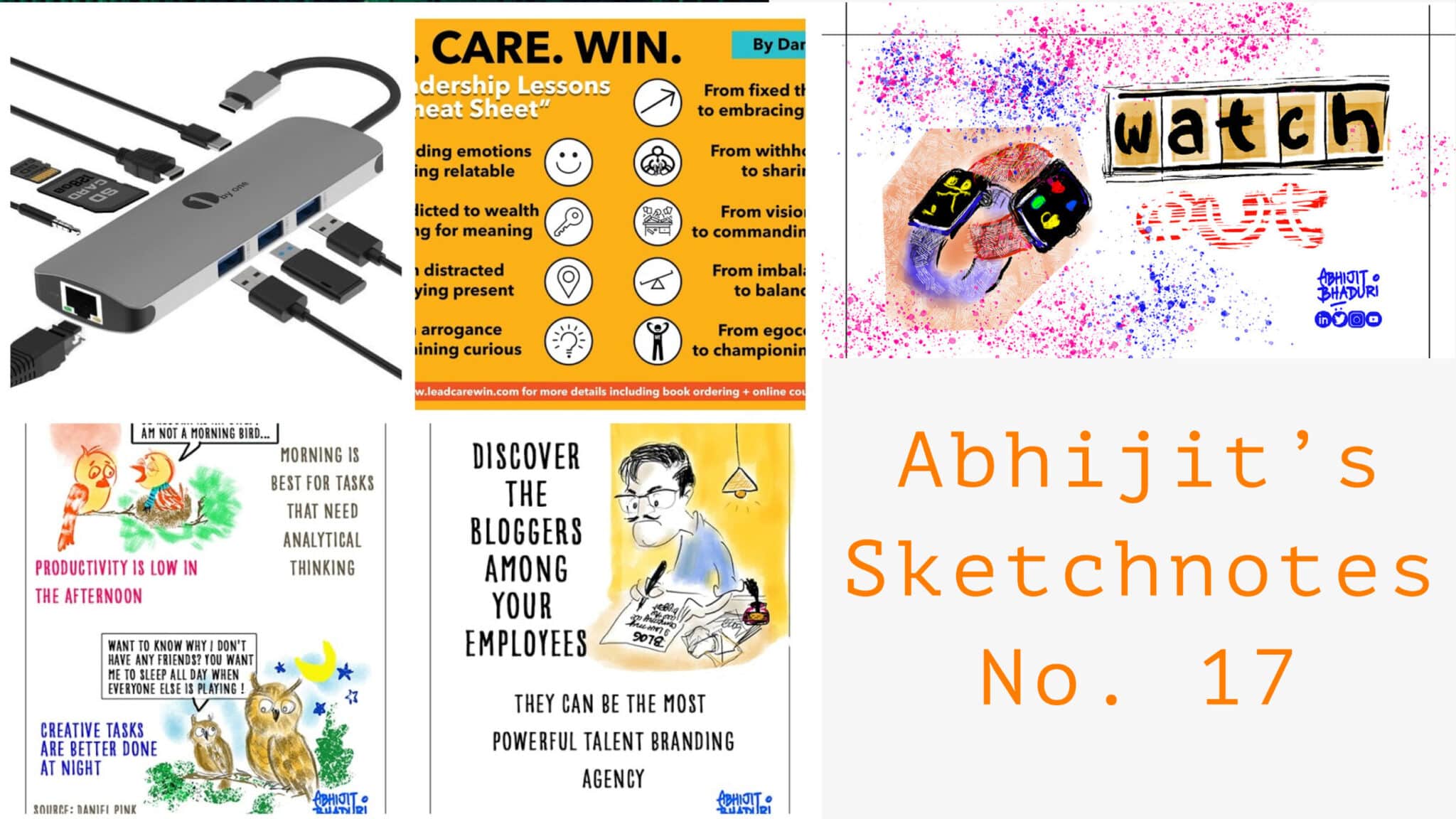
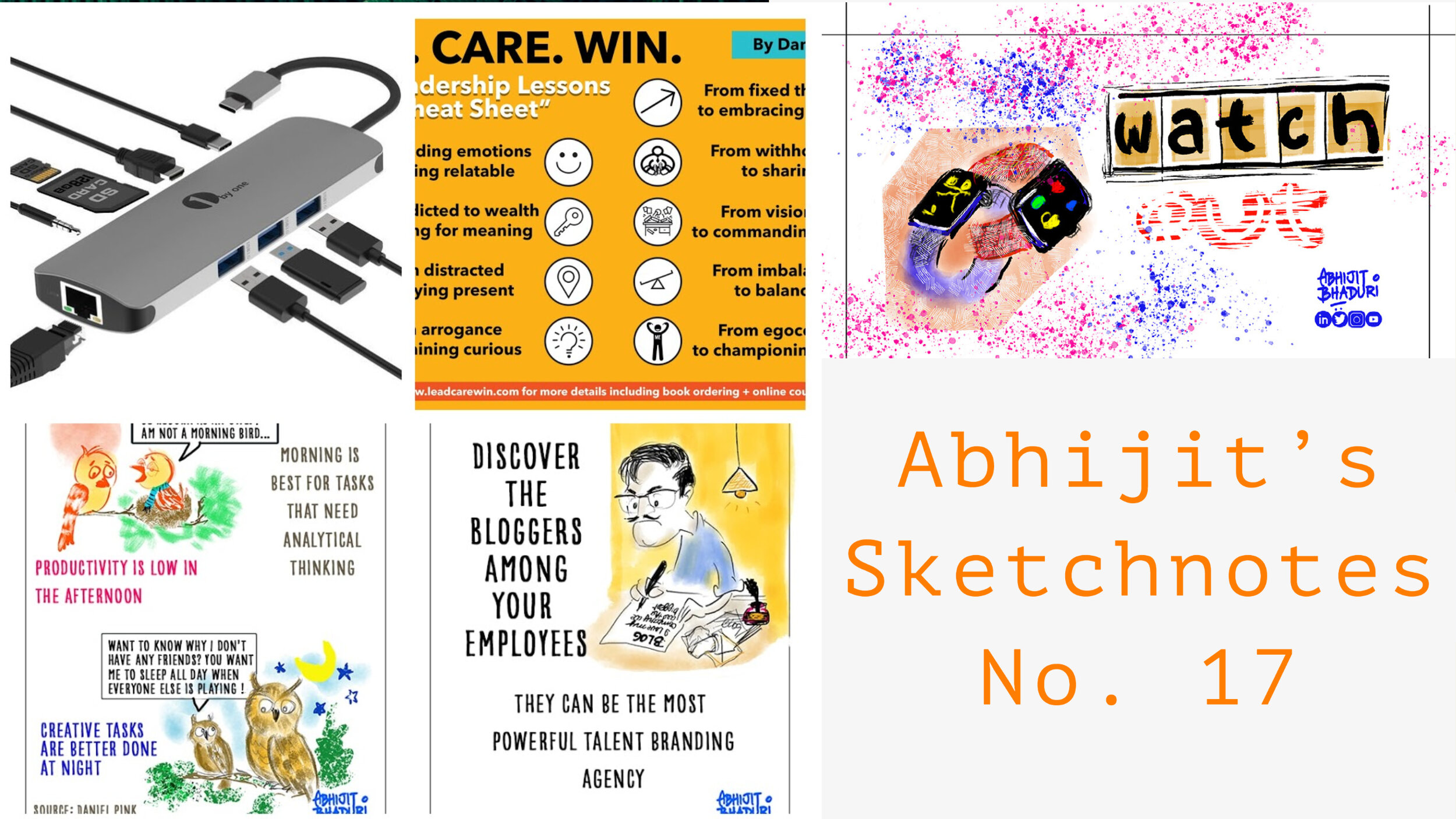
    You may notice that the headline gives the keywords that will let you search for a particular topic in the archives. The issue number is another way to search for the story.

    1. Why is it so hard to write a book?

    Abhijit's Sketchnotes No 17

    Abhijit’s Sketchnotes No 17

    1. Creativity and productivity:Most people think writing a book is a creative process. Here is a secret – creativity is a very small percent of the skill of writing. 90 per cent of a book happens because you (yes, you guessed it) sit down and WRITE – without getting distracted.

    2. Manage your attention filters: The game is not about managing your time. It is about managing your ‘attentional filters’.Adam Grant who is an expert on productivity says, “The stumbling block is that productivity and creativity demand opposite attention management strategies. Productivity is fueled by raising attentional filters to keep unrelated or distracting thoughts out. But creativity is fuelled by lowering attentional filters to let those thoughts in.” Dig deeper

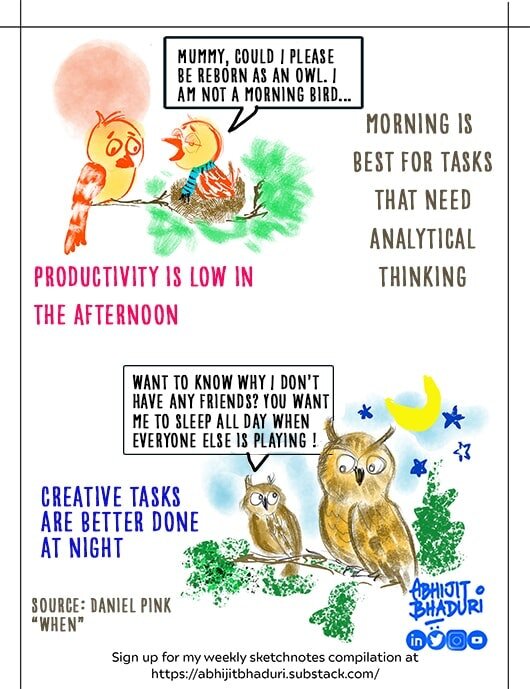
    3. Choose the time of day: Author Dan Pink in his book When, suggests that you manage the tasks depending on your body clock. If you’re a morning person, you should do your analytical work early when you’re at peak alertness; your routine tasks around lunchtime in your trough; and your creative work in the late afternoon or evening when you’re more likely to do nonlinear thinking. The reverse holds true if you are a night owl.Take a guess about the time of day when I made this cartoon. Leave your comment here

    PS: My book Dreamers & Unicorns is scheduled for release on 15th Nov 2020. Maybe I should shift it by a day to coincide with my birthday on 16th Nov. Any Scorpio readers here? Let me know. Want to pitch your design for my book cover? You can share it on Twitter (see an option here) till Oct 15th 2020 and tag me @abhijitbhaduri.

    2. Why you should have a blog

    Abhijit's Sketchnotes No 17

    Abhijit’s Sketchnotes No 17

    I met Alexandru Gotoi on Twitter. He is from Romania, and yes, he reads this newsletter (all smart people get this newsletter, I told you). He made a job board for HR remote jobs. I liked his blogpost about the company called Basecamp. It is called “Employer Branding Done Right”.

    a) A great employer branding opportunity

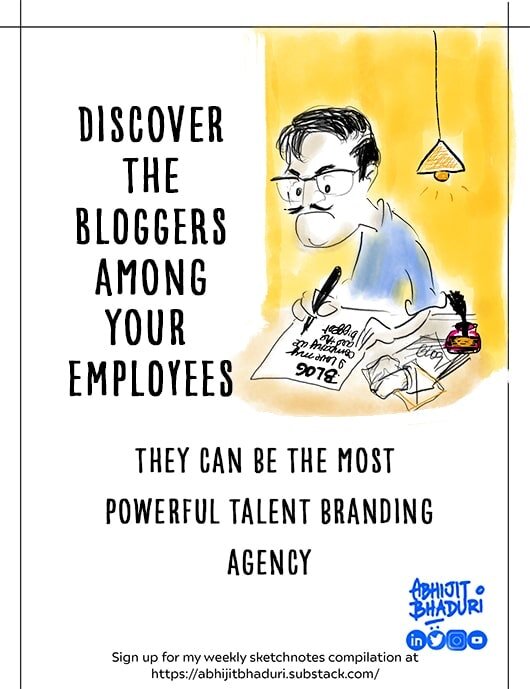
    A blog is a great marketing engine for commercial purposes but written in a personal and transparent way, it’s also a great magnet for employer branding. And they blog about everything from how they structure work and teamemployee benefits to why and when they freeze the hiring or product updates.

    b) Skill for the future

    I believe writing is going to become an incredibly important skill very soon. Jeff Bezos banned PowerPoint presentations in Amazon and replaced them with 6 page memos. Everyone reads it for a few minutes before the meeting starts.

    c) Teach people writing skills

    To teach someone, it is important to know what good writing looks like. And have a reasonable idea of how long it takes to learn the skill. Don’t miss the example of learning to do a handstand <read it here>There are lots of bloggers who would love to come and run workshops for your employees on how to blog. There are journalists looking for work. Hire them to teach the leaders how to write.

    3. Watch out

    Abhijit's Sketchnotes No 17

    Abhijit’s Sketchnotes No 17

    Apple announced Apple Watch Series 6, which has a Blood Oxygen feature, sleep tracking, automatic hand washing detection (yes, it detects when you wash your hand and nags you until you washed it long enough) and new workout types. They are trying to position the watch as a healthcare accessory. Heart Rate and Blood Oxygen, could serve as early signs of respiratory conditions like influenza and COVID-19. Health and wellness are two sectors all gadget makers will go after because it plays into what everyone worries about throughout their life.Chronophobia is the fear of time. It is the fear of time and of the passing of time. But chronomentrophobia, is the irrational fear of watches and clocks. Why am I telling you that? Read on…‘Watch out’ is what I said when I read that Singapore Government and Apple are teaming up to track and reward user behavior through the Apple Watch and an iPhone app. Citizens can earn up to $280 for completing health and wellness goals like yoga, swimming or taking immunisation shots. Read moreI am of course paranoid about data privacy. I know I know … I use Google Maps and Search (so there goes my privacy) and I use Netflix, so they know my taste in movies. I just watched The Social Dilemma (and it made me more paranoid!). Kindle knows my reading habits. What if this data fell into the hand of someone evil. We may have a knife at home. But a murderer could use the knife to be evil. A benevolent government could use the health data of citizens to provide flu shots to a vulnerable population. But then, an evil dictator could target specific groups if they had your data – especially your health data.Would you trust your employer more than the government (if you HAD to choose) when it comes to your health data.

    4. Lead, Care, Win by Dan Pontefract

    Abhijit's Sketchnotes No 17

    Abhijit’s Sketchnotes No 17

    USB-Hub.jpeg

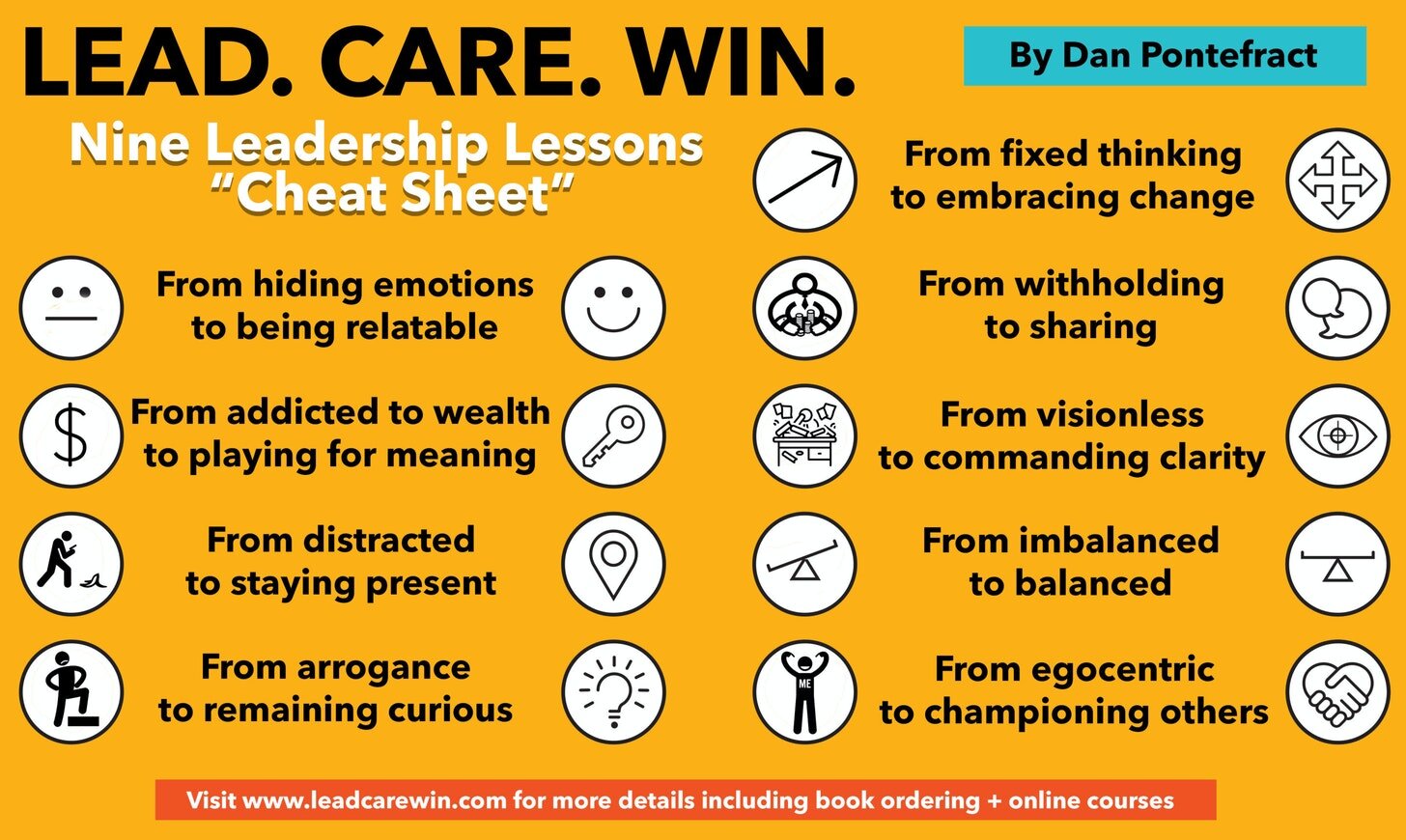
    Dan Pontefract@danpontefract sent me an advance copy of his new book Lead, Care, Win. I want to say thanks to him. I tell him that my favourite chapter of the book is about curiosity. I asked Dan what being curious means to him.He described it using the metaphor of a USB hub. The hub expands the number of ways in which your laptop can get inputs. A curious person expands the sources of information by creating many input options. I can never look at a USB hub without thinking of Dan’s metaphor.He also went on to suggest that the laptop can then connect to a projector and a printer etc to create different kinds of outputs. This cheat sheet gives you a view of the 9 leadership lessons that are explained through stories from his life.Leave a comment: https://abhijitbhaduri.substack.com/p/employer-brands-watches-and-culture/comments

    5. Does benchmarking kill creativity

    Image.jpeg

    In this episode of Unabashedthe question being debated is, ‘Does Creativity Kill Creativity?’ Several Indian organisations have taken the key idea of a successful company in Silicon Valley and cloned it in India (and then improvised to suit Indian needs). Is that a good outcome to expect when we benchmark? Or does it come in the way of creative thinking? If you drawn this picture while in school, then you will know how in different schools and in different states, we have all been asked to draw the same picture…But don’t miss listening to this conversationhttps://audioboom.com/posts/7686900-ep-028-unabashed-with-neha-pant-and-abhijit-bhaduriYou can email me at abhijitbhaduri@live.com

  • Can culture be benchmarked?

    Can culture be benchmarked?

    My-Post-2.jpg

    A company’s culture is its personality. It is hard to copy.

    A company’s culture is its personality. It is hard to copy.

    Can we learn about innovation from other businesses?I was once talking to the founder of a startup who wanted to build the culture of Google in his firm. He wanted to benchmark the ‘best practices’ of Google’s culture of innovation and that is how he implemented this policy in his 50-person startup. Every employee in that tiny startup had to work on a personal project. Two months later a few employees came to the founder and asked for permission to work from home so that they could work together undisturbed on a secret project they had come up with.Very soon, attendance in the office thinned on Fridays. One day the founder revoked the option to work-from-home on Fridays. Employees complained and sulked. The founder told the employees in a town hall that he had trusted the employees, but the employees had misused his trust.Was the founder of the startup being naïve when he gave the employees a day off to innovate?

    The back story of Google’s 20% Rule

    ‘20 percent time’ was created by Google Founders Larry Page and Sergey Brin in 2004. It’s designed to give employees one full day per week (20 percent of their time) to work on a Google-related passion project of their own choosing or creation. Gmail, AdSense and Google Talk were born from this 20%-time rule. In 2013 the company began cutting back on this policy and replaced it with a more focused approach to innovation. People had to seek their manager’s approval to be able to work on their passion project. The company would work on projects that fit into Google’s strategy and plans. (Read more

    >
    You can copy someone’s mannerisms – not personality

    Work Rules

    In 2015, the then Head of HR for Google, Laszlo Bock wrote a book called Work Rules where he laid bare the way Google works. I was struck by the section on hiring. Every company claims that they wish to hire the top talent and then have a process that is no different from any other. Have a scientific rigor around hiring people. Most people think that they are terrific at interviewing – they aren’t. People use their gut and all kinds of unproven approaches to hiring. No wonder so many people underperform or are miserable at work.This book tells you what the right way is. Don’t trust your gut is the first lesson Laszlo offers. He deconstructed the mystique behind Google’s hiring process. They continuously carry out their own research and gather data about every HR process. They test it against the academic research and then run their own stress-tests.

    The People Analytics team at Google is not your usual HR team.One third people come from traditional HR backgrounds and have high degrees of emotional intelligence. One third is recruited from consulting, and specifically from strategy consultancies, not HR consultancies. The final third of hires are deeply analytic and hold at least a Masters in analytical fields ranging from organizational psychology to physics. That mix may explain why HR policies are not based on gut feel and tradition but driven by research that is continuously refined after implementation.

    Our recommendation

    Here is what we recommend

    1. Stop benchmarking and build your own cultural norms. The culture that actually prevails in an organization depends on the behaviors that the leaders demonstrate every day.

    2. Look at the people you promote or let go (or continue to carry when they do not perform) – that is what the average employee believes is your culture. It is not what the posters on the wall claim.

    3. Studying the people who stay (and get promoted) and the people who quit are powerful inputs to design your hiring system. Your hiring system is the gatekeeper of your talent. Study it and continuously refine it.

    Another book on culture you should read <click this>

    Written for the SHRM South Asia Blog

    Read other posts

  • Talent, mentors & ‘No Rules Rules’

    Talent, mentors & ‘No Rules Rules’

    My-Post-6.jpg

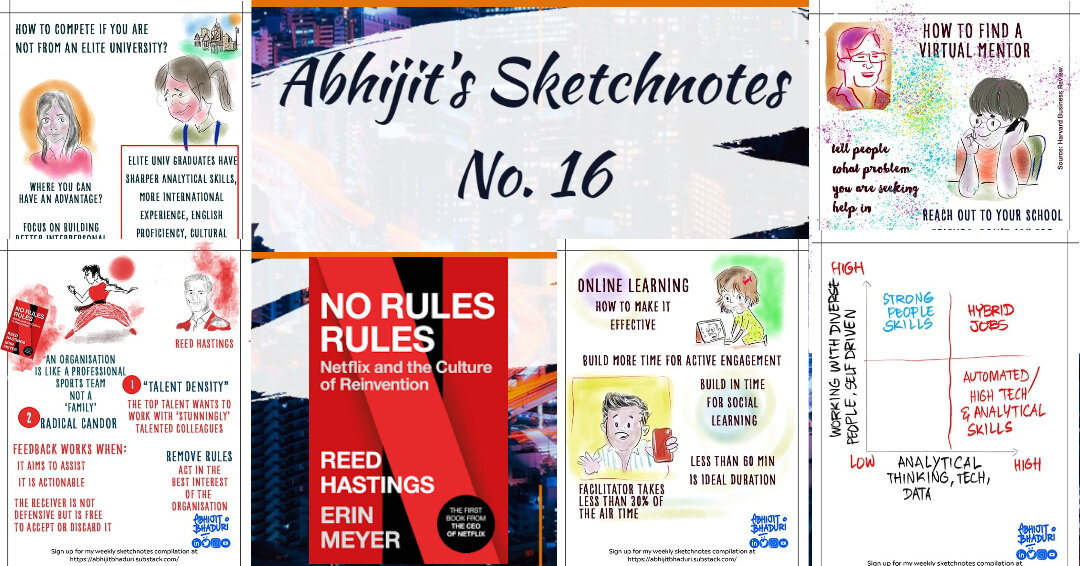
    Sketchnotes No 16 is here. This has a review of the book everyone is talking about ‘No Rules Rules’ by Reed Hastings who started Netflix. The video-streamer’s employees are not treated like ‘family’. So how are they viewed? We also will discover that there is an optimal amount of air time that the speakers in an online webinar must follow, before the audience gets disengaged (and watches Netflix on the sly). Can you find a virtual mentor even as you are locked up at home? That is what elite universities provide – great teachers and great mentors. Does that justify the premium they are paid? If you are NOT from an elite institute, is there any way you can compete? The 16th edition of my newsletter is all about Talent, Mentors and Rules

    1. ‘Elite universities’ graduates lose out on this count

    Abhijit's Sketchnotes No 16

    Abhijit’s Sketchnotes No 16

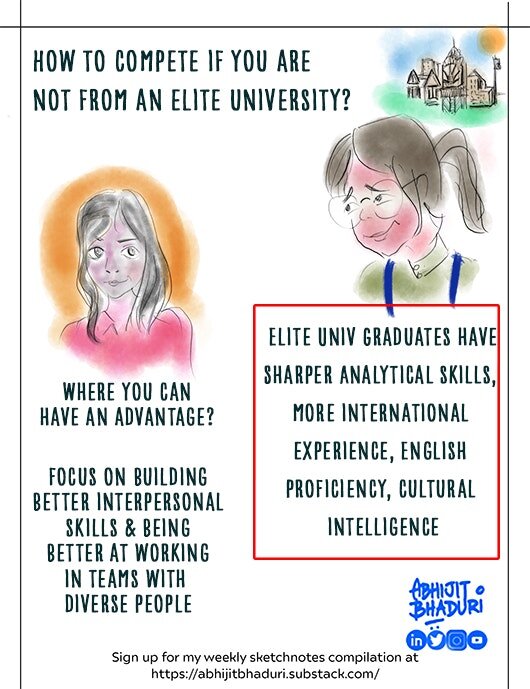
    In many countries, there is a clear distinction made between the “premier” institutes (Marking the B-School or Engineering college as Tier I or Tier II etc). Most entrance exams test for IQ and the tests favour people who have had an urban/privileged background. Not surprising that this article says ‘higher-ranked universities indeed score higher on general cognitive ability tests, have more international experience, better English proficiency, and higher cultural intelligence. Top universities employ better instructors, offer access to better-equipped facilities, attract better speakers and guests to campus, which in turn, should lead to better training and subsequent performance.

    Interestingly, the article goes on to say that graduates of the elite institutes pay insufficient attention to interpersonal relationships. Most tasks require us to work with others. This is a place where anyone with strong ‘people skills’ can have an advantage regardless of the institution they have graduated from. This is a great leveller. Building the ability to work in diverse groups is a great skill that any one can build. The ability to work harder than others is yet another skill that we have within our control.

    For me what is heartening is that graduates from lower-ranked universities showed an equal level of motivation and work ethics. Both motivation and diligence are individual traits. There is an advantage each group can have.

    I have a question for you:Should employers stop looking at grades as a predictor of success at work? What have you seen?

    Click the button to leave a comment https://abhijitbhaduri.substack.com/p/talent-mentors-and-no-rules-rules/comments

    Abhijit's Sketchnotes No 16

    Abhijit’s Sketchnotes No 16

    2. How to find a mentor virtually

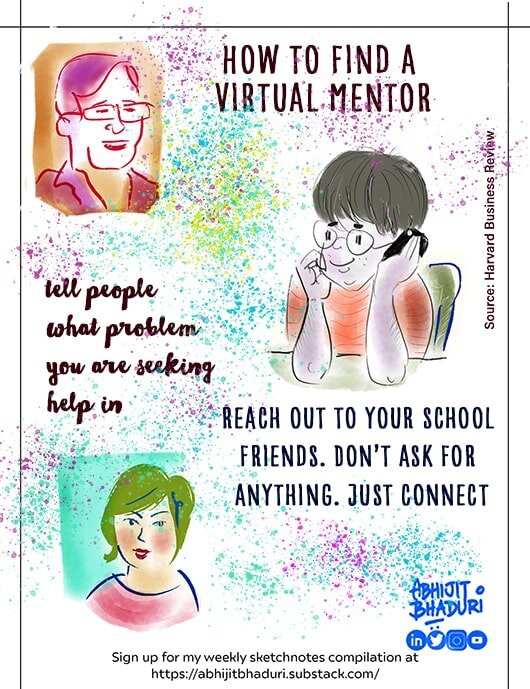
    If you are stuck at home, can you find a mentor? Does virtual mentoring work?

    • Reach out to your friends’ friends. Even though these may be people you have known, optimise the conversation by mentioning the specific challenge or area you’re looking for guidance on, not life in general. When people know the specific problem you are trying to solve, they can connect you to the people within their network. A friend’s friend can be a huge network to find a virtual mentor.

    Reconnect with people from your school. Reach out to them to see how they are doing and rekindle that relationship. Don’t ask for anything—simply reconnect. We often underestimate the ability of our peer network.Read more

    3. Your audience online is disengaged. Here’s why

    Abhijit's Sketchnotes No 16

    Abhijit’s Sketchnotes No 16

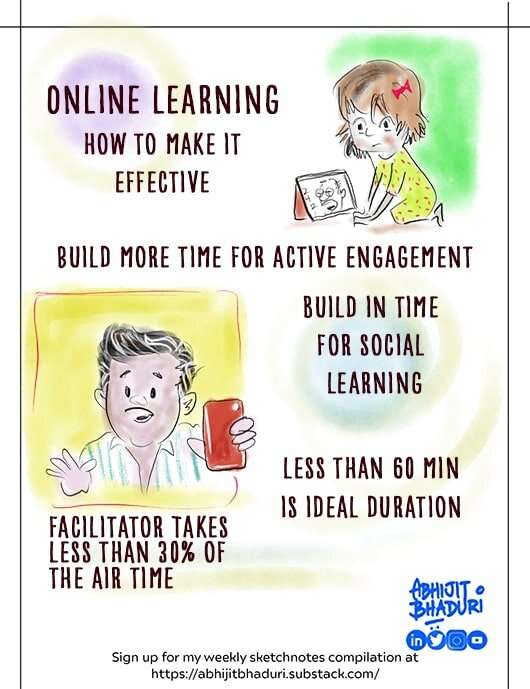
    People who organise webinars often treat online interactions much the same way as an in-person experience. The result is a disengaged audience and an ineffective facilitator.

    1. Screen time is for interaction – not monologue. If there is pre-work done (preferably in groups), it helps to get participants to share their ideas and have an engaged conversation online. One of the B-Schools gives every student a 30-minute video lesson by the professor that the students watch individually before the class. The time spent online is for asking questions, making presentations and sharing experiences and opinions.

    2. Shorter duration than in person classes: E-learning requires 40-60% less time to learn than in a traditional classroom. Sessions longer than 45-60 minutes seem to be threshold for an online learning experience. How does that change the role of the facilitator? And how should corporates leverage this new world of learning? Read this

    3. Book Review: No Rules RulesNo Rules Rules by Reed Hastings and Erin Meyer is a book about the culture of Netflix. Could it be that the workplace norms that exist today are archaic. They were formed in the early years of industrialisation and have remained unchallenged – until Netflix challenged many of the norms. That is what makes it a Market Shaper – a company that changes how we live and work. They are global, much like Netflix that operates in 190 countries. Netflix is famous for giving its employees unlimited (yes, you read that right) vacation days. They have no fixed rules about the hotel category you are entitled to stay in. There is no rule to tell you if you can buy a Business Class ticket to fly for a meeting. There are two big preconditions of this ‘No Rules’ culture

    4. Talent Density: “Our version of the great workplace is a dream team in pursuit of ambitious common goals, for which we spend heavily. It is on such a team that you learn the most, perform your best work, improve the fastest, and have the most fun.”The second element is a culture of radical candour and feedback. How does that work? Read about it by clicking hereWould this culture bring out the best in you? Would it make you more creative? Do leave a comment https://abhijitbhaduri.substack.com/p/talent-mentors-and-no-rules-rules/comments

    5. Where will your skills fit in?In this podcast by SHRM, Neha Pant and I have an Unabashed conversation about why the recent article about 21 HR Jobs of the Future is very narrow focused and why the future of jobs can be better explained by this framework instead. You can evaluate the extent of people skills and automation in the industry or function and then figure out where your job will go.

      If you have a question email it to me at abhijitbhaduri@live.com or on LinkedIn or on Twitter @AbhijitBhaduri

      I have explained the idea here. Listen by clicking

      Stay curious. Stay connected.

  • Abhijit’s Sketchnotes No 13

    Abhijit’s Sketchnotes No 13

    collage.jpg

    1. Why reading translated books is important

    Abhijit's Sketchnotes No 13

    Abhijit’s Sketchnotes No 13

    Tiger-Woman.jpeg

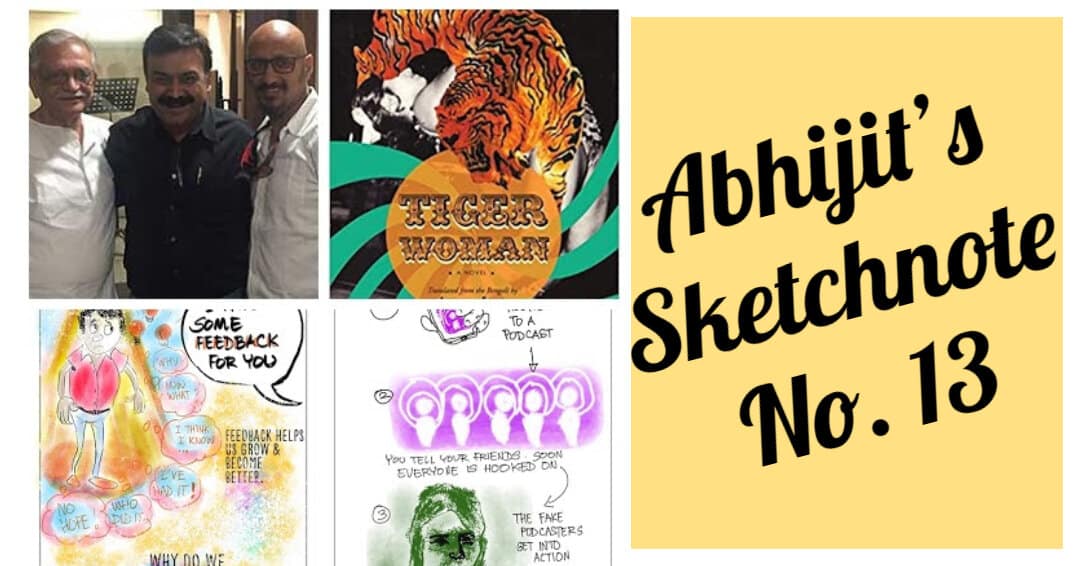
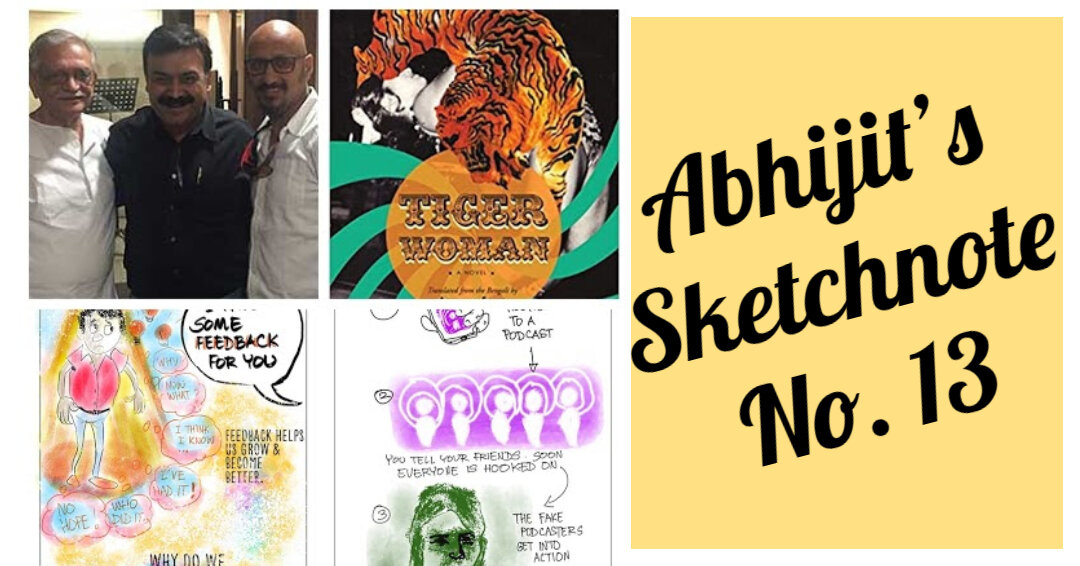
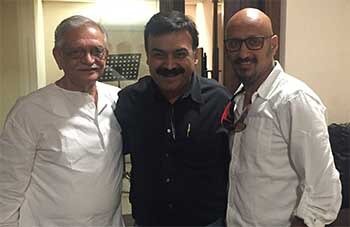
    When I was growing up, I read a lot of Russian literature translated into English or Bengali. More recently I read Gulzar’s translations of Tagore in Hindi. They have been set to music by Shantanu Moitra. <listen here> I wrote about the experience of spending a day with Gulzar Saab watching him record that translation. It was a fanboy moment for me. That is when I discovered that Gulzar Saab can read Bengali. (He translated the Bangla poem to Hindi while using the Urdu script). He writes in a note book or on pieces of paper. He turned 86 on 18 Aug 2020.I wrote about my meeting with Gulzar saab hereToday I want you to listen to this interview with Arunava Sinhawho has translated 45 Bengali novels into English. He has recently translated an intriguing story called Tiger Woman written by Shirsho Bandopadhyay (I ordered the book, waiting to read it). You can read a review here. It is a historical novel with a tragic love triangle as the core story thread.When you read a translated book, it enables you to understand other unfamiliar worlds. The most difficult part of the translation is the dialogue, says Arunava. You have to translate not what you see (read), but the words as you “hear it in your head”.

    Here is the interview that was sent to me by Dr Anjan Ray. Thanks

    https://valleyofwords.org/podcast/arunava-sinha/

    The cover design of the book is brilliant. What do you think? 

    Do you agree that reading translations can expand our world view? 

    Leave a comment

    Abhijit's Sketchnotes No 13

    Abhijit’s Sketchnotes No 13

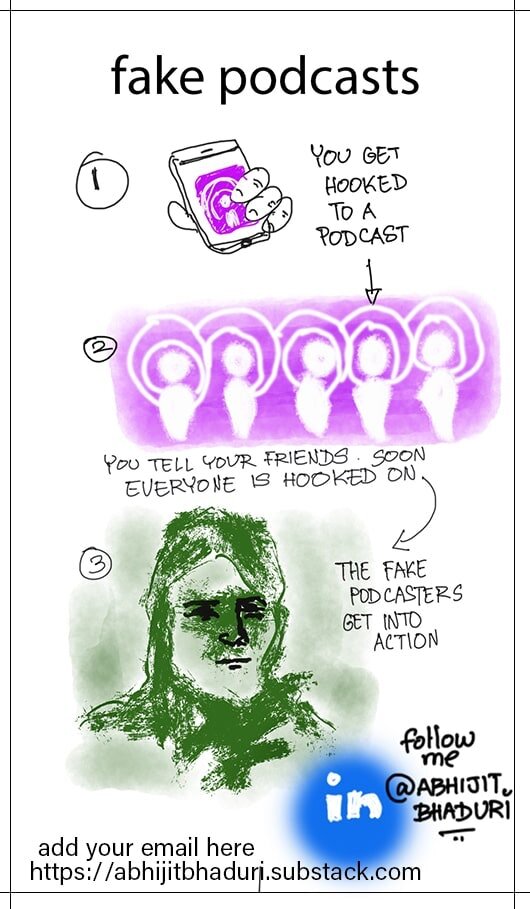
    2. Have you heard of ‘fake podcasts’?

    There are markets dedicated to fake handbags and watches and sneakers. But what is the difference between say ‘fake currency’ and ‘counterfeit currency’? Hint: All counterfeits are fakes, but all fakes are not counterfeits. Recently I was intrigued to read about ‘fake’ podcasts. So what makes a podcast fake?Podcast creators distribute dozens of shows with the same names as popular podcasts such as ‘Serial,’ and ‘The Joe Rogan Experience’ to be distributed across the podcast ecosystem. Digiday says

    ‘… copycats appear too, in many cases with nearly identical metadata and cover art. The fake shows appear designed to trick listeners into listening to them, so they can be monetized through ads injected automatically…’

    Do you think that these podcasts should be called “fake podcasts” or “counterfeit podcasts” … yes, what do you think? Leave a comment and tell me why

    3. Why do we dread hearing that phrase?

    Abhijit's Sketchnotes No 13

    Abhijit’s Sketchnotes No 13

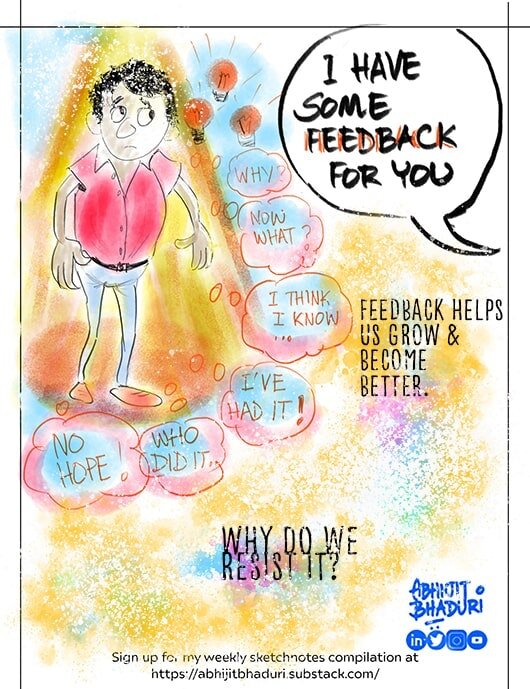
    ‘I have some feedback for you’… think of what that phrase can do.You curl up expecting the worst. The word feedback is value-neutral. It could be appreciative or corrective. Corrective feedback helps us become more successful. How do we do this in a manner that makes it easy to accept – without sugar coating and diluting the feedback.I had a professor who was hard to please. He set high standards and made us work much more than any other professor in the institute. He was less than generous with his grades. Yet, all of us thought he was very fair and was good at heart. I wonder what was his secret.This article talks about the ‘Five-One rule’Do share a tip you use to give feedback to people – especially when it is not complimentary. Have you worked with someone who gave you the toughest feedback but made you feel motivated enough to act on it? Leave a comment and tell us how it was done. By the way, I would value your feedback about the newsletter.

    4. How long does it take to be funny for 5 min?

    Atul Khatri used to be the CEO of a software firm. Then one day in his forties he decided to give it up to be a stand-up comedian. If you have watched Shah Rukh Khan host some of these film awards shows, then you may know that many of the witty one-liners are written by stand up comedians like Atul Khatri. Play to Potential is a podcast by Deepak Jayaraman where he speaks about career transitions that people navigate. This episode with Atul Khatri takes a look at how Atul moved from selling software to doing stand up comedy part time and then finally choosing comedy as his second career. How long does it take to write jokes that last five minutes on stage? Just take a guess and leave your response before you listen to the answer. Atul speaks of the Sindhi community in Hong Kong who have moved from selling tailored suits to VCRs, DVDs and now crypto machines. It is a lovely example of a community that has adapted to the changing times.

    You can email me at abhijitbhaduri@live.com and I promise to respond.

    Follow me on social media @AbhijitBhaduri

  • Online learning – is it better

    Online learning – is it better

    My-Post-38.jpg

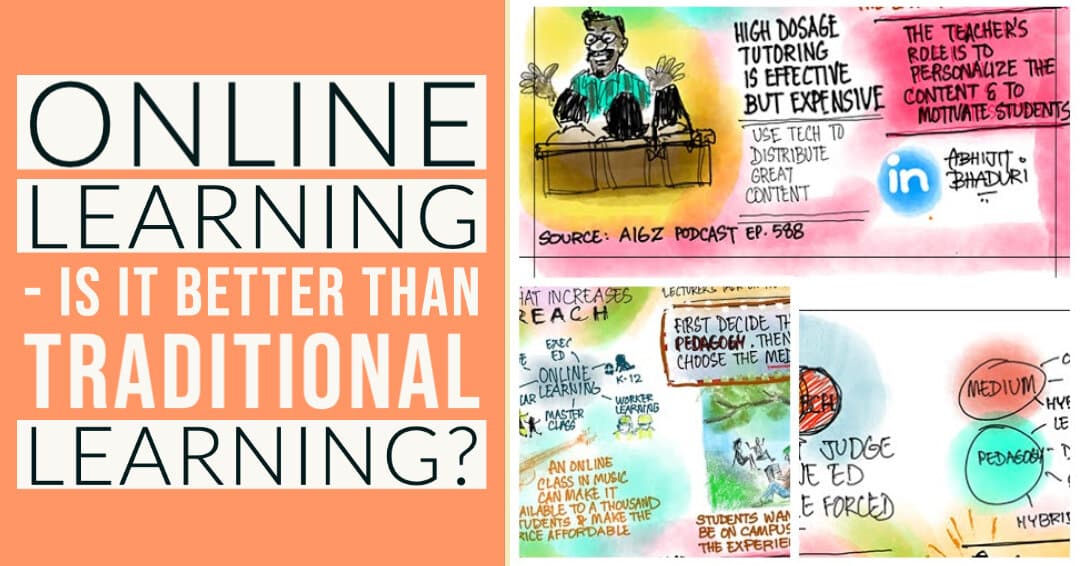
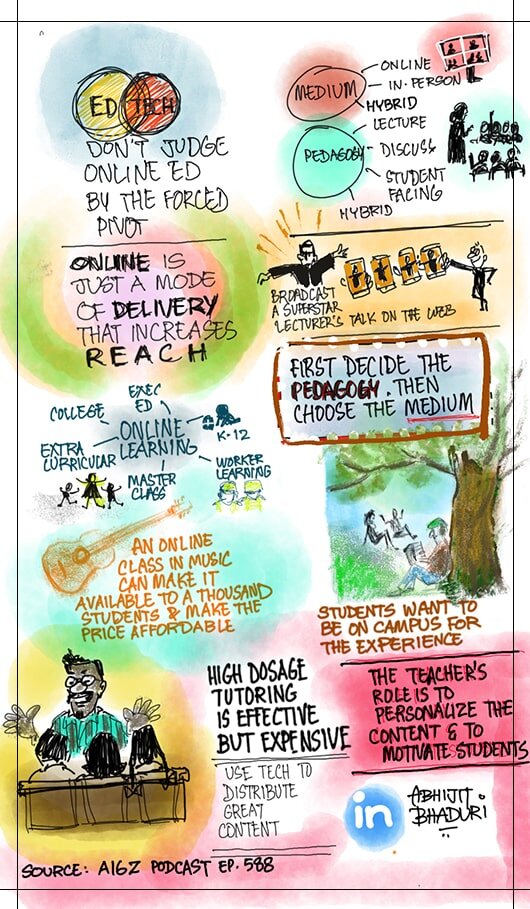
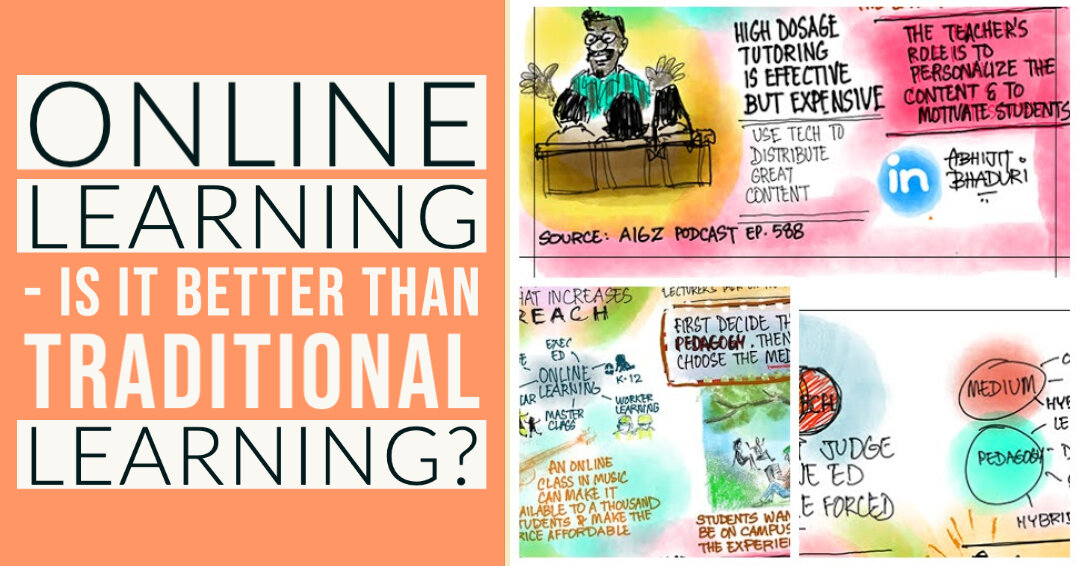
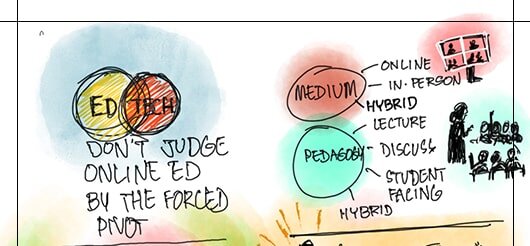
    When the lockdown began, education went through a forced pivot (along with many other things like healthcare, retail and the office, of course). Is online education effective and what is the problem EdTech should solve for instead?

    Online Education

    Online Education

    Pedagogy first, then the medium

    It can make college much cheaper. But Massive Open Online Courses (MOOCs) have not been able to replace college because being in college is a very different experience. Here are some free MOOCs you can take. For children going to school, online learning takes away the opportunity to build social skills and is not very effective in peer-group learning. Several helicopter parents stay out of the screen but prompt the child with the ‘correct response’, thus severely damaging the learning experience. Frequent testing is one of the best ways to learn at all ages. Being seen as the smartest baby is not a great way for the kid to learn (neither is it useful for an adult).

    What is effective is not cost-effective

    Online Education

    Online Education

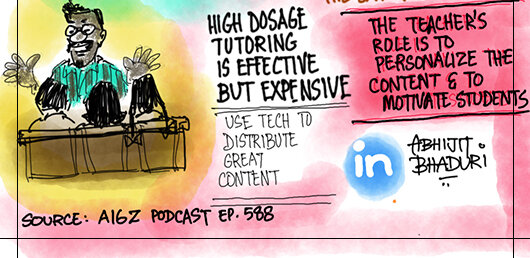
    Small group tutoring in high doses is very effective. But is not cost effective. When businesses allocate a coach for their high potential employees, they are providing the equivalent of high dosage tutoring. But it is expensive.

    Imagine if every student could have access to a life coach. What is every employee could work with a leadership coach. In a conversation with the Director of MICA, Ahmedabad, (full disclosure: I used to be on the MICA Governing Council) I learnt that the professors record a 30 minute ‘lecture’ which the students watch ahead of the class. The next day, the group of students use their time to have discussions with the professor. The projects, assignments and tests reinforce the learning further.

    Fewer content creators – more tutors

    1. Content creation is a complex task: What if content creators was left to a team of instructional designers, academics, storytellers, animators, video and audio creators. They could create short form and long form content that is engaging and interactive. If the content has already been created and can be used by the teacher, it is infinitely better than listening to someone standing before a camera and droning on.

    2. Multiple perspectives: Have unique perspectives (even when they are opposing views):Having one single content provider is dangerous. Education is one of the first places authoritarian states attack when they want to shape young minds. This awesome TED talk tells you about the “Danger of a Single Story”

    3. Personalisation: The role of the teacher/ instructor or coach can be to personalise the content to the context of the learner. That means being able to slow down or speed up depending on the student’s ability.

    4. Building habits: But the most important role of the teacher is to be able to simplify the idea and create opportunities for the student to apply the learning. The teacher can help the student to progressively become a self-starter. The role of the teacher is motivate and inspire and build great habits.

    Online Education

    Online Education

    Is online learning just as effective for you as in-person learning? Do let us know what is your experience. Thanks for leaving a comment here. Here is a #Sketchnote to summarise the articleI will be adding this to my weekly newsletter as the lead story. There are more ideas there. Get them every week in your mailbox by adding your email here https://abhijitbhaduri.substack.com/

    Here is the podcast and the TED talk I have referenced in my article https://a16z.simplecast.com/episodes/the-ed-techdebate

    Our lives, our cultures, are composed of many overlapping stories. Novelist Chimamanda Adichie tells the story of how she found her authentic cultural voice — and warns that if we hear only a single story about another person or country, we risk a critical misunderstanding.

  • Ep 9 In conversation with Pratik Kumar

    Ep 9 In conversation with Pratik Kumar

    Pratik-Poster-2.jpg

    CHRO to CEO - Pratik.jpeg

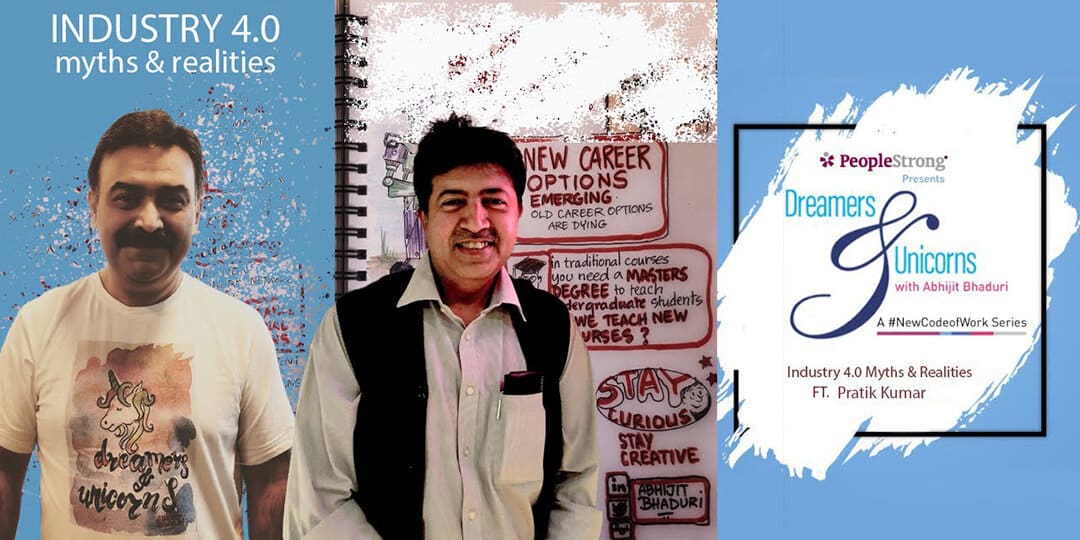
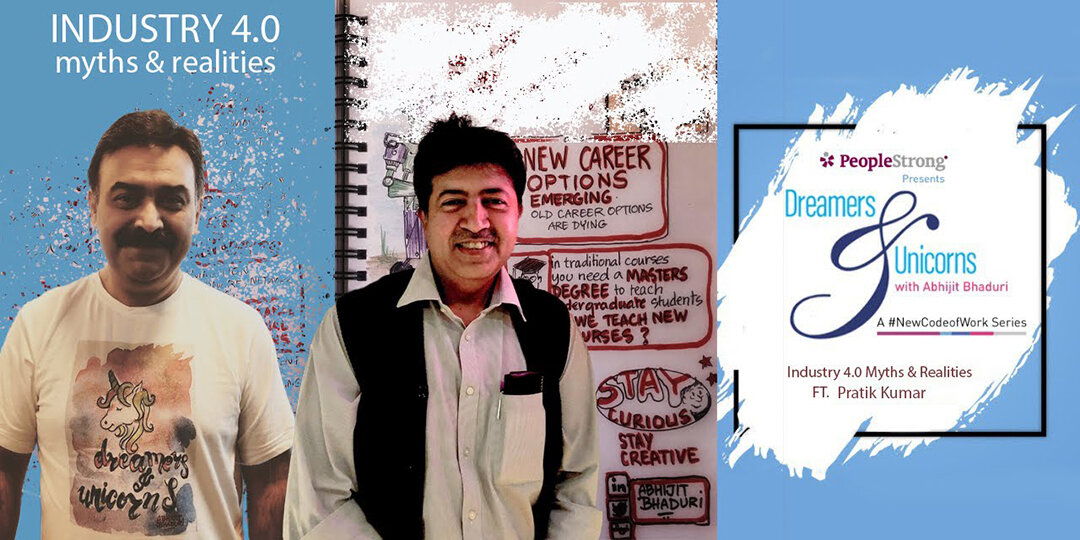
    Pratik Kumar has been associated with Wipro since 1991. Pratik spent his initial years in the IT business led the Corporate HR function from 2002. Pratik assumed leadership of Wipro Infrastructure Engineering (WIN) as its CEO in July of 2010. In the last few years, WIN has taken rapid stride in establishing its footprints in emerging as well as other growth markets. WIN, under his leadership has also focused its efforts in scaling up its nascent business in Aerospace & Defence and Water which would be strong platforms for WIN’s future growth. Pratik is member of the Board of Wipro Enterprises (P) Limited. He joined on my podcast Dreamers & Unicorns.Some key moments that stayed on with me:
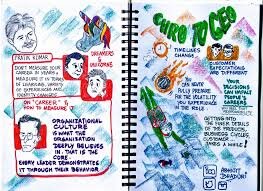
    Pratik Kumar on Careers. I started the conversation by asking him what made him spend time with one employer since 1991. Did he not feel the temptation to change employers?

    Pratik: “… career should not get measured in terms of its chronological age, not in terms of the tenure of association with an organization because I believe that career is a series of life-long experiences.  It’s about learning, it’s about transition, it’s about identity changes and that is what actually makes any career rich in terms of the experience and the variety of experiences one has had.”

    Pratik is one of the HR leaders who has successfully made the transition to the CEO Role. What changed and what did he have to learn? Did he feel burdened by the demands of the role?

    Pratik Kumar: I was lucky that I inherited a  team which was very very capable and I made no bones about  not being able to understand fully what was there and once you volunteer to learn from whoever can actually teach you and that’s one of the lessons which I picked up fairly early.  You would be finding yourself lot of people who would generally come forward and help you along.By the way this can only happen in the organization where you have grown and that’s the other lesson.  I mean, you do not get that kind of flexibility if you were to happen in an organization outside the fold. So, to your question, the difficulty was not so much in understanding the business and what we are driving but it was to get into the finer details of the products, it’s applications, the business cycle, the customer expectation which takes a while.  There is something else besides the role dimensions, I think there is a very high sense of responsibility when you get into a business leadership role and the responsibility is about you realize your decisions are beginning to impact the careers of people, their whole livelihoods, the direction which you wish the organization to take and you bet on could come through, it need not, it could have an impact and you need to do it in a lot more responsible manner. And that sense of responsibility just gets accentuated when you step into this role which I have to admit was not there earlier. 
    In this free flowing conversation, we spoke about many different things. Can a leader shape organizational culture? On how to make career choices. And much more.One thing you may want to listen for specifically is Pratik’s view of Industry 4.0. The broad concern I had is that Manufacturing, has been traditionally one of the large job creators and most large economies that goes almost up to 25-27% of the jobs go into manufacturing. But this is also the sector which will see a lot of automation. Is it a good sector for a young person to build a career?Listen to it. And if you like it, please do share the link maedinindia.fanlink.to/DAU

    And do rate it generously because it helps others to find us more easily.