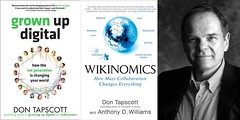
 The workplace is slowly changing. A multi-generational workforce needs different skill sets to manage. Author, thinker, guru and NetGen evangelist Don Tapscott continues our conversation. (If you want to read Part 1 of the interview, please click here). His research suggests that we are dealing with a smarter but “different” generation today and that requires decison makers to re-look at the way we have run organizations. After all, “IQ scores are up. SAT scores show an increase. There are more people graduating from college today than ever before. So they work hard and they are smart. They just work differently. This gen works in spurts. Taking a social media break is the equivalent of taking a smoke-break or a coffee break for the other generations. For this generation, working, learning, collaborating and entertainment are not separate activities. Working and learning is the same. There’s no reason why work should not be equally enjoyable.” You can read the NY Times review of Don’s book Grown Up Digital hereHe identifies eight norms of many members of the Net Generation: they prize freedom; they want to customize things; they enjoy collaboration; they scrutinize everything; they insist on integrity in institutions and corporations; they want to have fun even at school or work; they believe that speed in technology and all else is normal; and they regard constant innovation as a fact of life.Some interesting stats that come from Pew Research Center only confirm what Don has been saying now for many years. This generation is DIFFERENT in a very fundamental way. How will the workplace view them when they come in as employees complete with their iPods plugged in and desire to achieve work-life balance. Won’t they be viewed as irresponsible or just plain lazy in an economy that is still grappling with the after-shocks of recession?Abhijit: “This is not just a life stage difference, this is a generational difference because cognition and information process different because of way they have grown up” – what are the implications of this for Executive Education?Don Tapscott: Work and learning are becoming the same activity in a knowledge economy. Rather than sending executives off to a learning institution, it makes more sense to increase the learning component of their work. In the company I work for, nGenera Insight, our education program is quite simple: Everyone must blog. By blogging, they need to think about what’s going on the world. They need to become knowledgeable and develop their craft of writing. They need to put forward their thoughts and defend them. This is Executive Education fully integrated into work.
 Abhijit: Openness, Peering, Sharing, and Acting Globally are the four pillars of the collaborating economy, according to you. What are lessons here for Managers on how they will need to change?Don Tapscott: We need to rebuild all our institutions around the principles. But most companies don’t understand what they should be doing. Today there is a generational firewall in the organizations. Leaders must understand that the internet is not about having a page on Facebook or using Twitter. It is actually the new mode of production. It is part of the new operating system of businesses. The Net is to be used to create products and services and collaborate in the workplace. It is about learning to collaborate with stakeholders even outside the corporation.The young people are coming into the workforce and are bringing with them all the new culture of innovation, collaboration, speed, freedom and customization. This is a very exciting time to adopt new tools. Yet companies do just the opposite. They put the NetGen in a cubicle and ban their tools. This is self-defeating. Organizations need to use wikis, blogs, collaboration tools and document management tools to create a new workplace that can leverage the strengths of the new generation.Don Tapscott in conversation with Allen GregAbhijit: What is the new model of the leader and are there examples we can see of the new Leadership version 2.0?Don Tapscott: The leader at the top as a great visionary is becoming outdated. The person at the top cannot learn for the whole organization. Learning is everyone’s personal opportunity. Brad Anderson, CEO of Best Buy says his job is not to make decisions. He says, his role is to actually unleash the power of the human capital. The believes the most important people are the young people in the store. He created an internal social networking site called Blueshirtnation.com (Read more about it here) Best Buy employee site is a model for big firms. They are creating an electronic watercooler that is an integral part of the business. In the new world, the leader is not the centre of attention. It is everyone – every employee.Brad Anderson, CEO Best BuyRead part one of his interview———————Read the brilliant 8 part series about the Net Generation by Don Tapscott in BusinessweekPart 1: Net Geners Come of AgePart 2: How Digital Technology Has Changed the BrainPart 3: Net Gen Transforms MarketingPart 4: How to Hire the Net GenerationPart 5: How to Teach and Manage ‘Generation Net’Part 6: Supervising Net GenPart 7: Focus On the Net Gen Family Part 8: The Net Generation Takes the Lead

Demystifying “START”: More Than Just a Beginning
The word “START” appears in many contexts, from international treaties to early childhood education. Let’s explore some of the diverse