
AI is most powerful when it removes friction for people doing real work, not when it’s a flashy demonstration project
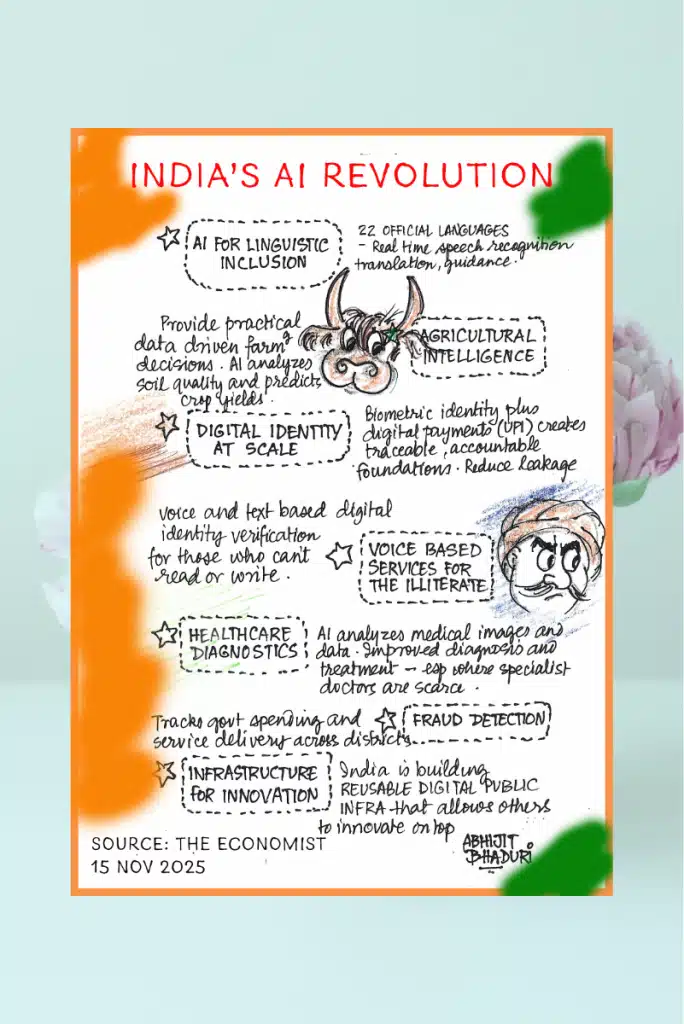
The Economist did a look ahead issue. I found it to be a collectors item. One essay by Nandan Nilekani in this issue of the magazine caught my attention. I had written about India will become the use case capital of the world for AI.
Here are seven use cases that serve as proof.
1. AI for Linguistic Inclusion India is using AI to bridge language barriers across its 22 official languages. Systems provide real-time speech recognition, translation, and local guidance in native languages, making government services accessible to citizens who don’t speak English or Hindi.
2. Agriculture Intelligence AI networks analyze soil quality, predict crop yields, and provide farmers with actionable recommendations – moving from theoretical advice to practical, data-driven farming decisions.
3. Digital Identity at Scale India’s biometric identity system combined with digital payments (UPI) has created a traceable, accountable foundation for delivering government benefits directly to citizens, reducing corruption and leakage.
4. Voice-Based Services for the Illiterate AI enables voice and text-based agricultural advice and digital identity verification for citizens who can’t read or write, dramatically expanding service accessibility.
5. Healthcare Diagnostics AI systems analyze medical images and data to improve diagnosis and treatment, particularly important where specialist doctors are scarce.
6. Fraud Detection and Accountability AI tools track government spending and service delivery across districts, collecting real-time data to identify inefficiencies and prevent corruption.
7. Infrastructure for Innovation Rather than just deploying AI solutions, India is building reusable digital public infrastructure (APIs, identity systems, payment rails) that allow others to innovate on top.
How Organizations Can Apply These Ideas Creatively
1. Break Down Your Own Language Barriers
Manufacturing Companies:
- Deploy AI translation for shop floor safety protocols and equipment manuals so a Polish machinist and a Vietnamese assembly worker can access critical information in real-time without waiting for formal translations.
- Create voice-enabled quality control systems where workers can report defects or check specifications hands-free while on the production line.
- Make technical training videos available in workers’ native languages so your Haitian maintenance technician and your Somali line worker can learn advanced manufacturing techniques at the same pace as native speakers.
Healthcare Organizations:
- Use AI translation for patient intake and medical histories so Filipino nurses, Indian doctors, and Spanish-speaking patients can communicate care plans without critical details getting lost.
- Build voice-enabled clinical documentation systems for nurses and physicians who are moving between patient rooms and procedures, capturing observations in their flow of work.
- Translate continuing education materials and protocol updates into staff native languages so your diverse clinical team—from Tagalog speakers to Arabic speakers—can stay current on best practices with equal comprehension.
Retail Chains:
- Deploy AI translation for daily huddles and corporate communications so your Mexican store manager and your Chinese district supervisor receive the same strategic context.
- Create voice-enabled inventory and POS systems for frontline staff who are constantly moving, helping customers, and restocking—allowing them to check stock levels or process returns without stopping their workflow.
- Make product knowledge training available in multiple languages so your Russian-speaking sales associate and your Korean-speaking visual merchandiser can deliver the same expert customer experience.
Technology Companies:
- Use AI translation for cross-functional team meetings and Slack conversations so your Brazilian engineer, your Ukrainian designer, and your Egyptian product manager can collaborate without one person always having to work in their second language.
- Build voice-enabled code review and documentation systems for developers who want to explain complex logic while pair programming or walking through architecture.
- Translate technical documentation and API guides into developers’ native languages so your global engineering team can contribute equally to design discussions and architectural decisions.
Professional Services Firms:
- Deploy AI translation for client communications and internal knowledge sharing so your German consultant and your Japanese analyst can both access the same institutional knowledge with full nuance.
- Create voice-enabled time tracking and project documentation systems for consultants who are in client meetings or traveling between sites.
- Make training materials and methodology guides available in multiple languages so your São Paulo office and your Seoul office can develop the same quality of client deliverables.
2. Democratize Expert Knowledge
Manufacturing Companies:
- Turn your master toolmaker’s 30 years of equipment troubleshooting into an AI diagnostic assistant that guides apprentices through complex machinery repairs step-by-step.
- Convert your quality assurance director’s defect pattern recognition into a visual AI tool that helps line inspectors catch problems before they become recalls.
- Create AI assistants that walk plant managers through environmental compliance checks and safety audits using your veteran HSE director’s systematic approach.
Healthcare Organizations:
- Turn your head of critical care’s triage decision-making into an AI coach that helps ER residents prioritize patients during surge conditions.
- Convert your infection control specialist’s outbreak investigation methods into diagnostic tools that guide any floor nurse through proper containment protocols.
- Create AI assistants that help billing staff navigate complex insurance authorization rules using your most experienced medical coder’s knowledge base.
Retail Chains:
- Turn your top luxury sales associate’s relationship-building techniques and product storytelling into an AI coach for new hires in all locations.
- Convert your visual merchandising director’s seasonal display strategies into a tool that guides any store manager through creating compelling presentations.
- Create AI assistants that help shift supervisors handle difficult customer situations using your customer service director’s de-escalation playbook.
Technology Companies:
- Turn your principal architect’s system design principles and scaling decisions into an AI mentor for mid-level engineers evaluating technical trade-offs.
- Convert your senior security engineer’s threat modeling approach into diagnostic tools that guide any developer through secure code reviews.
- Create AI assistants that walk product managers through prioritization frameworks using your VP of Product’s strategic decision-making process.
Professional Services Firms:
- Turn your senior partner’s client relationship management and deal structuring expertise into an AI coach for associate consultants preparing proposals.
- Convert your subject matter expert’s analytical frameworks into tools that guide junior analysts through complex problem decomposition.
- Create AI assistants that help any team member navigate conflict-of-interest checks and ethics considerations using your chief counsel’s decision trees.
3. Build Infrastructure, Not Just Solutions
Manufacturing Companies:
- Create a central production data API that quality, maintenance, supply chain, and finance teams can all query for real-time insights without building separate integrations.
- Build identity/authentication systems that work across your ERP, MES, quality management, and maintenance platforms so workers don’t juggle multiple logins.
- Develop shared AI models for equipment sensor data analysis, defect image recognition, and predictive maintenance that any plant can leverage without training from scratch.
Healthcare Organizations:
- Create a central patient data API that clinical, billing, scheduling, and care coordination teams can access with proper permissions instead of maintaining separate patient databases.
- Build identity/authentication systems that work across your EHR, lab systems, imaging platforms, and patient portals so clinicians have seamless access.
- Develop shared AI models for medical image analysis, clinical note processing, and readmission risk prediction that any department can use without building specialized capabilities.
Retail Chains:
- Create a central customer data API that e-commerce, in-store POS, loyalty programs, and marketing can all tap into for unified customer views.
- Build identity/authentication systems that work across your inventory management, scheduling, POS, and employee portals so staff have frictionless tool access.
- Develop shared AI models for demand forecasting, customer segmentation, and inventory optimization that any region or store format can deploy.
Technology Companies:
- Create a central user analytics API that product, engineering, customer success, and sales teams can query without each building their own instrumentation.
- Build identity/authentication systems that work across your internal tools, customer-facing products, and partner integrations with consistent security policies.
- Develop shared AI models for code analysis, log parsing, and anomaly detection that any engineering team can integrate into their workflows.
Professional Services Firms:
- Create a central project data API that delivery teams, finance, resource management, and business development can access for real-time project health.
- Build identity/authentication systems that work across your knowledge management, time tracking, CRM, and collaboration tools without credential sprawl.
- Develop shared AI models for document analysis, contract review, and research summarization that any practice area can customize for their specialty.
4. Use AI for Accountability and Transparency
Manufacturing Companies:
- Track production run costs against budgets and flag when material waste, overtime, or scrap rates spike above historical norms on specific lines or shifts.
- Monitor equipment uptime, cycle times, and first-pass yield across all facilities in real-time to identify which plants are falling behind on operational excellence.
- Analyze patterns in safety incidents and near-misses to identify systemic training gaps or process design flaws before OSHA comes calling.
Healthcare Organizations:
- Track departmental supply spending and flag when units are ordering significantly more of certain items than peer units with similar patient volumes.
- Monitor patient wait times, length of stay, and readmission rates across departments and locations in real-time to identify care delivery bottlenecks.
- Analyze patterns in patient complaints and safety reports to identify systemic communication failures or process breakdowns before they become sentinel events.
Retail Chains:
- Track store labor hours against sales and flag when scheduling practices are creating either chronic understaffing or excessive overtime costs.
- Monitor customer service metrics, basket size, and conversion rates across locations in real-time to identify which stores need operational coaching.
- Analyze patterns in employee turnover and exit interview themes to identify managers or locations with systemic culture problems before they damage your employer brand.
Technology Companies:
- Track project cloud infrastructure costs and flag when teams are running expensive resources longer than needed or choosing premium service tiers unnecessarily.
- Monitor service uptime, error rates, and response times across regions and customer segments in real-time to catch degrading experiences before customers churn.
- Analyze patterns in customer support tickets to identify product usability issues or documentation gaps causing systematic confusion.
Professional Services Firms:
- Track project budgets versus actuals and flag when scope creep, inefficient staffing, or rework is eroding margins on specific engagements.
- Monitor utilization rates, realization rates, and client satisfaction across practices and offices in real-time to identify teams struggling with delivery quality.
- Analyze patterns in client feedback and engagement extension rates to identify which service offerings or delivery approaches are creating the most value.
5. Design for Your “Last Mile” Users
Manufacturing Companies:
- Create voice-enabled quality inspection interfaces for assembly workers who need both hands free to manipulate parts and operate measurement tools.
- Build simple, visual production dashboards for plant managers who want to see today’s output, quality metrics, and schedule adherence without parsing complex reports.
- Design mobile-first maintenance request tools for technicians moving between machines on the factory floor without desktop computers nearby.
Healthcare Organizations:
- Create voice-enabled patient documentation interfaces for nurses who are drawing medications, starting IVs, or helping patients ambulate.
- Build simple, visual census dashboards for charge nurses who want to see bed availability, staffing ratios, and patient acuity at a glance during shift huddles.
- Design mobile-first care coordination tools for home health aides visiting patients in the community without laptop access.
Retail Chains:
- Create voice-enabled inventory lookup interfaces for sales associates helping customers on the floor who can’t step away to check a terminal.
- Build simple, visual sales performance dashboards for store managers who want to see today’s traffic, conversion, and average transaction without digging through reports.
- Design mobile-first scheduling tools for part-time workers managing their availability and shift swaps from their phones between college classes.
Technology Companies:
- Create voice-enabled code review tools for engineers who want to explain architectural decisions while whiteboarding or pair programming.
- Build simple, visual system health dashboards for executives who want to understand service uptime, customer growth, and infrastructure costs without engineering degrees.
- Design mobile-first on-call incident management tools for SREs responding to alerts while away from their desks or during off-hours.
Professional Services Firms:
- Create voice-enabled time entry interfaces for consultants who want to log hours while traveling between client sites or during their commute.
- Build simple, visual engagement health dashboards for partners who want to see utilization, billing, and client satisfaction without complex financial reports.
- Design mobile-first knowledge capture tools for subject matter experts who want to document insights from client meetings while ideas are fresh, before returning to the office.
6. Fraud Detection Beyond Finance
Manufacturing Companies:
- Identify unusual patterns in material requisitions or vendor payments—like the same supplier suddenly receiving much larger orders from one plant at premium prices.
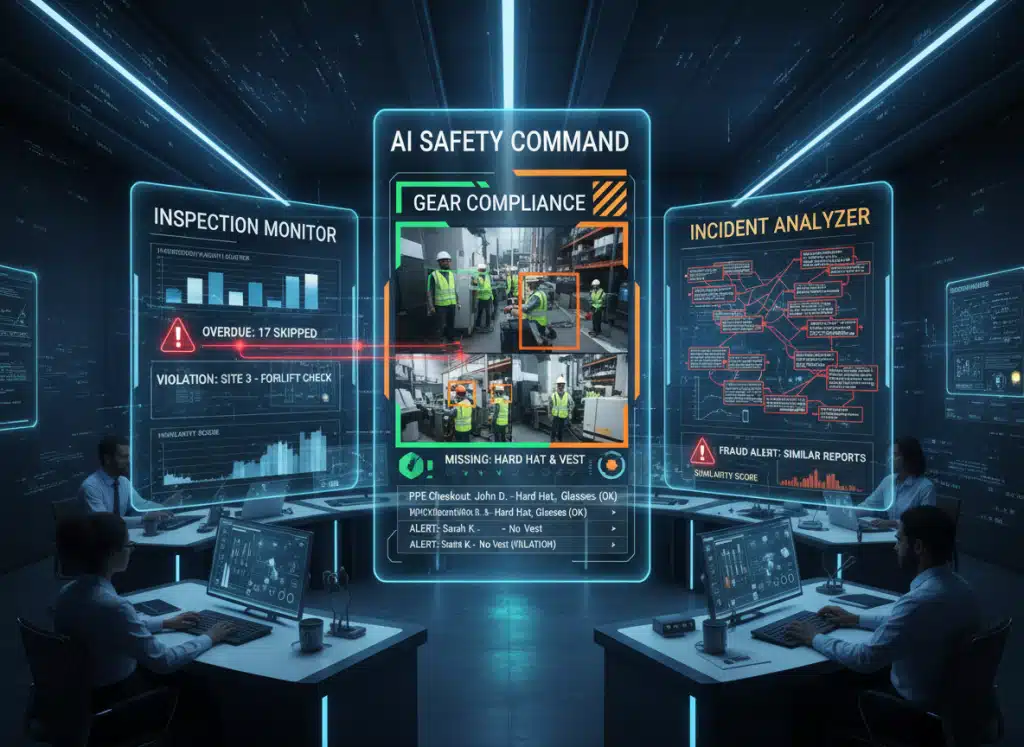
- Detect potential safety compliance violations by flagging when required inspections are skipped, safety gear isn’t checked out, or incident reports have suspicious similarities.
- Flag inconsistencies in production reporting where yield numbers, scrap rates, or cycle times don’t align with sensor data from the equipment itself.
Healthcare Organizations:
- Identify unusual patterns in supply usage or pharmaceutical ordering—like one unit consuming significantly more controlled substances than peer units with similar patient acuity.
- Detect potential billing compliance violations by flagging when documentation doesn’t support the level of service billed or when coding patterns differ dramatically from peers.
- Flag inconsistencies in clinical outcomes reporting where patient satisfaction scores, readmission data, or complication rates seem statistically improbable compared to case mix.
Retail Chains:
- Identify unusual patterns in returns or refunds—like certain employees processing significantly more high-value returns without receipts or manager overrides.
- Detect potential theft by flagging when inventory shrinkage is concentrated in specific departments, shifts, or locations with unusual patterns.
- Flag inconsistencies in labor reporting where employees are clocked in at times that don’t align with transaction logs or security system access records.
Technology Companies:
- Identify unusual patterns in cloud resource usage or vendor spending—like one team suddenly spinning up expensive GPU instances that run idle or paying for licenses never activated.
- Detect potential security violations by flagging when data access patterns are unusual, like employees downloading customer data shortly before departing the company.
- Flag inconsistencies in performance metrics where self-reported project milestones, velocity, or customer adoption numbers don’t match underlying system usage data.
Professional Services Firms:
- Identify unusual patterns in expense reports or travel bookings—like consultants claiming meals for more people than were staffed on the project or booking personal travel on client codes.
- Detect potential conflicts of interest by flagging when employees have relationships with vendors who are subsequently selected for engagements they influenced.
- Flag inconsistencies in time reporting where billable hours claimed don’t align with email activity, calendar availability, or deliverable output patterns.

7. Scale Through Standardization
Manufacturing Companies:
- Develop standard data formats for production orders, quality inspections, and maintenance work orders so any plant can share data without custom integration.
- Create reusable AI components—defect detection models, predictive maintenance algorithms, demand forecasting engines—with consistent APIs that any facility can plug into their existing systems.
- Build once, deploy everywhere: like a standard shop floor data collection system that works whether you’re running injection molding, metal stamping, or electronics assembly.
Healthcare Organizations:
- Develop standard data formats for patient demographics, lab results, and medication orders so systems can exchange information following FHIR standards without custom interfaces.
- Create reusable AI components—clinical note summarizers, radiology image analyzers, sepsis risk predictors—with consistent interfaces that any department can integrate into their workflows.
- Build once, deploy everywhere: like a standard patient intake system that works whether you’re running an emergency department, outpatient clinic, or ambulatory surgery center.
Retail Chains:
- Develop standard data formats for product information, customer profiles, and transaction data so every channel—stores, e-commerce, mobile app—shares a common language.
- Create reusable AI components—demand forecasting models, customer segmentation engines, product recommendation systems—with consistent APIs that any business unit can leverage.
- Build once, deploy everywhere: like a standard loyalty program infrastructure that works whether customers are shopping in urban flagship stores, suburban strip malls, or online.
Technology Companies:
- Develop standard data formats for user events, system logs, and API responses so every service can emit telemetry that flows into unified observability platforms.
- Create reusable AI components—log analyzers, anomaly detectors, code reviewers—with consistent interfaces that any engineering team can incorporate into their CI/CD pipelines.
- Build once, deploy everywhere: like a standard authentication and authorization framework that works whether you’re building customer-facing products, internal tools, or partner integrations.
Professional Services Firms:
- Develop standard data formats for project plans, client deliverables, and engagement economics so knowledge and resources can flow across practice areas and geographies.
- Create reusable AI components—contract analyzers, research summarizers, presentation builders—with consistent interfaces that any practice can customize for their methodology.
- Build once, deploy everywhere: like a standard engagement management system that works whether you’re delivering strategy consulting, technology implementation, or managed services.
AI is most powerful when it removes friction for people doing real work, not when it’s a flashy demonstration project. Would you agree? Leave your views in the comment.