Consistency builds strength, variety builds capability and knowing when to change routines prevents plateaus
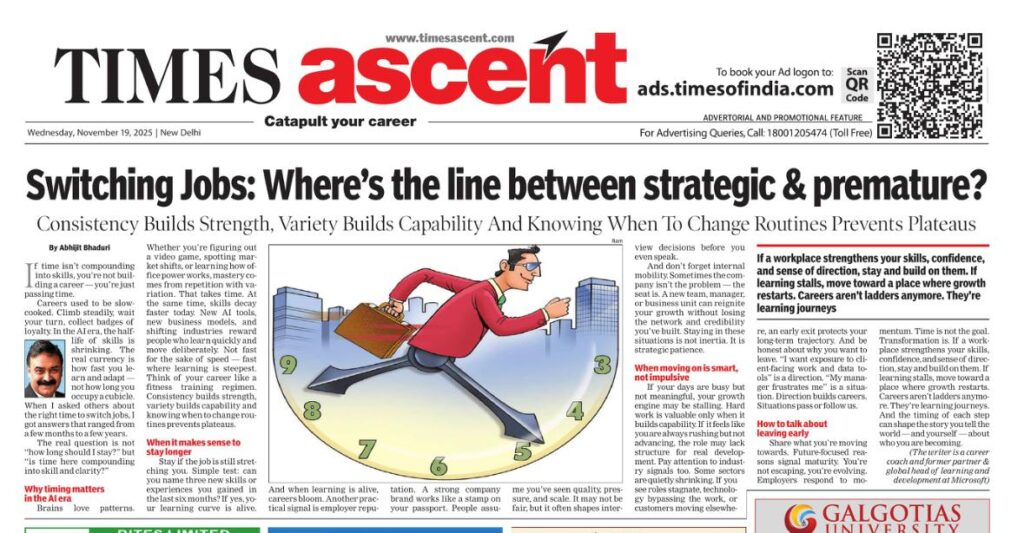
When Is It Too Early to Switch Jobs?
If time isn’t compounding into skills, you’re not building a career — you’re just passing time.
Careers used to be slow-cooked. Climb steadily, wait your turn, collect badges of loyalty. In the AI era, the half-life of skills is shrinking. The real currency is how fast you learn and adapt — not how long you occupy a cubicle. When I asked others about the right time to switch jobs, I got answers that ranged from a few months to a few years.
The real question is not “How long should I stay?” but “Is time here compounding into skill and clarity?”
Why Timing Matters in the AI Era
Brains love patterns. Whether you’re figuring out a video game, spotting market shifts, or learning how office power works, mastery comes from repetition with variation. That takes time.
At the same time, skills decay faster today. New AI tools, new business models, and shifting industries reward people who learn quickly and move deliberately. Not fast for the sake of speed — fast where learning is steepest.
Think of your career like fitness training. Consistency builds strength, variety builds capability and knowing when to change routines prevents plateaus.
When It Makes Sense to Stay Longer
Stay if the job is still stretching you. Simple test: can you name three new skills or experiences you gained in the last six months? If yes, your learning curve is alive. And when learning is alive, careers bloom.
Another practical signal is employer reputation. A strong company brand works like a stamp on your passport. People assume you’ve seen quality, pressure, scale. It may not be fair, but it often shapes interview decisions before you even speak.
And don’t forget internal mobility. Sometimes the company isn’t the problem — the seat is. A new team, manager, or business unit can reignite your growth without losing the network and credibility you’ve built.
Staying, in these situations, is not inertia. It is strategic patience.
When moving on is smart, not impulsive
If your days are busy but not meaningful, your growth engine may be stalling. Hard work is valuable only when it builds capability. If it feels like you are always rushing but not advancing, the role may lack structure for real development.
Pay attention to industry signals too. Some sectors are quietly shrinking. If you see roles stagnant, technology bypassing the work, or customers moving elsewhere, an early exit protects your long-term trajectory.
And be honest about why you want to leave. “I want exposure to client-facing work and data tools” is a direction. “My manager frustrates me” is a situation. Direction builds careers. Situations pass — or follow us.
How to Talk About Leaving Early
Share what you’re moving toward. Future-focused reasons signal maturity. You’re not escaping — you’re evolving. Employers respond to momentum.
“Time is not the goal. Transformation is”
If a workplace strengthens your skills, your confidence, and your sense of direction, stay and compound. If learning stalls, move toward a place where growth restarts.
Careers aren’t ladders anymore. They’re learning journeys. And the timing of each step can shape the story you tell the world — and yourself — about who you’re becoming.
—
A version of this was published by Times of India on Nov 18-2025