
 I know parents who roll up their eyes in horror when their kid wants to pursue a Liberal Arts degree in college. Does Liberal Arts fall short of that promise or is it the hottest degree for the future? My interest in the subject was triggered by Pulitzer prize winning journalist George Anders who wrote a post for Forbes in 2015 titled That ‘Useless’ Liberal Arts Degree Has Become Tech’s Hottest Ticket. He explains why Facebook and Uber believe that the war for talent has moved to nontechnical jobs, particularly sales and marketing. Abhijit Bhaduri: Is a Liberal Arts degree just not “practical” (proxy for employability) to pursue?
 George Anders: It depends on your time horizon. When workforce needs are predictable and companies optimize for the short run, that dynamic favors business or engineering graduates who can be plugged into productive jobs right away. In such situations, non-practical majors may be seen as “useless.” Why take a year to train an anthropology major when U.S. universities’ output of ready-for-action marketing majors, accounting majors, etc. is soaring? These days, however, growth opportunities and business models are in flux. As a result, there’s greater need for highly agile people who can move from specialty to specialty as needed, rather than single-subject experts who can’t be replanted. Liberal-arts training develops this mobility. In my forthcoming book, “You Can Do Anything,” I will focus on ways to put this dynamic to use in building your own career or running your own business.AB: What does a degree in liberal arts teach you that is valuable to software companies? GA: I’ll offer you three common payoffs, focused mostly on areas such as sales, marketing and project management.
-
-
-
-
-
-
- Dealing with ambiguity
-
-
-
-
-
Liberal arts majors (generally) spend more time working with murky and fragmentary data. They are quite comfortable coming up with ways to proceed amid ambiguity.
-
-
-
-
-
-
- Emotional intelligence
-
-
-
-
-
Study a lot of novels, and you’ll be attuned to different people’s motivations — including some people whose life values are highly at variance with your own. Study a lot of history, and you’ll have a sense of how coalitions form and break up. This can be quite valuable in negotiating with partners, figuring out what’s keeping the reluctant customer from buying more, etc.
-
-
-
-
-
-
- Persuasive speaking
-
-
-
-
-
In the humanities and social sciences, students have to debate and convince others about their point of view unlike STEM fields, where students generally don’t have to talk as much because there is one right answer, logically speaking. In business, the thorniest challenges come when it isn’t clear that there is a right answer. In such situations, companies need flexible thinkers who can work through a series of trade-offs and uncertainties. Just as important, they need bold communicators who can champion “the best idea for now,” while still doing so in a way that makes it possible to regroup later without too much shame. AB: Is the liberal arts major valuable to companies beyond software? GA:Yes. There are a surprising number of philosophy majors who do extremely well in finance/investing. There’s something about the discipline of forming belief systems, critiquing them, etc. that can translate into a great knack for sorting through market chaos and finding opportunities that others don’t see. AB: Should L&D teams be encouraging liberal arts appreciation among business leaders? GA: Leaders often are the outside face of the company, dealing with regulators, key suppliers, unions, the general public, etc. Being able to understand multiple perspectives — even if they are being expressed in jarring ways — can have a huge impact on a company’s reputation and its ability to sort out turmoil without making lasting enemies. Ditto for the ability to communicate in a way that’s mindful of audiences’ emotional state as well as logical considerations. 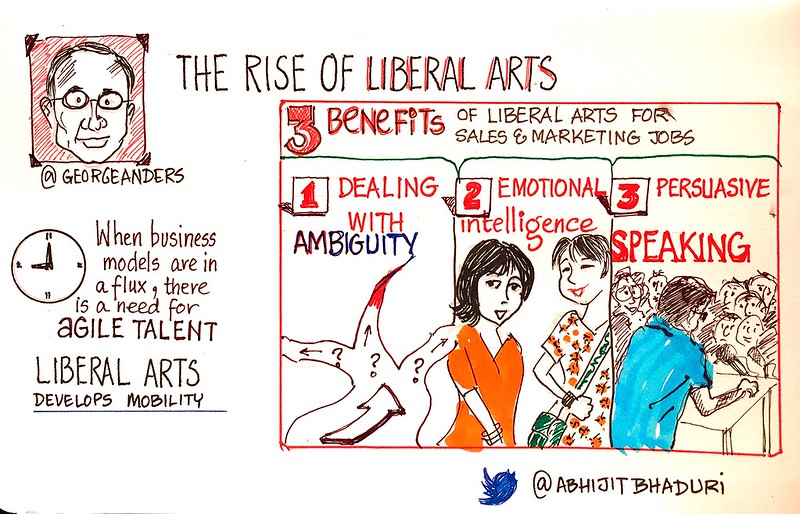 ——–I had interviewed George Anders for my blog <read this fascinating interview>The Digital Tsunami: Jobs———–Join me on Twitter @AbhijitBhaduriA slightly modified version appeared in HR Katha <click here>