
Should you choose and internal candidate or an external candidate? Focus less on finding the perfect candidate for tomorrow and more on developing leaders who can figure things out as circumstances evolve.

Imagine sitting on a dock with a fishing rod, hoping to catch dinner. You’re thinking about that one perfect fish. But beneath the surface, an entire ecosystem thrives in different directions, at different depths, each fish with unique colors and capabilities. You can’t see them. You don’t know which ones are ready to surface. And by the time you realize you need to catch one, it’s often too late.
This is CEO succession planning. And I’ve watched brilliant companies fumble it repeatedly.
Here’s what nobody tells you: when a CEO changes, everything changes. Not just the person in the corner office, but the entire molecular structure of decision-making, risk appetite, strategic priorities, and cultural norms. It’s organizational open-heart surgery performed while the patient runs a marathon. And we wonder why so many don’t survive the operation.
When Succession Planning Becomes Succession Panic
I’ve spent years studying why leadership transitions fail, from my time as Chief Learning Officer at Wipro to advising boards across industries. The pattern is depressingly consistent. Companies treat succession as an event, a crisis to manage, when it should be a continuous process of organizational renewal.
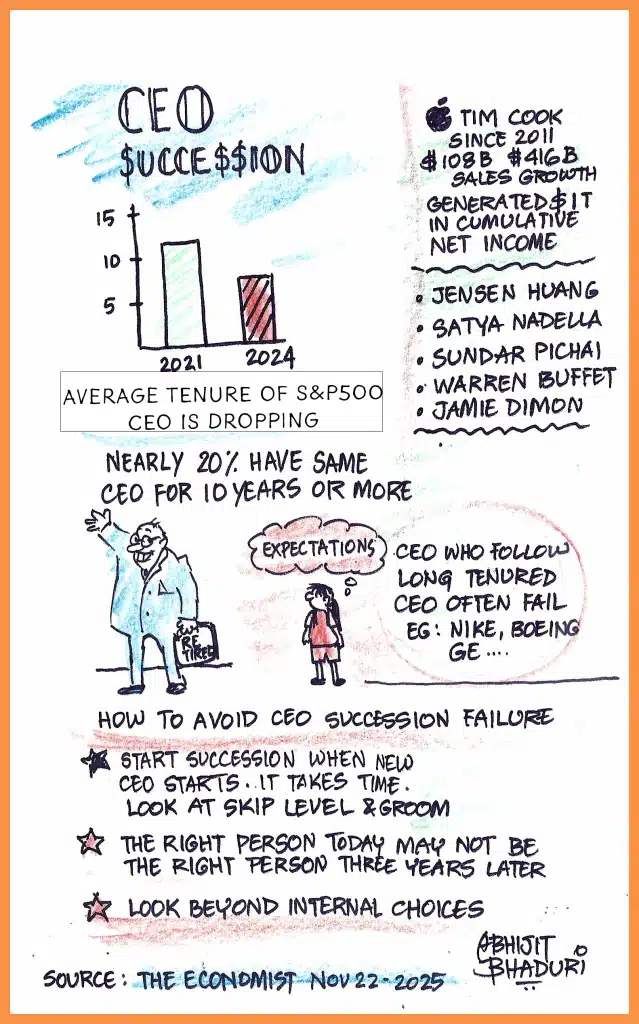
The data backs this up. CEO tenures at S&P 500 companies have dropped dramatically. Nearly 20% still have the same leader for a decade or more, but those who follow these legends often crash spectacularly.
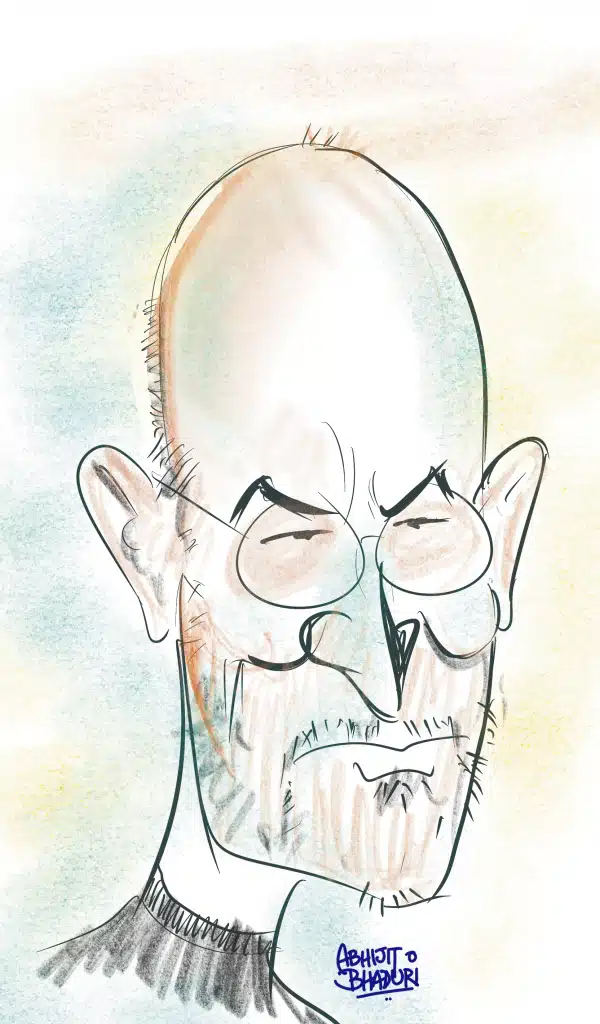
Tim Cook at Apple stands as the rare exception, generating over $1 trillion in cumulative net income since taking over from Steve Jobs.
But for every Tim Cook, there’s a string of failures at Nike, Boeing, and GE, where it took 17 years to find someone good enough to lead GE. Steve Jobs was a larger than life figure especially after he launched the iPhone.
I know of so many CEOs of startups who copied Steve Jobs and wore black turtle necks and blue jeans.
Copying his dress sense was easier than being as innovative as Jobs.
Indian companies have their own painful lessons. When Cyrus Mistry was abruptly removed from Tata Sons in 2016, it triggered years of legal battles and uncertainty across the vast Tata empire. More recently, several tech companies cycled through CEOs with concerning frequency, each transition bringing questions about strategic direction and cultural continuity. These weren’t just leadership changes. They were existential tremors that affected thousands of employees, billions in market value, and decades of institutional knowledge.
But here’s where it gets really complicated: the challenges differ dramatically between internal and external hires, yet both face impossible expectations.
Internal candidate or external? Who is better?
Internal successors carry organizational memory, which sounds like an advantage until you realize it’s also an anchor. They know where all the bodies are buried because they helped bury some of them. Every decision they made climbing the ladder now limits their freedom to pivot. Relationships that helped them rise can become constraints when they need to make unpopular choices.
Internal successors carry organizational memory, which sounds like an advantage until you realize it’s also an anchor
They also face the authenticity paradox. Stay too consistent with the previous CEO and you’re seen as lacking vision. Change too much and you’re accused of betraying the culture. It’s like being asked to renovate your childhood home while your family still lives there, and everyone has strong opinions about which walls can’t be moved.
External hires have the opposite problem. They bring fresh perspective but lack the cultural decoder ring. They don’t know which initiatives failed three times before, why marketing and engineering hate each other, or which customers threaten to leave annually but never do. Their bold new strategies often ignore crucial institutional knowledge that wasn’t documented anywhere because everyone just knew it.
External hires lack the cultural memory needed to navigate landmines of resistance
Yet both internal and external candidates face the same fundamental challenge: they’re being selected for a future nobody can accurately predict. In a world where AI might transform your business model, geopolitics might disrupt your supply chain, and a pandemic might force everyone to work remotely, how do you choose someone for circumstances that don’t exist yet?
Five ideas to get succession right
The good news is that companies can dramatically improve outcomes with approaches that are challenging but achievable. Here’s what actually works:
Build Your Pipeline Five Years Early, Not Five Months Late
Start succession planning when your current CEO is thriving, not departing. Identify ten potential successors across the organization and deliberately craft experiences that stretch them. Send them to run unfamiliar markets. Give them P&L responsibility where failure won’t sink the company but success builds real capability. Samsung does this brilliantly, rotating high-potential leaders through challenging international assignments years before they might need to step up.
Cast a Wider Net Than Feels Comfortable
The best successor might come from an adjacent industry with transferable skills rather than a carbon copy of your current leader. Look for people who’ve solved similar strategic challenges in different contexts. A retail executive might thrive in consumer banking. A technology leader from enterprise software might excel at industrial digitalization. The key is strategic pattern recognition, not domain expertise that’s probably becoming obsolete anyway.
Create a Structured Transition with Built-In Support
Every new CEO, internal or external, needs a transition coach for their first 18 months. This independent advisor helps decode cultural dynamics, identifies blind spots, and provides the honest feedback nobody else will give. Companies spend millions selecting leaders but almost nothing helping them succeed. That’s backwards. Consider a formal overlap period where successor and incumbent work together for six to twelve months, allowing real-time knowledge transfer about board dynamics, key relationships, and cultural nuances.
Make Succession a Board Discipline, Not a Board Discussion
Succession can’t be an occasional agenda item. Dedicate time at every board meeting to review the pipeline, assess development progress, and update plans based on evolving priorities. Board members should personally know the top ten candidates through informal dinners, site visits, and strategy sessions. This direct exposure prevents over-dependence on the current CEO’s assessment, which may be clouded by personal loyalty or political considerations.
Prepare for Multiple Futures Instead of Predicting One
Since you can’t know what the future holds, develop leaders who can adapt to different scenarios. Create experiences that build versatility, crisis management, digital fluency, stakeholder navigation, and authentic communication. Focus less on finding the perfect candidate for tomorrow and more on developing leaders who can figure things out as circumstances evolve. Resilience beats precision when the future is fundamentally uncertain.
The fishing metaphor holds a final lesson: the talent is already swimming beneath the surface in your organization.
Your job isn’t to wish for different fish. It’s to look more carefully, cast more widely, and create conditions where diverse leaders can surface and thrive before you desperately need them to.
Read this: How office politics corrupts the search for high potential employees