
Japan is already there: adult diaper sales exceed baby diapers. More spending on senior living facilities than Montessori schools. More pet food than baby formula. Families used to be factories of belonging. No longer so.

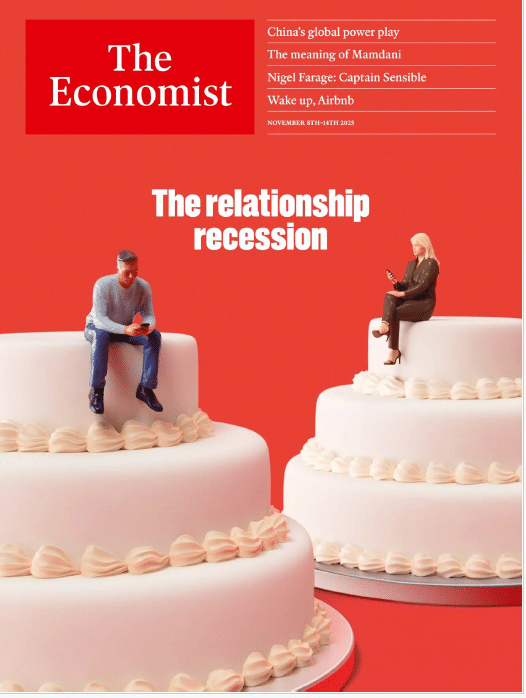
The world has 100 million more single people today than if coupling rates had stayed at 2017 levels. In America, 50% of men and 41% of women aged 25-54 now live without a spouse or partner—double the rate from five decades ago. In China, there will be 30-50 million “excess men” by 2027. South Korea, Japan, India, and across Europe, the pattern repeats: people aren’t pairing up. Read more in the latest issue of The Economist
This isn’t a dating crisis. It’s a structural shift that’s quietly redesigning our entire economy, and most business leaders are completely unprepared for what’s coming.
Peter McGraw, a behavioral economy prefers to use the term The Solo Economy which is a $150 billion holiday in China.
Why This Is Happening: The Perfect Storm
The Demographics Don’t Lie Start with raw numbers. India has 20 million surplus boys from sex-selective abortions. China’s ratio hit 119 men per 100 women. But the West has the opposite problem—college enrollment is now 60% female, 40% male. In America and Europe, educated women outnumber educated men at marriageable ages, creating a different kind of mismatch.
The Economic Reality Check From an anthropological lens, marriage has historically been an economic necessity. You couldn’t afford housing alone. You needed two incomes to raise kids. You pooled risk. But now? High-earning individuals—especially women—can self-insure. The economic imperative has weakened just as the cultural one has.
The Psychology Shift Here’s where it gets interesting: 62% of single American women say they don’t want to date, versus only 37% of single men. The COVID-19 pandemic alone created 13.7 million additional singles. Psychologists observe that people’s “standards” aren’t just rising—they’re fundamentally changing what partnership means. From a behavioral economics view, we’ve gone from “satisficing” (good enough) to endless optimization, with dating apps creating the illusion of infinite choice.
When women want someone who is more than six feet tall, then 85% of the population is ruled out. In choosing a romantic partner, the list includes
- Shares religious beliefs, food preferences and political views
- Loves the same sports or hobbies or travel choices
- Educated more than the advertiser unless the person earns more
- Does not/ does smoke or drink or recreational drugs
- Kind, generous, forgiving, adaptable and has a sense of humor
- Loves/ is not allergic to my pets etc etc etc etc

The Technology Trap Social media and dating apps promised connection but delivered comparison. Young people now spend twice as much time gaming and streaming as they did in 2011. Face-to-face socializing has plummeted. Marketers call this “para-social relationships”—people developing one-sided bonds with influencers, streamers, and yes, AI. Seven percent of young singles now say they’d consider an AI romantic partner.
The Ripple Effects Are Everywhere
The Housing Market Is Reconfiguring Two-bedroom apartments were designed for couples. Three-bedrooms for families. But singles need space too—for home offices, hobbies, guests. Real estate developers are finally catching on: micro-studios were the wrong bet. The future is one-bedroom “flex” units and co-living spaces with private bedrooms and shared amenities.
In South Korea and Japan, entire neighborhoods of “one-person households” are emerging. In the U.S., the surge in single living is driving demand for urban housing even as family-oriented suburbs stagnate. If you’re in commercial real estate, watch this: single-person households spend 30% more per capita on housing than coupled ones.
Cars: From Family Haulers to Solo Pods The auto industry built its fortune on family sedans and SUVs. But singles don’t need seven seats. They want different things: luxury interiors (your car is your sanctuary), advanced safety features (no co-pilot), and increasingly, they don’t want to own at all. The subscription model? Partly driven by single urbanites who want flexibility over commitment—even with vehicles.
The Pension Time Bomb Here’s the nightmare scenario for actuaries: pension systems were designed assuming people would couple up, have kids, and those kids would support the tax base. But singles have fewer children (obviously) and save differently. They’re more likely to have career gaps, earn less over a lifetime (no “marriage premium”), and live alone in old age—requiring more social services, not fewer.
Japan is already there: adult diaper sales exceed baby diapers. More spending on senior living facilities than Montessori schools. More pet food than baby formula. This is coming to America and Europe within 5-7 years.
Office Buildings Are Obsolete (Partly Because of This) Everyone blames remote work for empty offices. But there’s another force: single people don’t need to “get out of the house” the way families do. They actually like their apartments. They’ve invested in making them comfortable. The psychological need for a “third place” (not home, not work) is higher than ever, but traditional offices aren’t it.
Smart companies are converting would-be office space into social clubs, hobby workshops, and community centers. The loneliness economy is real, and it’s worth billions.
The Benefits Revolution Corporate benefits packages are still designed for 1950s families: spouse healthcare, parental leave, “family” plans. But modern benefits should include: egg freezing and fertility support (for women delaying partnership), mental health stipends (loneliness is the new smoking), pet insurance (65% of singles own pets), sabbaticals (singles are more mobile), housing assistance (the new courtship currency).
Companies offering “single-friendly” benefits have 20-30% better retention among under-40 talent in recent studies. Yet most HR departments haven’t caught up.

Seven percent of young singles now say they’d consider an AI romantic partner.
Marketing’s Demographic Blindspot Advertisers still default to couples and families. But singles control trillions in spending—and they spend differently. They’re more likely to splurge on experiences (no one to judge), invest in hobbies (time abundance), buy premium versions (no one to split with), and prioritize convenience (time scarcity without a partner).
The pet industry has exploded partly because of this: dogs are surrogates for partnership and family. Premium pet food, pet insurance, doggy daycare—these are relationship-substitute markets hiding in plain sight.
The Talent Pool Inversion Anthropologically, marriage used to be about survival. Now it’s about optimization. The result? The most educated, capable, high-earning people are least likely to partner up. In China, college-educated urban women face stigma for being “too successful to marry.” In the West, men without college degrees struggle to attract partners who out-earn them.
For employers, this means your highest performers are disproportionately single and facing unique stressors. They’re also your most mobile employees—no spouse to coordinate with, no kids’ schools to consider. Retention requires different strategies.
Preparing for 2026-2028
For Real Estate & Infrastructure:
- Redesign residential units for “flex living” (one person who sometimes hosts)
- Invest in “third places”: not offices, not homes, but community spaces
- Senior housing will outpace family housing in most developed markets
For Employers:
- Audit your benefits by 2026: Are they single-friendly?
- Create community infrastructure at work (it’s existential now, not nice-to-have)
- Rethink geographic requirements: singles are mobile, use it strategically
- Mental health support isn’t optional anymore—budget for it
For Marketers & Product Developers:
- Singles are your growth segment: study their spending patterns
- “Table for one” should feel premium, not sad
- Convenience, experience, and self-care categories will boom
- The “loneliness economy” (pets, AI companions, social clubs) is a trillion-dollar opportunity
For Policy Makers:
- Pension systems need fundamental redesign by 2030 or they’ll collapse
- Immigration policy should account for demographic imbalances
- Urban planning must shift: fewer playgrounds, more dog parks
- Tax structures built around married couples are increasingly regressive
For Investors: Hot sectors for 2026-2028:
- Senior living facilities (not nursing homes—luxury “third act” communities)
- Pet industry (premium services, not just food)
- Mental health tech (especially for men)
- Social infrastructure (co-living, social clubs, hobby communities)
- Fertility tech (egg freezing, IVF)
- AI companionship (yes, really)
Read more: The Futures Platform
The Bottom Line
This isn’t about morality or “fixing” a problem. The relationship recession is a structural economic shift as significant as women entering the workforce or the rise of dual-income households.
By 2028, the effects will be impossible to ignore:
- Urban housing markets will look fundamentally different
- Benefit packages will have evolved or companies will struggle to retain talent
- Entire industries (senior living, pets, mental health, community spaces) will have exploded
- Pension systems will be in crisis mode in most developed nations
Think of it as a design challenge
The 100 million person gap isn’t a dating problem. It’s a design challenge for civilization itself—and the companies, investors, and leaders who understand this earliest will build the next decade’s winners.
What are you seeing in your industry? How is the rise of singlehood changing your business? Let’s discuss in the comments.
#FutureOfWork #Demographics #BusinessStrategy #RealEstate #HRTrends #Marketing #Innovation