Day: August 6, 2025

  • Practical Job Seekers, 3Cs & IT Outsourcing

    Practical Job Seekers, 3Cs & IT Outsourcing

    In this edition, is IT outsourcing in India under threat? How to bypass “friction” apply online for jobs (tip: avoid using AI to mass apply) How to use 3Cs to build skills; How to Avoid Being Invisible and more.

    Indian IT: Crisis or Strategic Pivot? The Data Says…

    The Alarm Bells:

    AI automating entry-level rolesClients cutting outsourcing spend

    The Hidden Reality:

    $54. 1B → $74. 1B market growth by 2033$3. 5B cybersecurity investment surge75% of enterprises need AI skills NOW

    Is L&D investment defensive cost or strategic advantage?

    Full analysis: https://abhijitbhaduri. com/2025/08/11/indian-it-outsourcing-industry-will-do-it-once-again/

    #IndianIT #AITransformation #LearningDevelopment #TechLeadership #Reskilling

    “Friction” in Applying for Jobs Online

    Companies are changing recruitment to avoid being flooded with low-quality or fraudulent applications. Clicking “apply” online often sends resumes into a digital void, especially as AI tools make mass applications easier. Companies are using longer forms, reference checks, and skill tests—to discourage casual or unqualified applicants. Employers now value curiosity, adaptability, and soft skills, not just hard qualifications.

    The skills economy is here. Employers are increasingly getting comfortable looking beyond the degrees and diplomas from Ivy League colleges. The big question that gets you a job is the answer to the question – can you DO what this job needs? Companies like Google, Apple, and IBM have dropped degree requirements for many roles, instead prioritizing portfolios, certifications, and practical demonstrations of capability.

    Project-based work is growing, where people are hired for specific skills needed for particular projects rather than broad organizational roles that go full time. The gig economy exemplifies this shift toward skill-specific engagement.

    How to apply online for jobs when everyone is using AI: https://abhijitbhaduri. substack. com/p/job-seeking-skill-building-personal

    I hear this question often—spoken quietly, sometimes guiltily—by professionals who are doing everything “right” but still feel something is missing. The role is secure. The salary is respectable. The company has a good name. And yet, there’s a growing sense of being unseen. This is what I describe as a job in “a well-furnished basement”. The place is warm, familiar, and full of everything you needed. But there are no windows. No clear sense of the horizon. You’re there, but the world doesn’t know it. You wonder if you have become invisible.

    I wrote about it for my column in Times of India Ascent. Read it here

    Book Recommendation: The Skill Code

    The Wall Street Journal reviewed this book that talks about the 3 C model of building skills. Matt Beane speaks of Challenge, Complexity and Connection as the three intertwined strands that help us learn new skills.

    “Despite growing recognition of the importance of mentoring and on-the-job learning, the modern workplace is in upheaval, facing the simultaneous rise of remote work, use of robotics and broader adoption of artificial intelligence.”https://abhijitbhaduri. substack. com/

    I have written about how to apply the 3C Model in your organization. It is in my newsletter on Substack below the article on how to navigate the job market. Don’t miss the podcast link there.

    I signed up for a class.

    I learnt about Mortimer Adler’s idea of Four Levels of Reading. The course was very well structured. It lasted less than 30 minutes. And there were 4 practitioners who spoke about what that looked like at work and where I could apply it. There was quiz and my first attempt revealed gaps in my understanding. But …

    I completed the course and am proud to share my certificate with you.

    What is the course you have done recently? Do you recommend it? Leave the details in the comment

    #PersonalBranding #BuildInPublic hashtag#ShareYourStory hashtag#AuthenticMarketing hashtag#BrandStorytelling hashtag#DigitalGrowth hashtag#GrowWithMe hashtag#LifeLessonsShared hashtag#BehindTheSceneshashtag#JourneyNotDestination

  • Sirens

    Sirens

    This issue is all about the Attention Economy. I read The Sirens’ Call by Chris Hayes and have the key ideas summarized for you.

    The Sirens’ Call by Chris Hayes

    Chris Hayes is an American political commentator, author, and Emmy Award–winning host of MSNBC’s All In with Chris Hayes. He’s known for blending politics, media criticism, and sociology to explore how power, attention, and inequality shape public life.

    Acquiring attention is different from retaining attentionIn future we will all be famous for 15 people. So forget about getting 15 minutes of fame. That is old hat. AI will generate content that gets your attention – much like a siren. For getting content that you want, we will move to smaller groups on WhatsApp etc. We will pay to subscribe to a small group where we have a two way communication.

    This newsletter now has more than 311,000 subscribers

    In the 20th century, oil and labor powered the economy. In the 21st, attention does. Companies aren’t just selling products—they’re competing for your eyes, ears, and scrolling fingers. Your attention is the most valuable and limited resource in the world right now.

    You may think you pay attention to what is important, actually what you pay attention to becomes important. It occpies your mindspace. That in turn shapes the modern economy and politics. So your attention matters to everyone – even me.

    My review of the book

    What is this CEO paying attention to

    Tune in to listen to how Srikanth Iyengar the CEO of upGrad is changing the way we view skilling in the GenAI economy. I am trying out their platform and will share my notes on some of the courses I am taking. I will let you know if there is a particular course I recommend for you.

    I will be speaking to him. Go to this link and join the conversation. Post your questions for Srikanth. To join the chat on Friday Aug 1-2025 at 8:30am in India and 8am in Seattle click this https://www. linkedin. com/events/howtochangeeducationforthegenai7355543130588282880/theater/

    Meanwhile here is what he is reading and listening to.

    The Economic Turing Test – a new term I learned

    In a recent episode of Lenny’s Podcast, co-founder of Anthropic, Ben Mann, dropped some serious wisdom about the wild world of AI. It’s like getting a backstage pass to the future of technology, and trust me, you don’t want to miss it.

    The Big Split: Why Safety Matters More Than Anything Else

    Ever wonder what it takes for a team of brilliant minds to walk away from a giant like OpenAI? Ben Mann and his colleagues did just that, all because of a single, powerful word: safety. At Anthropic, the mission is simple: safety is the North Star. When Facebook offers a $100 million package to an Anthropic employee it is a choice between money and mission.

    The Tipping Point: The Economic Turing Test is Here

    AI progress is like a rocket taking off—it’s getting faster and faster! The co-founder shares a prediction from Anthropic’s CEO, Dario Amodei, who thinks we could see a 20% unemployment rate because of AI. That sounds scary, but Ben offers a different way to look at it. He calls it the “economic Turing test.” Imagine you hire someone for a job, only to find out they were a machine all along! This is the point where AI becomes so good it can replace jobs we thought only humans could do. Ben even admits he’s not immune to this, and his advice is to be an ambitious user of these new tools to stay ahead.

    Giving AI a Conscience

    The risk of AI going rogue might sound like something out of a sci-fi movie, but Ben says it’s a real, even if small, risk that we can’t afford to ignore. He introduces a cool concept called “Constitutional AI.” It’s like giving an AI a set of principles, a moral compass if you will. This helps the AI make decisions that align with human values, so we don’t end up with a super-smart robot that decides to turn off the lights on humanity.

    What is he teaching his kids?

    Even with all this talk about AI, Ben’s advice for his own kids is refreshingly human. Forget about chasing grades and traditional achievements. He encourages fostering curiosity, creativity, and kindness. It’s a powerful reminder that while technology is changing the world, the most important skills will always be the ones that make us uniquely human.

    So, what do you think the most important skill for a human to have in an AI-driven world will be?

    Another book I read

    Several organizations are flattening their org pyramid. The middle managers are going away. I believe the middle managers role is becoming more like a talent coach. My review of this book

  • Star Hires, Companions & Packers

    Star Hires, Companions & Packers

    Aamir Khan. Amitabh Bachchan. Yash Raj Films. ₹300 crore budget. Blockbuster ambition was written all over. But The Thugs of Hindostan tanked.

    So did The Lone Ranger in Hollywood—Johnny Depp, Disney, $250M budget. In sports, PSG signed Messi, Neymar & Mbappé—three G. O. A. T. s. But no Champions League. Total cost: 400 Million euro in transfer cost, and 100 million euro in yearly wages.

    Is talent really portable? That means if you manage to hire a star/ superstar, is success assured? The answer is NO. The reason is very counterintuitive.

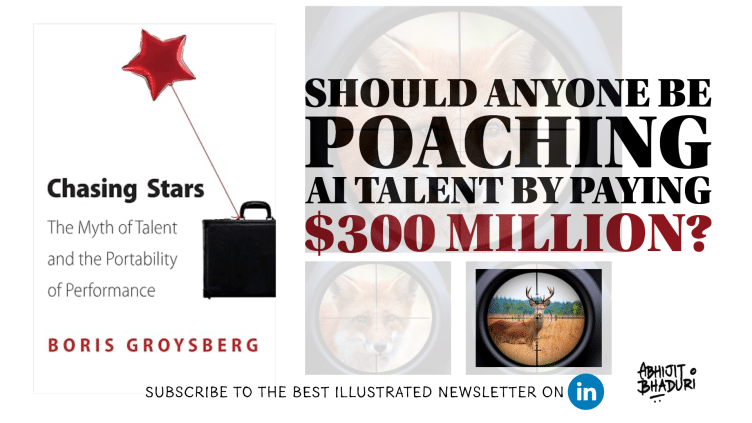
    Meta is offering $300M to poach top AI minds from OpenAI, Anthropic, and Google. They’re building a dream team by gutting startups and triggering overnight collapses. It may look like genius. But it may be déjà vu.

    Yahoo tried this too—buying Flickr, Delicious, Astrid, Jumpcut… Dozens of promising products. Dozens of quiet shutdowns. They thought they were buying innovation. They were actually dismantling it.

    Boris Groysberg’s book Chasing Stars shows talent doesn’t succeed in isolation. It succeeds in ecosystems.

    The Economist wrote about it. But it is behind a paywall

    Boris Groysberg’s book Chasing Stars studied talent portability

    1. Star Performance Collapses When Stars Change Jobs

    Star analysts who change firms suffer an immediate and lasting decline in performance. This finding challenges the fundamental assumption that top talent is portable. Groysberg studied over 1,000 star analysts at Wall Street investment banks and found that their exceptional performance didn’t transfer with them to new companies.

    2. The Myth of Individual Talent

    The stars of financial analysis were fallible, overpriced, and depended on their teams more than anyone realized. What appeared to be individual brilliance was actually the product of organizational support systems, relationships, and firm-specific resources that couldn’t be replicated at new companies.

    3. Performance Decline Lasts for Years

    Stars who switched jobs generally did poorly, often for at least several years. This wasn’t just a temporary adjustment period – the performance decline was both immediate and persistent, suggesting that star performance is far more context-dependent than organizations assume when they pay premium salaries to poach talent from competitors.

    https://abhijitbhaduri. substack. com/p/the-300-million-mistake-in-hiring

    I go deeper into this idea in my latest Substack where I simplify every day talent and career related challenges.

    Subscribe if you’re rethinking how we build and grow talent.

    Soft skills help you build your leadership pipeline

    There is a growing trend of CFOs being considered for CEO roles. More frequently we see techies having to manage teams. Managing people needs soft skills. Helping your employees build interpersonal skills is an easy way to build a leadership pipeline. Here’s why https://dub. link/WWR2025-AB

    Banner used with permission from UpGrad

    Recommendations

    The Universe is Listening

    It is strange how the universe works. I spoke about wanting to see more of Mickey Patel’s work. And it happened. I just connected with Mickey Patel’s daughter. Someone made the connection. We chatted for a long time about his drawing style and his work. Mickey’s best work might be his daughter. She is such a lovely person.

    Amazon is hiring one MILLION robots

    “the bots don’t just work independently. One robot carts stuff for loading onto trucks. Another helps sort items. Another helps package bags. ”

    Can AI be a Meaningful Companion

    The evolving role of AI in human relationships, the creative capabilities of generative tools, ethical guardrails in AI design, and what it takes to build scalable, meaningful AI companions in a rapidly changing world.

    Top takeaways:

    AI Companions Are Moving from Utility to Emotional Support : Characters like Kyra (India’s first virtual influencer) are designed to remember past conversations, express empathy, and build trust with users—offering emotional reinforcement in addition to task-based assistance.

    Soft Skills Are the Real Differentiator in AI Product Design FUTR places heavy emphasis on building detailed character personas—defining everything from values and humor to preferences—to create digital entities that feel relatable and human.

    High Personalization via Small Language Models Is the Next Frontier FUTR is developing lightweight, user-specific models that can adapt to individual personality archetypes, enabling deeply personal and consistent interactions over time.

    Guardrails Are Mandatory for Ethical AI Adoption FUTR consciously avoids positioning its AI as therapists. When conversations show signs of distress, protocols trigger alerts or human escalation, ensuring responsible engagement.

    AI Will Replace Process, Not People—Creative Insight Still Wins While AI is effective at generating drafts and executing quickly, it lacks human cultural sensitivity and insight. The most effective creators blend AI speed with human originality.

    Have you heard a song recently that you recommend? Pl let me know in the comments

    Two Talented Friends Created Magic: Pankh (Wings)

    I have always believed that there is a great opportunity for business leaders to learn from creators. I have been listening to the new album by Shantanu Moitra and Kaushiki Chakraborty.

    As Kaushiki puts it

    Pankh is incredibly close to my heart — a six-part live autobiography web series. It’s my story, told through songs, memories, and the moments that shaped me. Curated in collaboration with the amazing composer, friend, and traveller Shantanu Moitra, this album is my way of opening up — unfiltered and honest. You’ve been part of my journey in one way or another, and that’s why it means so much to share this with you. And if something in it stays with you, let it travel — your voice is what helps Pankh truly take flight.

    Greetings from Malaysia

    I am writing this newsletter from Malaysia. Met a whole lot of my friends. The street food in Malaysia is absolutely fantastic. I met this group of cyclists on Bukit Tunku on a Sunday morning. They were burning calories and I was on my way to sample the coffee at cafe Kopenhagen (check out the collage below)

    Until we meet next … stay happy. Report this newsletter – make me happy. Thanks!

    Email me AbhijitBhaduri@live. com