When the flight took off on 12 June 2025, there were 242 passengers and crew on the Boeing 787-8 Dreamliner. There were 169 Indian nationals, 53 Britons, seven Portuguese nationals and one Canadian on the Air India flight bound for London from Ahmedabad. Everyone died EXCEPT the passenger in seat 11-A. The plane crashed into a hostel near the airport killing another 29 people, who were not even in the plane.
Fluke makes you pause and wonder
1. Does everything happen for a reason, or does stuff… just happen?
2. Why do tiny changes sometimes produce huge impacts?
3. Why do we cling to a storybook version of reality even if it’s not true?
4. Can’t we just tame flukes with better data and more sophisticated
probability models?
5. Where do flukes come from—and why do they blindside us?
6. Can we live better, happier lives if we embrace the chaos of our world?
Why Hiroshima & Nagasaki and not Kyoto and Kokura?
What saved Kyoto and Kokura, two of the four cities on the list where the atom bomb was to be dropped in 1945?
Not strategy or ethics—but nostalgia.
Two decades earlier, U.S. Secretary of War Henry Stimson visited Kyoto with his wife and fell in love with its gardens and temples. That emotional memory led him to remove Kyoto from the atomic target list, despite military pressure. Hiroshima was bombed instead.
Another fluke saved Kokura. A patch of unexpected cloud cover obscured the target on the day of the bombing. So the pilot moved to the secondary option—Nagasaki. To this day the Japanese have a phrase Kokura’s Luck when someone escapes disaster by chance.
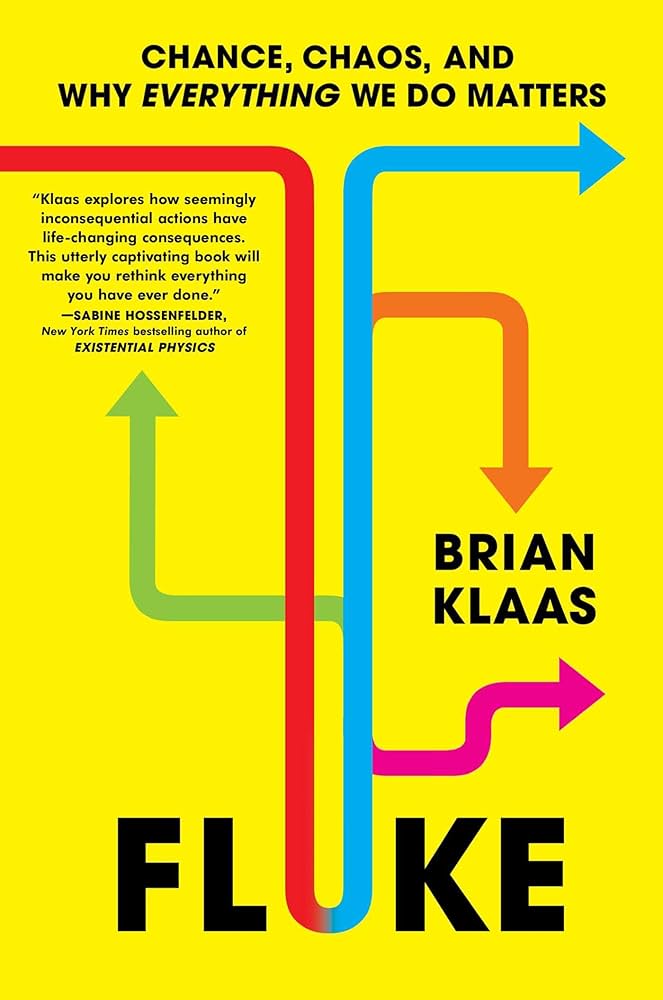
These aren’t anomalies. In Fluke: Chance, Chaos, and Why Everything We Do Matters, political scientist Brian Klaas shows that randomness shapes our lives far more than we admit.
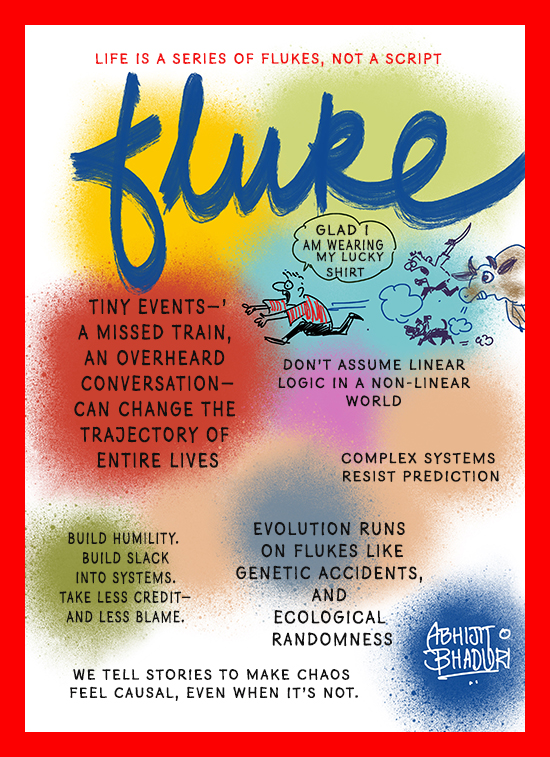
Klaas builds his argument from chaos theory, complexity science, and evolutionary biology. His message is clear: our lives unfold not like carefully laid dominoes, but like sand piles—ready to collapse or transform with the tiniest shift. Identical fruit flies, raised in identical conditions, develop different behaviors. Why? Pure chance. Even at the molecular level, randomness rewrites outcomes.
So why do we struggle to accept this? Because our brains crave stories, not probabilities. We believe outcomes follow effort, that success reflects ability. But Klaas argues that a great story is not the same as truth.
He dismantles the myth of meritocracy with a simple observation: intelligence is normally distributed; wealth is not. If merit alone shaped success, the distributions would match. They don’t. That’s not failure—it’s fluke.
Every decision—many of them unconscious—limits or expands future possibilities. But many of those forks appear because of someone else’s choices, random events, or trivial moments you’ll never know about.
This isn’t an argument against agency—it’s a plea for humility. You didn’t build your life alone. Nor did others build their failures unaided. Accept humility. Build slack. Take less credit—and less blame.
In a world of complexity, optimizing everything is a trap. You need room for mistakes, serendipity, and recovery. Stop scripting every outcome. Let go of micromanaging life.
Parents: your child’s future won’t follow a spreadsheet.
Creators: your breakthrough might start with an accident.
Friends: not everything has to be fair to be meaningful.
Sometimes, your life changes because of a cloud you never saw coming. And that’s okay.
If you enjoy thinking about where chance ends and agency begins, this book is worth your time. It’s unsettling, sharp, and surprisingly reassuring.
Have you experienced a fluke that changed your life or career? I’d love to hear it.
