Day: July 6, 2025

  • Wimbledon, Nvidia, Dove & Trillion

    Wimbledon, Nvidia, Dove & Trillion

    Nvidia is worth 4 trillion – so it pays to play games

    On Nvidia’s swelling market capitalisation underscores Wall Street’s big bets on the proliferation of generative AI technology, with the chipmaker’s hardware serving as the foundation. In November of last year, Nvidia took over the spot on the Dow Jones Industrial Average formerly occupied by chipmaker Intel, reflecting a major shift in the semiconductor industry toward AI-linked development and the graphics processing hardware pioneered by Nvidia.

    The stock market value of Nvidia, whose core technology was developed to power video games, has increased nearly eight-fold over the past four years, from $500 billion in 2021.

    Nvidia was founded in 1993 with a focus on graphics processing units (GPUs) for gaming, and that gaming foundation has been crucial to its success.

    The gaming industry’s demands for better graphics, faster frame rates, and more realistic rendering pushed Nvidia to continuously innovate in parallel processing. Those same GPU architectures that made games look amazing turned out to be perfect for AI and machine learning workloads, which require massive parallel computation.

    The gaming industry has historically been a driver of technological advancement because gamers are willing to pay premium prices for cutting-edge performance. This creates a market incentive for companies to push the boundaries of what’s possible. The competition between graphics card manufacturers, the constant demand for better performance, and the creative challenges of rendering complex 3D worlds in real-time all contributed to rapid technological progress.

    What’s fascinating is how those gaming-focused innovations became the foundation for AI, cryptocurrency mining, data centers, and scientific computing. The parallel processing capabilities that make games run smoothly also happen to be ideal for training neural networks and running AI models.

    All work and no play makes Jack a dull boy, but gaming brought Nvidia 4 Trillion of joy!

    https://www. cnbc. com/2025/07/09/nvidia-hits-a-4-trillion-market-cap-here-are-buy-levels-for-new-investors-in-1-chart. html

    What does a Trillion look like?

    I have no idea how many zeros would be needed in a trillion. How much bigger than a billion is that. For reference

    A million seconds is 11. 5 days. A billion seconds is 31. 7 years.

    The “FAULT” Lies in AI

    Machines and tech do some things better. But humans are human. They smile at you at the supermarket checkout, can out-banter any bot at the bank or the hardware store and they added to the spectacle that is Wimbledon. They’re not perfect, but I miss seeing the linespeople at Wimbledon. Wimbledon is the oldest tennis tournament in the world, first held in 1877 when the price of a ticket was one English shilling (approx 10 cents). Sad to see the most vulnerable pay the price for the tournament.

    What do we get when we let AI take over the jobs of the less privileged? We get no protests. They silently leave letting the faceless machine take their job. I did this painting to bring our attention to the invisible.

    Painting Title: The Missing Linesman

    https://www. theguardian. com/commentisfree/2025/jul/02/wimbledon-line-judges-tech-people

    Brand operates like compound interest

    Before you read further, write down the number of cars that Ferrari sells every year. Then watch this video.

    Captions are auto generated

    PlayMedia is loadingPlayPlayLoaded: 0%0:00Stream Type LIVERemaining time -1:01 1xPlayback speedPlayback speed0. 5×0. 75x1x, selected1. 25×1. 5×1. 75x2xTurn closed captions offShow captionsUnmuteTurn fullscreen onFullscreenMedia player modal window

    Follow my new Substack Newsletter

    A personal brand builds interest – compound interest

    Marketing activity builds interest in the product or service. It is actually like Compound Interest. It starts small and then gallops. The ROI of skilling and learning is long term. When I partner with an organization, I always encourage them to build a long term view of the partnership. The organization needs to put the same rigor in choosing an influencer as they do for a senior level hire. Ask if the influencer can go beyond the brief. Innovation comes from partners who go beyond the job description.

    Unilever and the AI-fluencer Army

    Unilever is redefining the influencer engagement model. They have created a digital twin of each product. Then they use that info to churn out endless amount of content. So they are working with thousands of influencers. Next year they want to increase that number 10x or 20x. (see the sketchnote)

    One idea to be an influencer

    Become the “Question Person” in your field—instead of always providing answers, become known for asking the most thought-provoking questions that others haven’t considered. Start every meeting, LinkedIn post, or conversation with a counterintuitive question that reframes the topic. People will start inviting you specifically to challenge their thinking, positioning you as the strategic mind who sees what others miss.
  • Neuroscience, Lucky Kokura & Professionals

    Neuroscience, Lucky Kokura & Professionals

    This is the 200th edition of the newsletter. So thank you for reading and sharing the newsletter with your followers. While the studies from Korn Ferry show (link given in this newsletter) and that maybe what you know anyway, it is the best answer to

    Professionals WANT to be skilled – but have no access

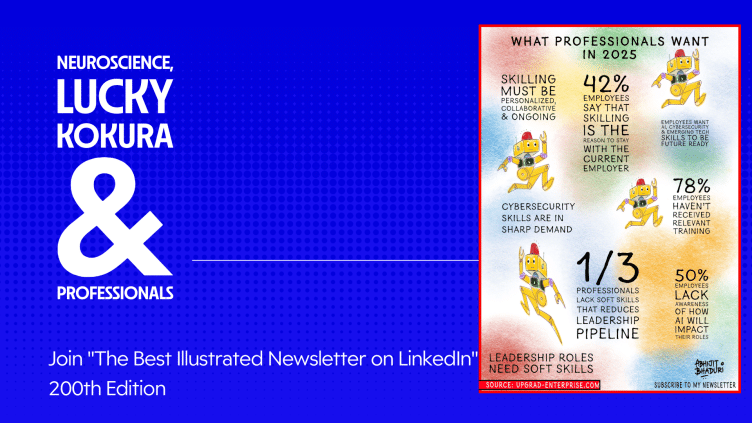
    Half of India’s workforce didn’t participate in formal skilling last year—not due to lack of interest, but due to poor access (66%) and irrelevant content (34%). upGrad Enterprise’s latest report, ‘Skilling Smarter: A strategic guide to training across generations,’ unpacks what’s broken in current workplace training strategies, drawing insights from 12,000+ professionals across roles, industries, and age groups.

    While organizations focus on technical and industry-specific skills, employees seek soft skills, leadership, and strategic thinking support to fuel their careers.

    Only 16% of professionals upskilled quarterly in FY 2024–25. Most (75%) trained only when mandated, with relevance, access, and time cited as top barriers. The report also reveals a sharp mismatch in priorities: while organizations focus on technical and industry-specific skills, employees seek soft skills, leadership, and strategic thinking support to fuel their careers.

    Generational preferences further complicate the landscape. Gen X favors expert-led learning, millennials cast their votes for peer-driven formats, and Gen Z expects immersive, on-demand content. Yet 63% of HR leaders continue to embrace a cookie-cutter approach.

    This refreshingly quick read offers leaders like you a clear, data-driven view into what needs to change, and how organizations can course-correct to ensure learner-first, future-fit skilling.

    Download your copy of the report now. https://dub. link/SSReport-AB

    https://www. upgrad-enterprise. com/reports/the-workforce-wishlist-2025

    https://abhijitbhaduri. substack. com

    Why you need neuroscience to fix your talent management crisis

    Businesses are grappling with a talent paradox. Despite massive investments in learning and development, employee engagement remains stubbornly low. Training programs fail to stick, feedback sessions backfire, and high-potential employees quietly disengage. The problem isn’t what we’re doing—it’s that we’re fighting against how the human brain actually works.

    Here’s how neuroscience can solve three critical talent management challenges every organization faces.

    Problem 1: Training That Doesn’t Stick

    The Korn Ferry 2025 report on Talent Acquisition found that 67% of employees view investment in L&D as a reason to stay.

    Captions are auto generated

    PlayMedia is loadingPlayPlayLoaded: 0%0:00Stream Type LIVERemaining time -0:00 1xPlayback speedPlayback speed0. 5×0. 75x1x, selected1. 25×1. 5×1. 75x2xTurn closed captions offShow captionsUnmuteTurn fullscreen onFullscreenMedia player modal window

    Most companies pour crores into elaborate training programs that employees forget within weeks. The culprit? We’re designing learning for machines, humans.

    Your brain’s prefrontal cortex—think of it as the CEO of your mental operations—has the attention span of a smartphone battery. Just as your phone drains faster when running multiple apps, your brain’s decision-making power depletes throughout the day. That’s why cramming eight hours of leadership training into a single day is not effective.

    The neuroscience solution lies in understanding neuroplasticity—your brain’s ability to rewire itself. Think of learning a new skill like creating a walking path through a forest. The first time, you’re pushing through thick undergrowth. But each repetition clears the trail a little more, until eventually you have a highway.

    Replace marathon training sessions for “microlearning”—bite-sized lessons spread across weeks. Shifting from week-long technical bootcamps to daily 15-minute skill-building sessions can lead to better knowledge retention.

    Problem 2: Feedback That Triggers Fear, Not Growth

    Annual performance reviews are where careers go to die. Despite good intentions, these sessions often trigger what neuroscientists call “amygdala hijack”—when your brain’s alarm system shuts down rational thinking.

    Imagine your amygdala as an overprotective security guard. The moment it detects threat—whether it’s a charging tiger or harsh criticism from your boss—it slams the emergency brake on your thinking brain. Your employee isn’t being defensive; their brain has literally switched into survival mode.

    This is why public feedback sessions and surprise performance conversations often backfire spectacularly. The brain processes social rejection the same way it handles physical pain. When an employee feels blindsided or embarrassed, they’re not thinking about improvement—they’re just trying to survive the encounter.

    The neuroscience fix? Create psychological safety before delivering feedback. Share specific observations rather than broad judgments. Instead of “You need to improve your communication skills,” try “In yesterday’s client meeting, when you interrupted the CFO it broke his chain of thought. What are ways in which you can get your ideas across without breaking someone’s chain of thought. ”

    Problem 3: High Performers Who Quietly Check Out

    Your star employees aren’t leaving for better salaries—they’re leaving because their brains are starving for dopamine, the anticipation chemical that fuels motivation.

    Dopamine surges when you’re chasing a goal. The anticipation, not the reward, creates the energy. The anticipation of the reward creates the dopamine rush.

    Most career paths in Indian companies are opaque ladders that offer little visibility into what’s next. High performers can see their current role clearly but have no compelling vision of their future. Without anticipation, motivation withers.

    Companies solving this create what neuroscientists call “dopamine trails”—visible pathways that make progress tangible. Design a career progression platform that doesn’t just list job levels; it shows employees exactly which skills, projects, and experiences will unlock their next role. Each milestone becomes a dopamine trigger, maintaining engagement even during routine work.

    The Brain-Based Talent Strategy

    The most successful talent strategies work with the brain, not against it. They recognize that employees aren’t malfunctioning machines—they’re sophisticated neural networks that respond predictably to specific inputs.

    The future of talent management isn’t more technology or better policies—it’s better neuroscience. Because when you design for how the brain actually works, everything else falls into place.

    Here is the complete version of the post which has more ideas. It is on Substack

    Kokura’s Luck

    When the flight took off on 12 June 2025, there were 242 passengers and crew on the Boeing 787-8 Dreamliner. There were 169 Indian nationals, 53 Britons, seven Portuguese nationals and one Canadian on the Air India flight bound for London from Ahmedabad. Everyone died EXCEPT the passenger in seat 11-A. The plane crashed into a hostel near the airport killing another 29 people, who were not even in the plane. Then there are people who WERE SUPPOSED to be on the same flight but missed it. That would be Kokura’s Luck.

    Brian Klaas’ book FLUKE is a fascinating account of how more of the world is interconnected than we pause to notice. I went to school in Delhi. What if my father took a job in a different city and place. How would that have changed my life? Our life is shaped far more by seemingly unconnected events because they are ACTUALLY connected. The road not taken, also influences our lives as sharply as the choices we make.

    Four cities were shortlisted in Japan where the atom bomb was to be dropped. Hiroshima, Kokura,Niigata, and a late addition, Nagasaki. The first bomb was dropped on Hiroshima.

    The second bomb was to be dropped on the city of Kokura. But as the B-29 bomber approached the city, cloud cover made it difficult to see the ground below. The clouds were unexpected. A team of army meteorologists had predicted clear skies. The pilot circled, hoping the clouds would clear. When they didn’t, the crew decided to attack a secondary target rather than risking a botched drop. As they approached Nagasaki, that city was also obscured by cloud cover. With fuel running low, they made one last pass, and the clouds parted at the last possible minute. The bomb fell at 11:02 a. m. on August 9, 1945.

    Kokura escaped getting wiped out because of clouds. It is all there in the book Fluke by Brian Klaas. It was certainly a book that made me pause and think.

    What is Kokura’s Luck?

    Thanks for reading. Let me know what you found to be useful and what else I could write about.

  • $100 Million To Say “Yes”; Career Shaping Ideas, Llamas & Alpacas

    $100 Million To Say “Yes”; Career Shaping Ideas, Llamas & Alpacas

    The internet was full of Sam Altman and Zuck trading allegations. OpenAI CEO Sam Altman said that Meta had offered his employees bonuses of $100 million to recruit them. This amount is for people working at the cutting edge of AI. Meta paid $14. 3 billion in data-labeling startup Scale AI, and hired its top boss, Alexandr Wang, to lead its new superintelligence team.

    Courting top talent is what makes or breaks organizations. Growing your own talent is a smarter strategy but when it comes to hiring one of the handful of nerds who can make or break your business model, the purse strings loosen up.

    I wrote about two sectors that also pay the big bucks to acquire top talent. Read about it here

    https://abhijitbhaduri. substack. com/

    Watch Ratatouille Again After Reading This

    Career shaping ideas from a RAT!

    I am such a sucker for movies about underdogswinning

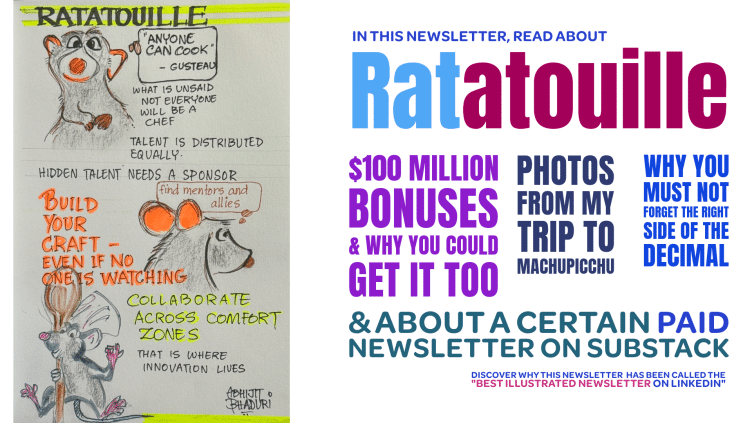
    Ratatouille is a traditional French vegetable stew—simple, rustic, and often underestimated, much like the film’s unlikely hero, a rat named Remy who dreams of becoming a chef. The title is both literal and symbolic: it refers to the dish Remy masterfully reinvents, proving that greatness can come from the most unexpected places. At its heart, the movie is a celebration of hidden talent, creative passion, and the courage to pursue your calling—even when the world says you don’t belong. I am just a sucker for stories about underdogs.

    For me this was a movie about career identity. The most misunderstood line in the film is, what the great Chef Gusteau book says, “Anyone can cook”. What is unsaid is that not everyone will be a chef. This is where the $100 million dollar sign on bonus comes into play.

    Did you know that in the film Ratatouille, Pixar’s legendary attention to detail comes through.

    Every dish in the movie was created and styled by real chefs. Pixar animators were trained at a real culinary school to understand technique and authenticity. A powerful example of learning by immersion—the best way to learn a new craft from a practitioner’s point of view.

    The name of the critic and the shape of his typewriter have hidden symbols. Read about it here https://abhijitbhaduri. com/2025/07/02/ratatouille-unlikely-lessons-in-career-identity/

    Photos from my Peru Trip

    Here is what you see in the photos

    Machu Picchu – the stone structures use no mortar. You can’t slip a credit card between the stones. Peruvians LOVE colors. Their clothes are SO colorful. I got tempted. Those are llamas – but the cuties are the alpacas. She had one of the most memorable faces I saw. That’s how breakfast (fruits and oats) was served. Plan to go around 21st June. The whole week is full of celebrations. Peru art and handicrafts are also so colorfulAnd their clothesThe graffiti and street art was lovely.

    Coming soon…

    Micro Management vs Micro Understanding – Indra Nooyi explains

    When Indra Nooyi took over as the CEO of PepsiCo, a company that I have always loved, there was lots that one learned by observing her in meetings and reviews. She would read and make notes in multiple places of the fat binders we had prepared. I had asked her, “Do you ACTUALLY read all the pages?”

    “Yes, because the buck stops with me,” said Indra Nooyi. Here is a fabulously structured chat with Indra. Terrific stuff. Don’t just listen, take notes.

    About a certain newsletter on Substack

    If you’ve been enjoying these reflections and insights here, I’ve got something a little deeper cooking elsewhere.

    On my Substack newsletter https://abhijitbhaduri. substack. com/ I will share extended essays, behind-the-scenes ideas, and experiments I’m not yet ready to post publicly. It’s where I test the edges of what’s next in work, talent, creativity, and life.

    If you’d like to support my writing and go further with me on this journey, consider subscribing to the paid newsletter on Substack. Think of it as buying me a coffee each month

    Here’s the link to join the inner circle https://tinyurl. com/2zup57d9

    Your support means the world—and helps me keep creating work that matters.