Day: June 5, 2025

  • Tech is Adapted at the Speed of Trust

    Tech is Adapted at the Speed of Trust

    Thomas Edison welcoming his guests

    The gaslit streets of Manhattan shivered with anticipation on that frostbitten New Year’s Eve in 1879. Inside Menlo Park’s laboratory, Thomas Edison prepared his moment. A dozen investors, wrapped in fur coats and quiet scepticism, ascended a creaking staircase into darkness. Their gold pocket watches glinted as the door shut behind them—a tomb of shadows. Then came Edison’s voice:

    “Gentlemen, witness tomorrow.”

    What followed wasn’t fireworks. It was a glow. A soft, amber wash of light spread across the room as the electric bulbs hummed to life. The warmth danced off champagne flutes and wide eyes. Edison had staged a miracle—not just of science, but of a story. The wires were hidden inside gas pipes. The light mimicked the familiar flicker of gas lamps. It was like building the trust someone you already know.

    It didn’t shout “future.” It whispered “We have known each other forever.”

    That’s the moment trust was born.

    Technology is easy to build. Trust takes time. Adoption follows.

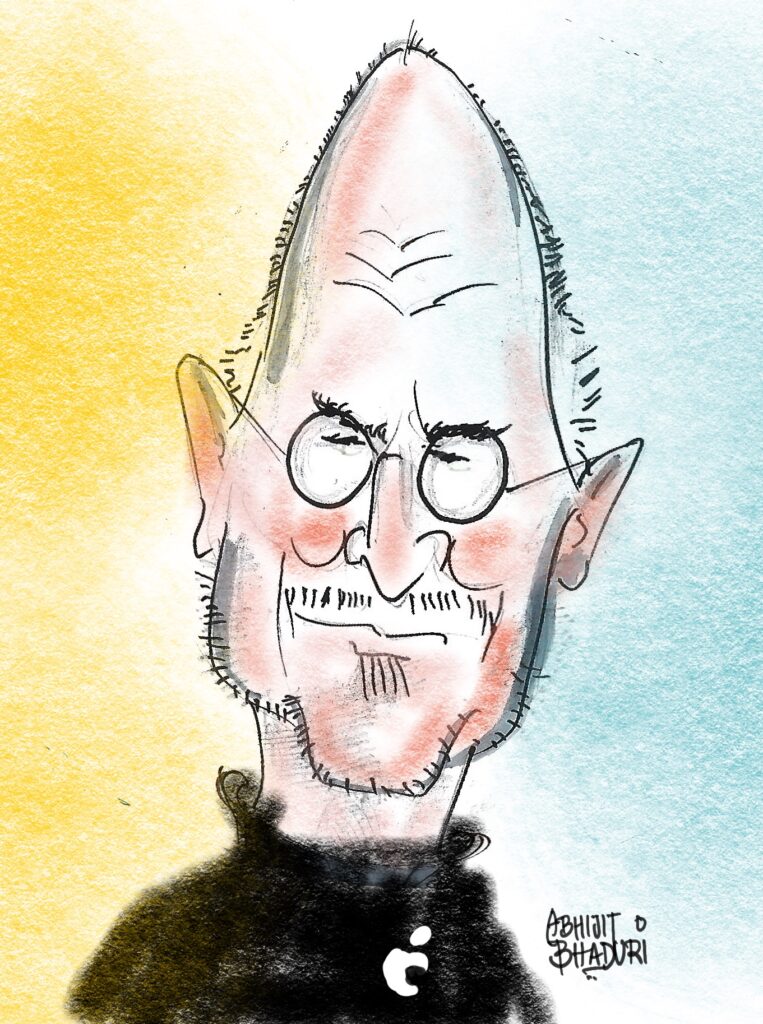
    Steve Wozniak needed the storytelling skills of Steve Jobs to drive adoption.
    Steve Jobs Caricature
    Steve Jobs Caricature

    Innovation’s Invisible Ingredient

    We love to talk about innovation as if it’s a race: faster processors, smarter code, tighter loops. But when it comes to adoption—especially in sensitive areas like healthcare and finance—it’s not technology that moves the needle.

    It’s trust.

    A doctor may use AI to spot signs of cancer earlier than the human eye can. A financial advisor might rely on machine learning to customize investment plans. It is hard to sell an algorithm. Stories build trust.

    That’s why the story of the hare and the tortoise have lasted longer than the calculators that came after them. They’re simple. They’re sticky. And they speak to something deeper than logic—they speak to emotion.

    Science cannot convince

    Let’s look at the world of vaccines, where scientific progress has always run into a wall: human hesitation.

    Edward Jenner developed the smallpox vaccine in 1796, but adoption was slow. People feared side effects, questioned the method, and resisted change. It took nearly a century before smallpox vaccination became the  norm.

    Fast forward to 2020. The world got not one, but several COVID-19 vaccines—some developed in under a year. AstraZeneca, Pfizer, Moderna, Covaxin. The science moved faster than ever. But mass adoption? That still hinged on one question:

    “Which one do you trust?”

    Some people hesitated because of how quickly the vaccines were developed. Others distrusted the source, the brand, or the rollout process. In India, the conversation wasn’t just about efficacy—it was about familiarity, recommendation from trusted doctors, and even regional preferences.

    The lesson? Trust spreads slower than code.

    It was a missed moment of trust.

    When a banker in Hyderabad using AI to assess loan risk, the system flags a promising applicant as ‘high risk’ based on historical defaults in their PIN code. The if banker can vouch for the applicant’s context, say a new job, the algorithm can be overruled.

    In truth, technology doesn’t replace people. It replaces tasks.

    What remains irreplaceable is the human connection.

    But the light hasn’t gone out. It’s shifting—toward a new kind of partnership between people and machines. Let the human stay in charge and let AI play apprentice.

    That’s the model that works everywhere.

    It’s the same with a financial planner who uses AI to analyze thousands of data points—but always explains the logic behind the advice in plain English or Hindi. She’s not competing with the tool. She’s translating it. That’s what builds trust.

    Three Simple Ideas for Human-Centered Tech

    If we want AI to be truly transformational—not just technically brilliant—we have to design it the way Edison did: with the human first.

    1. Design for certainty

    When people reject technology, they often aren’t rejecting the tool. They’re rejecting the uncertainty. In every rollout—healthcare, finance, insurance—the first question isn’t “Is it simple to use like the Post It note?”

    2. Design with the user

    Aravind Eye Hospital designed their intraocular lens for the rural poor after observing them. The lenses matched the global quality but cost a fraction of the imported lens. That made the lens accessible to the consumer.

    3. Humans want the option to say no

    The trust grows when users—doctors, bankers, teachers, farmers—can turn the AI on or off. Give them the agency, and you’ll earn their allegiance.

    Because in the end, people don’t adopt technology because it’s smart.

    They adopt it because it feels human. Would you agree? Leave me a comment. Thanks


    A version of this appeared in The Economic Times June 9-2025

    Leave a Reply

    Your email address will not be published. Required fields are marked *

  • HR for Irrational Humans: Information Friction and Non-Friction

    HR for Irrational Humans: Information Friction and Non-Friction

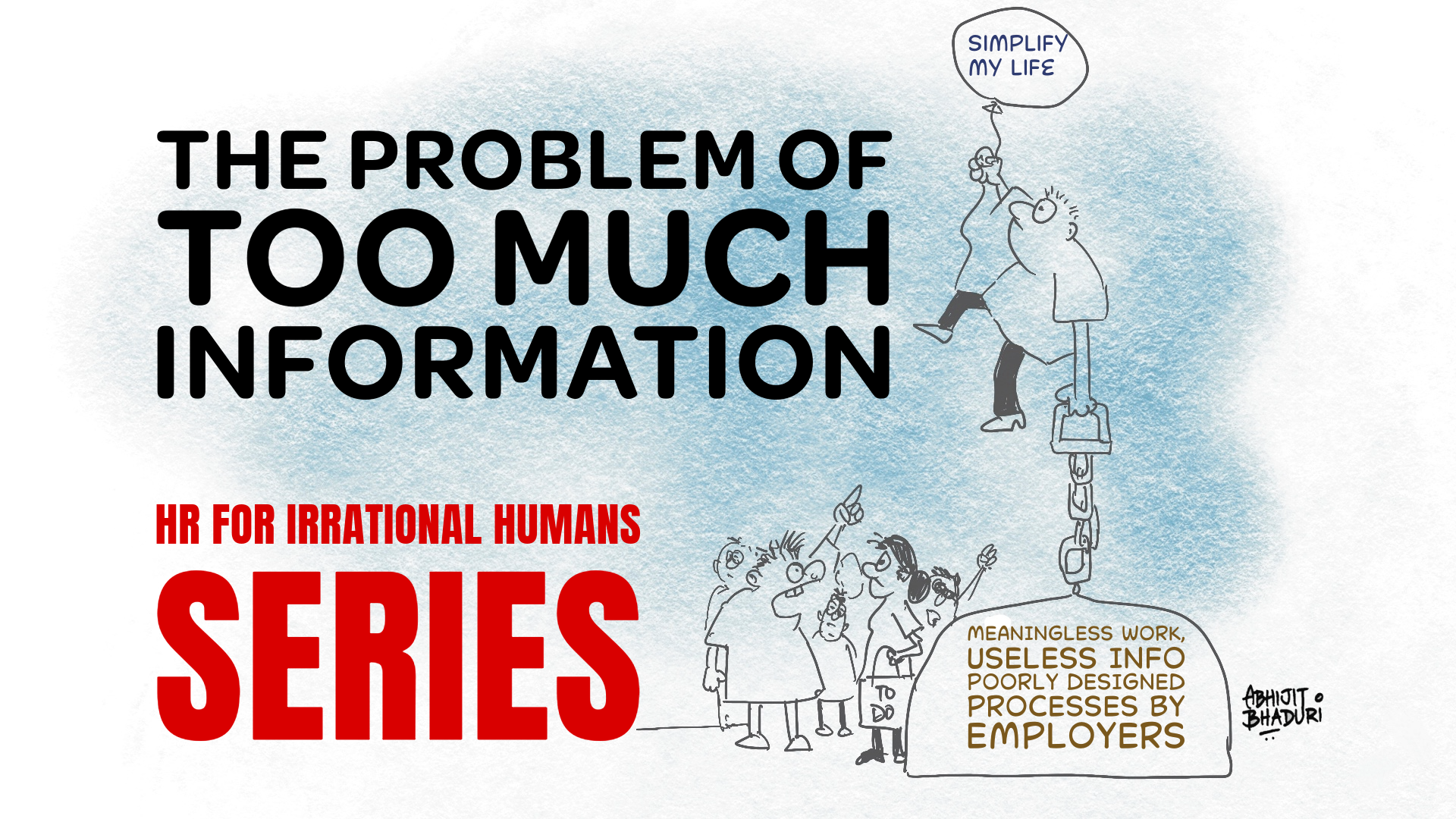
    Edition 1: The Problem with TMI (Too Much Info) – And What HR Must Do Differently

    HR for Irrational Humans - Too Much Information

    What is harder – choosing the glasses or the frame?

    If you think choosing the eyeglass is hard, then wait till you have to choose a frame that fits your face and your pocket.

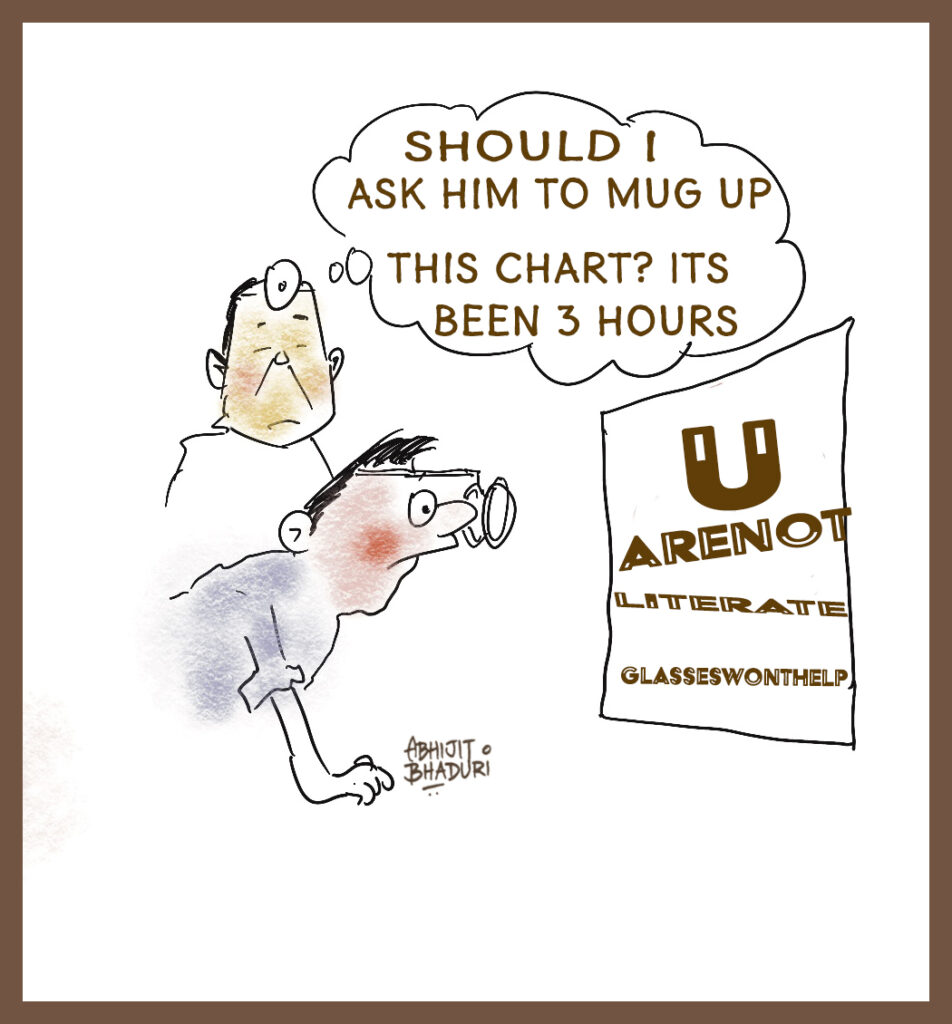
    I sit in the chair, the optometrist slides over a giant lens frame, and flips through lenses rapidly. “Better or worse? One or two? Three or four?”

    After about ten lenses, everything looks the same. I am trying hard to remember what I said the last nine times. Will someone design a pair of glasses that help me SEE better… and recommend what makes look trendy.

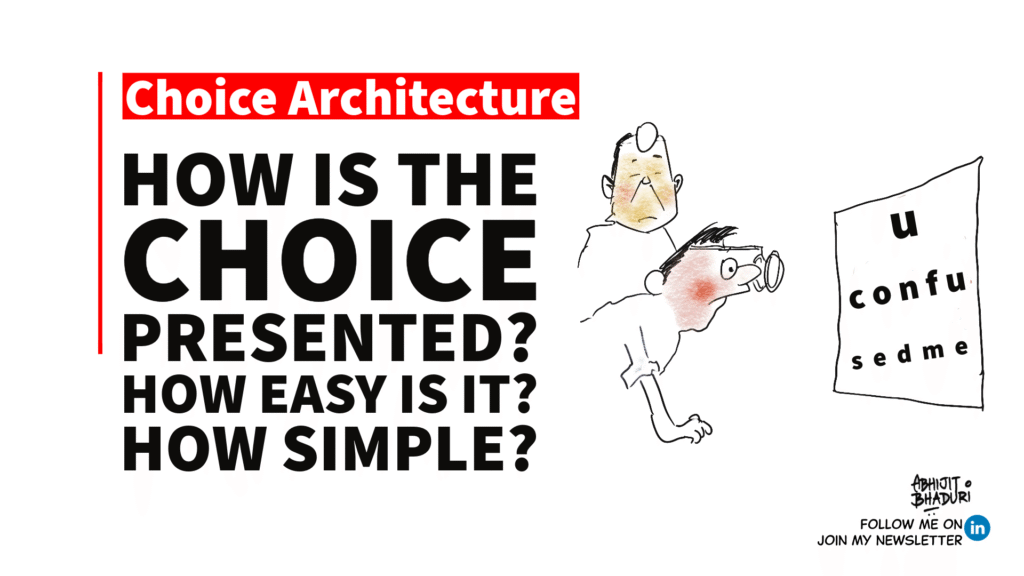
    That’s the hidden trap of too many options—eventually, our ability to choose breaks down.

    This moment of decision fatigue isn’t just happening in eye exams. It’s happening across talent systems—in hiring platforms, learning dashboards, and career paths—where HR unintentionally overwhelms people with too much data, too many tools, and too many choices.

    The Behavioral Science Insight: We Don’t Want More Information. We Want Meaning.

    Cognitive Overload Creates Fatigue

    That’s what happens when our minds face too many choices in too little time: we hit cognitive overload. The ability to decide—clearly and confidently—erodes.

    From job applications with 18 clicks, to learning portals with 600 courses, to performance tools with 47 competencies—we’re unintentionally fatiguing our people.

    Humans like things to be simple. Talk to a politicians. They will tell you the magic of slogans and how to reach the hearts of the voters.

    • We avoid emotionally uncomfortable information – like bad feedback or health warnings. No one wants to know what they have always dreaded.
    • We ignore data we don’t understand – you never read those agreements written to say that you agree to all the terms and conditions. You will be shocked what you have signed away.
    • We freeze when choices are excessive – like internal job boards with no filters. Limit it to 2-3 options to choose from/
    • We don’t act when priorities are unclear – most disappointments with appraisals happens because the boss and the team member did not agree what was the priority everytime things changed.

    So if employees aren’t acting, learning, or engaging—it might not be because they’re unwilling. It might be because they’re overwhelmed.


    5 Things HR Should Fix

    Let’s walk through how this plays out:

    1.  Onboarding Overload

    New hires are sent links to 11 documents, 4 videos, 3 portals, and 2 emails from IT. Most delay engaging until they “have time”—which rarely comes. I have first hand experience of this. New hires don’t protest because they don’t want to start off on the wrong foot.

    Fix it: Create a “Day One Card” with just 3 actions. Everything else follows, gradually.

    2. Manager Metrics Maze

    HR provides people leaders with 20+ engagement metrics and expects action. But without guidance on where to focus, managers close the dashboard and do nothing.

    Fix it: Give a monthly “Manager Snapshot” with 1 priority metric, what it means, and a prompt: “Here’s one thing to try this month.”

    3. Learning Paralysis

    Learning portals promise “anytime, anywhere” learning—with thousands of videos. But employees log in, scan options, and bounce off.

    Fix it: Curate 3 featured pathways based on roles. Label them: “Quick Wins,” “Upskill Now,” and “Future Ready.”

    4. Performance Feedback Fog

    Employees receive multiple templates, scorecards, definitions, and guides—yet leave reviews vague or empty.

    Fix it: Give one simple question to start with: “What do you want to get better at this year?”


    Curators, Not Broadcasters: The New Role for HR

    We often think of HR as educators, communicators, or policy designers. But the modern HR leader must now be a curator—someone who reduces noise, sharpens relevance, and nudges action.

    That means:

    • Showing only what matters now
    • Explaining the “why” before the “what”
    • Sequencing information by urgency
    • Designing systems with simplicity and intention

    In short, behavioral economics gives HR a design challenge: don’t add more—filter better.


    Final Thought

    People don’t suffer from a lack of information. They suffer from fatigue caused by useless information. Stories sell more than information. I know this. I have written both – fiction and non fiction.

    Behavioral science teaches us that friction, fear, and fatigue are not just emotions—they’re barriers to action. The HR systems we build must reflect this. When in doubt, design for simplicity, curate for meaning, and start with what matters most.increase usage, and create real behavior change.