Day: May 6, 2025

  • Entry level jobs are disappearing, what should you do

    Entry level jobs are disappearing, what should you do

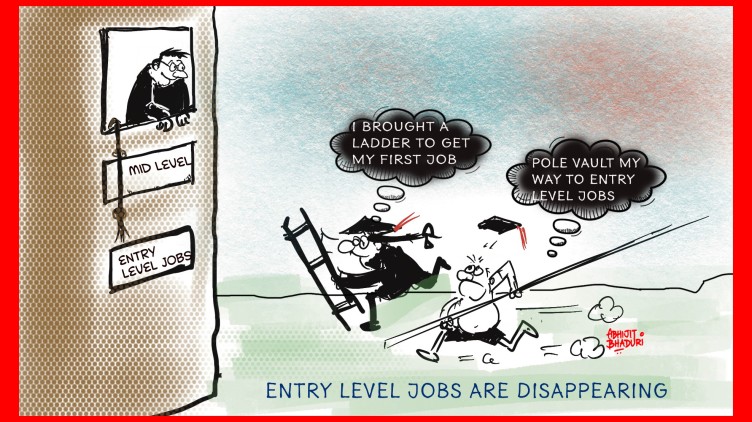
    AI has occupied the first floor of the building

    Across industries and continents, the first floor of careers is quietly disappearing. For decades, entry-level jobs were the first step on the ladder to success. They offered on-the-job learning, mentoring, and space to make beginner mistakes. But today, that bottom rung is eroding fast—especially in office jobs.

    When a surgeon uses robotics, the junior surgeons do not get a chance to practice under the watchful eye of the experienced surgeon. (Read this)

    Why? Because AI is automating the foundation layer of work. Junior coders once learned by debugging—now AI writes and fixes code. Paralegals reviewed documents—AI now does it in hours. Retail associates answered questions—chatbots do it instantly, 24/7.

    This isn’t just a tech-sector story. From fast food in the U. S. to banking in India to finance in Europe, early-career tasks are being handed over to automation.

    Let’s understand this shift through the Skills Pyramid

    I wrote about it here

    At the top: Creativity, empathy, problem-solving, leadership In the middle: Collaboration, pattern recognition, communication At the base: Routine, rule-based work (most vulnerable to AI)

    AI excels at the bottom. That’s why entry-level roles—once the training ground—are being commoditized. The tasks still exist, but they’re increasingly done by machines.

    What does it mean for GenZ

    Not despair. Just a different route forward.

    Here’s how Gen Z can adapt and thrive:

    1. Stop thinking of the “first job” as task-based. Think learning-based.

    Choose roles that stretch you, not just keep you busy.

    2. Move up the skills pyramid early.

    Learn to frame problems, communicate ideas, and collaborate across teams. These are skills AI can’t replicate.

    3. Use AI as a co-pilot, not a crutch.

    Speed up the basics with AI, then focus on quality, judgment, and improvement. That’s what firms like KPMG and Macfarlanes are doing with their early-career hires.

    4. Build a portfolio, not just a résumé.

    Projects. Certifications. Side hustles. These matter more than job titles when everyone’s career is non-linear.

    5. Trade pay for growth if needed.

    A small salary cut today for a bigger learning curve tomorrow is a smart investment. 40% of Gen Z says they’re already willing to do this.

    6. Seek roles that teach adaptability—not repetition.

    Today’s world of work rewards agility. Don’t aim to be irreplaceable at the bottom—aim to be versatile at the top.

    The first job hasn’t vanished. It’s just been redefined.

    And those who treat it not as a step but as a springboard will rise faster than ever before.

    Let’s help Gen Z see opportunity—not scarcity—in this transformation.

    Would love to hear your thoughts. How are you redesigning early-career roles in your organization?

    Subscribe to the best illustrated newsletter on LinkedIn

    Gen AI Can Boost Your Game—But Don’t Let It Steal the Joy of Playing

    Think of a tennis player with a world-class coach whispering strategies through an earpiece. The player performs better, anticipates the opponent’s next move, and wins more games. But now imagine that same player being asked to switch off the earpiece and play solo. Suddenly, the silence feels louder than before. That’s what’s starting to happen at work—with Gen AI.

    We’ve entered a new era where Generative AI is the co-pilot for everything—from writing emails and brainstorming ideas to drafting performance reviews. It’s faster. It’s sharper. And it often sounds better than what we might write ourselves.

    But here’s the catch.

    When we return to tasks that don’t involve AI, they can feel flat, even boring. In a study involving more than 3,500 professionals, researchers found that people who used Gen AI for one task reported feeling less motivated and more bored when switching to the next task without AI. It’s a bit like watching a Christopher Nolan film and then being asked to sit through a PowerPoint presentation. The contrast is jarring.

    The science behind this is simple.

    When AI takes over the most mentally stimulating parts of a task—like thinking, creating, refining—we lose some of the satisfaction that comes from solving a problem ourselves. We become spectators in a game we used to play.

    Struggling and wrestling is actually part of what engages us in a task. Strange but true. Calvin’s dad had said, “struggle builds character”. Don’t laugh. It turns out that if you are not struggling just a bit at work, or struggling a bit as you try to learn something, you lose motivation. Stuggle builds character AND keeps you motivated !

    Fanart from Calvin and Hobbes

    Here are five ways to make AI your teammate, not your replacement:

    Use AI to warm up, not play the whole match. Let AI help you draft the first version of a document or brainstorm ideas—but do the final pass yourself. That’s where your experience, your voice, and your insights shine through. Design your day like a training regimen. Start your day with creative solo work—like solving a problem, designing a pitch, or making a decision. Use AI later in the day for more structured or repetitive tasks. This preserves your mental energy and keeps you engaged. Be transparent about the collaboration. People feel more ownership when they know their input matters. If you’re managing teams, make it clear how AI supports—not replaces—their thinking. In cinema terms, AI is the editor, not the director. Switch tasks like a good playlist. Mix AI-assisted work with tasks that require human creativity and judgment. Think of it like alternating action scenes with moments of dialogue. You keep the energy up without burning out. Invest in your own thinking muscles. Use AI as a partner to sharpen—not soften—your skills. Just like a chess grandmaster uses practice games to prepare for the real match, treat Gen AI as practice—not the final performance.

    Gen AI is a powerful tool. But the magic of work comes from what you bring to it—your questions, your quirks, your connections.

    We don’t go to the movies just to see special effects. We go to feel something real.

    Let’s make sure the future of work feels just as human.

    When you struggle, your brain is forming new connections – YOU ARE LEARNING

    Can you teach an old dog new tricks? You certainly can teach anyone a new skill – provided they have the internal motivation to learn. There is a video in this post I have linked here has been viewed 42 MILLION times. You may have missed it. Click anywhere in that para to watch it.


  • Should Every CHRO Become the Chief Digital People Officer?

    Should Every CHRO Become the Chief Digital People Officer?

    Moderna Merge Tech and HR Departments

    Read the story in Wall Street Journal

    There are four big factors driving this:

    AI-Driven Workforce Transformation Moderna’s merger of tech and HR functions is a response to the sweeping influence of AI on workforce planning. The company is optimizing what work gets done by humans vs. what can be automated using AI (notably GPT-powered systems). The partnership with OpenAI signals a strategic shift: automation is no longer just an operational efficiency play—it is reshaping the core architecture of how roles, skills, and people are managed. Strategic Integration, Not Just Efficiency Tracey Franklin’s appointment as Chief People and Digital Technology Officer reflects a structural integration of talent and technology—a rare move that aligns workforce design with digital evolution. It’s a bet on hybrid leadership: combining behavioral insight (HR) with technological foresight (IT). Operational Complexity and Speed Moderna’s explosive growth—from 830 to over 5,000 employees in just five years—created the need for scalable, AI-enabled people systems. During Covid-19, HR had to accelerate hiring under intense pressure. Now, AI offers a way to sustain that pace without chaos—via “digital agents” that answer employee queries, optimize roles, and route people decisions to specialized GPTs. Reimagining Role Design Roles are no longer being designed strictly by traditional job descriptions. They are co-created by understanding what humans should do, what machines can do, and what needs to be done. That thinking allows for AI to take over junior analyst tasks, freeing up humans for higher-order work.

    Is this going to be the norm? Should your organization follow suit? I predict that in the next 5-7 years we will see HR, Tech and Marketing all managed under a common leader. Do you agree? Leave me a comment

    Why Every HR Person Must Read Anthropology

    Most performance reviews, leadership assessments, and potential ratings still assume a narrow model of “the ideal employee”—typically assertive, expressive, confident, visible, and individualistic. This model fits some cultures perfectly. But for millions of employees worldwide, it can feel like trying to perform a symphony with the wrong instrument.

    Imagine trying to assess a world-class violinist using a basketball metric. They may score zero on dunks—but does that mean they lack talent? Success means different things to someone who is growing up in rural India as compared to a kid growing up in Silicon Valley.

    The Eastern philosophy stresses group harmony, roles and duties. The Western self values personal goals, choice and independence. A married man asking their parents for advice will trigger smirks among colleagues in the West. They will view the parents having failed in their duty to make their progeny independent. In

    That’s precisely what happens in talent management systems that fail to recognize a core anthropological truth: The self is a cultural construct. Who we are, how we behave, and what we reveal (or conceal) about ourselves at work is shaped by deep cultural coding—expectations, rewards, punishments, and shared scripts.

    What if we flipped the script? What if HR became anthropology-aware?

    Read more

    94% of their students get jobs – the rest get a fee refund

    I spoke to the CEO of Kraftshala Mr Varun Satia – the big jaw dropping discovery: They update their curriculum every month! EVERY MONTH??? Yes, every month. And also listen to what Harsha Bhogle had to say about reinvention. Here is a glimpse (the full interview link is given just below)

    Captions are auto generated

    PlayMedia is loadingPlayPlayLoaded: 0%0:00Stream Type LIVERemaining time -0:00 1xPlayback speedPlayback speed0. 5×0. 75x1x, selected1. 25×1. 5×1. 75x2xTurn closed captions offShow captionsUnmuteTurn fullscreen onFullscreenMedia player modal window

    Watch the full interview of Kraftshala

    Click this

    ================================================

    Every Anecdote is NOT a Story

    Someone rushes up to you and says breathlessly, “You won’t believe this…” chances are that they are telling a story. You won’t believe this … is often a sign of a transformation. That is the necessary and sufficient condition of a story.

    =============================================

    SHRM chooses the Top HR Voices of India 2025

    Delighted to see the list of most influential #storytellers of the profession. Thank you SHRM India for the honor!

  • Stories Tell You Everything About the Culture – Create a Workplace Which Is Storyworthy

    Stories Tell You Everything About the Culture – Create a Workplace Which Is Storyworthy

    Let me ask you something: When was the last time you heard a great story at work? You know, one of those “you won’t believe what happened” moments that had everyone gathered around the coffee machine laughing or nodding in recognition?

    I worked in a organization where every week there was a informal get together of all the employees. Everyone laughed at the anecdotes and juniors narrated their boss’s quirks. Even the MD was not spared. There was only one sacrosanct rule. The storytellers had absolute immunity from retaliation. Employees who left to work for other employers came back because they missed this culture.

    When organizations start hiring people who are clones of each other, the stories dry up. So does innovation.

    Why Stories Dry Up: The Trust Drought

    In lots of workplaces, stories disappear because people are straight-up scared to share them. I’ve seen it firsthand – environments where chatting with colleagues is viewed with suspicion, where casual conversations at lunch feel like potential minefields.

    “I stopped sharing anything personal after I mentioned a minor frustration about a project timeline and found myself called into the boss’s office the next day,” a friend in finance told me recently. “Someone had overheard my comment and twisted my words completely. ”

    When every comment might be misinterpreted, reported, or used against you later, people clam up. They stick to safe topics like weather and traffic. The real stories – the meaningful ones about challenges, victories, and human moments – stay locked away because nobody trusts anyone. And without trust, stories wither and die.

    The Silent Workplace Warning Sign

    Think about the most engaging workplaces you’ve been part of. I bet they were buzzing with stories: “Remember when Sarah closed that impossible deal?” or “Did you hear how the dev team pulled an all-nighter and still managed to throw a surprise birthday party for their manager?”

    These aren’t just random anecdotes – they’re the cultural glue that bonds people together. When nobody’s telling stories, it usually means one of three things:

    Nothing interesting is happening (yikes!)People don’t feel comfortable sharing their experiences (double yikes!), or worst of all …People have learned through painful experience that opening up is professionally dangerous (triple yikes!).

    Why Stories Make Work Come Alive

    A friend of mine worked at a tech company where the CEO would start every all-hands meeting with a customer story. One time, he shared how their software helped a small business owner in a small town keep her shop open during a flood because she could manage everything remotely. My friend told me she worked extra hours that week not because she had to, but because that story reminded her why her code mattered.

    That’s the power of workplace stories – they transform abstract missions into tangible impact. They help us see the “why” behind the “what” of our daily tasks.

    Uncovering Stories (Even When They Seem Hidden)

    So how do you get the stories flowing if your workplace feels like a library where everyone’s on mute? Here are some approaches that actually work:

    1. Create “Story Triggers”

    At a healthcare company I consulted with, they placed small “victory bells” around the office. Whenever someone had a win – big or small – they’d ring the bell, and colleagues would gather to hear what happened. One billing specialist rang it after helping an elderly patient navigate a complex insurance issue. “It wasn’t even my job,” she said, “but hearing her relief made my whole month. ” That thirty-second story did more for team morale than a dozen motivational posters ever could.

    Try setting up physical or digital “triggers” that invite storytelling:

    A Slack channel called #TIL (today I learnt) or #guesswhatA “Story Wall” where people can post sticky notesA weekly “High Five” email where anyone can share a colleague’s achievement

    2. Turn Meetings into Story Moments

    Start your next team meeting with: “Before we dive into the agenda, can someone share a moment from last week when they felt particularly proud or challenged?” Then be quiet and wait. The silence might feel uncomfortable at first, but someone will eventually speak up.

    A marketing director I know tried this and was stunned when her usually quiet content writer shared how she’d helped a customer find information on their website after hours. “I could have just forwarded the email to customer service,” the writer said, “but something told me to help right away. Turns out the customer needed information for her son’s school project due the next morning. ” That story revealed more about the company’s values than any mission statement.

    3. Story Scavenger Hunts

    Send employees on “story scavenger hunts” with prompts like:

    Find someone who solved a problem in an unusual wayDiscover a colleague who went above and beyond for a customerLearn about someone’s most embarrassing first day

    A manufacturing company tried this during their annual team day. The winning story? An accountant who noticed a tiny discrepancy in shipping orders that ended up uncovering a major logistics issue that was costing the company thousands. Nobody knew about this everyday hero until the scavenger hunt brought her story to light.

    4. Create Safe Spaces for Tough Stories

    Not all workplace stories are victories. Sometimes the most powerful ones come from failures or struggles.

    A software team I worked with had a monthly “Fail Forward” lunch where people shared missteps and what they learned. Their best story came from an intern who accidentally deleted a test database. Instead of hiding it, he immediately told his manager. Together they not only restored the data but also implemented a new backup system that prevented similar issues in the future. That story became legendary – not because of the mistake, but because of how it was handled.

    Stop! Please tell me if you think, stories about the workplace are better measure of culture.

    Making Storytelling Part of Your DNA

    The trick is to weave storytelling into everyday work life so it doesn’t feel forced or fake. A few approaches:

    Record and share: Create podcast-style recordings of employee stories that people can listen to during their commuteStory slams: Host informal competitions where employees share quick stories around themes like “my most unusual customer interaction”New hire narratives: Ask fresh employees to document their first impressions – they often see things long-timers miss.

    At an architecture firm in Chicago, they created a simple “Story of the Week” feature in their internal newsletter. What started as a communication experiment turned into the most-read section of their company updates. Five years later, they published a book of these stories as an anniversary gift to employees – a tangible reminder of their shared history.

    The Bottom Line: Stories = Life

    Here’s the truth: A workplace without stories is like food without flavor – it might provide sustenance, but nobody’s excited about it. When you create space for storytelling, you’re actually creating space for meaning.

    So tomorrow, ask a colleague: “What’s the best thing that happened to you at work recently?” Then shut up and listen. You might just uncover the first drop of water in your company’s story desert.

    Because in the end, we don’t remember policies or procedures or even paychecks as much as we remember the stories we collect along the way.

    Let me know if you agree that boring workplaces have no stories.

    Follow me on LinkedIn

  • Low engagement is a social issue that can help redesign work and workplaces

    Low engagement is a social issue that can help redesign work and workplaces

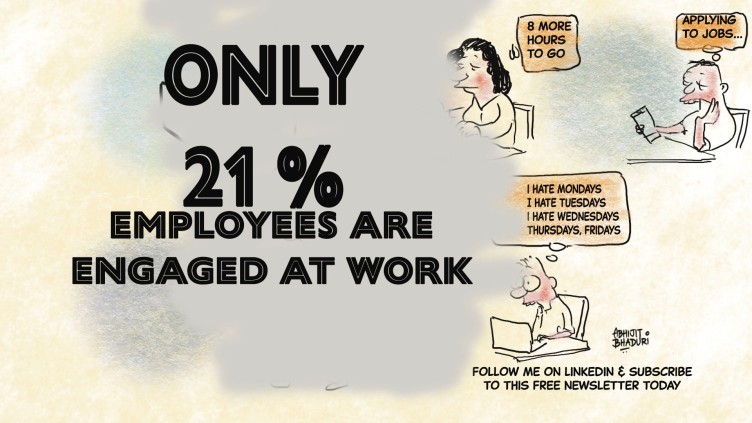
    Gallup’s 2025 Global Workplace Report reveals a sobering picture: only 21% of employees are engaged at work — a 2-point drop from last year. Meanwhile, 62% remain not engaged and 17% are actively disengaged, up 2 points. The emotional toll is visible, with 40% of workers reporting daily stress, 21% anger, 23% sadness, and 22% loneliness— all indicators of rising burnout and eroding workplace wellbeing.

    Life satisfaction is slipping, too: just 33% describe themselves as thriving, while a majority (58%) are struggling. Even perceptions of the job market have dimmed, with just 51% saying it’s a good time to find a job and half of all employees (50%) looking to leave. These signals point to a global workforce in quiet crisis — disengaged, emotionally drained, and uncertain about the future. For organizations, this is not just an HR issue. It’s a business risk that demands immediate redesign of the manager-employee experience.

    Share this newsletter with your followers and colleagues

    Low engagement is a social issue

    The decline in manager engagement. The very people we count on to guide teams through disruption are burning out. And it’s showing up in more than just the workplace — it’s altering how people view their lives overall .

    This isn’t just a workplace issue. It’s a societal one. Declining engagement mirrors rising loneliness, stress, and dissatisfaction across many regions — issues that are also being picked up in consumer trends (like the booming wellness economy) and social behavior (e. g. , the surge in quiet quitting, career sabbaticals, and “lazy girl jobs”). Read more

    Key Takeaway #1: Global Engagement Is Falling — And Managers Are the Epicenter

    Global employee engagement dropped to 21% in 2024. Manager engagement fell more sharply: from 30% to 27%. Young (