Day: March 6, 2025

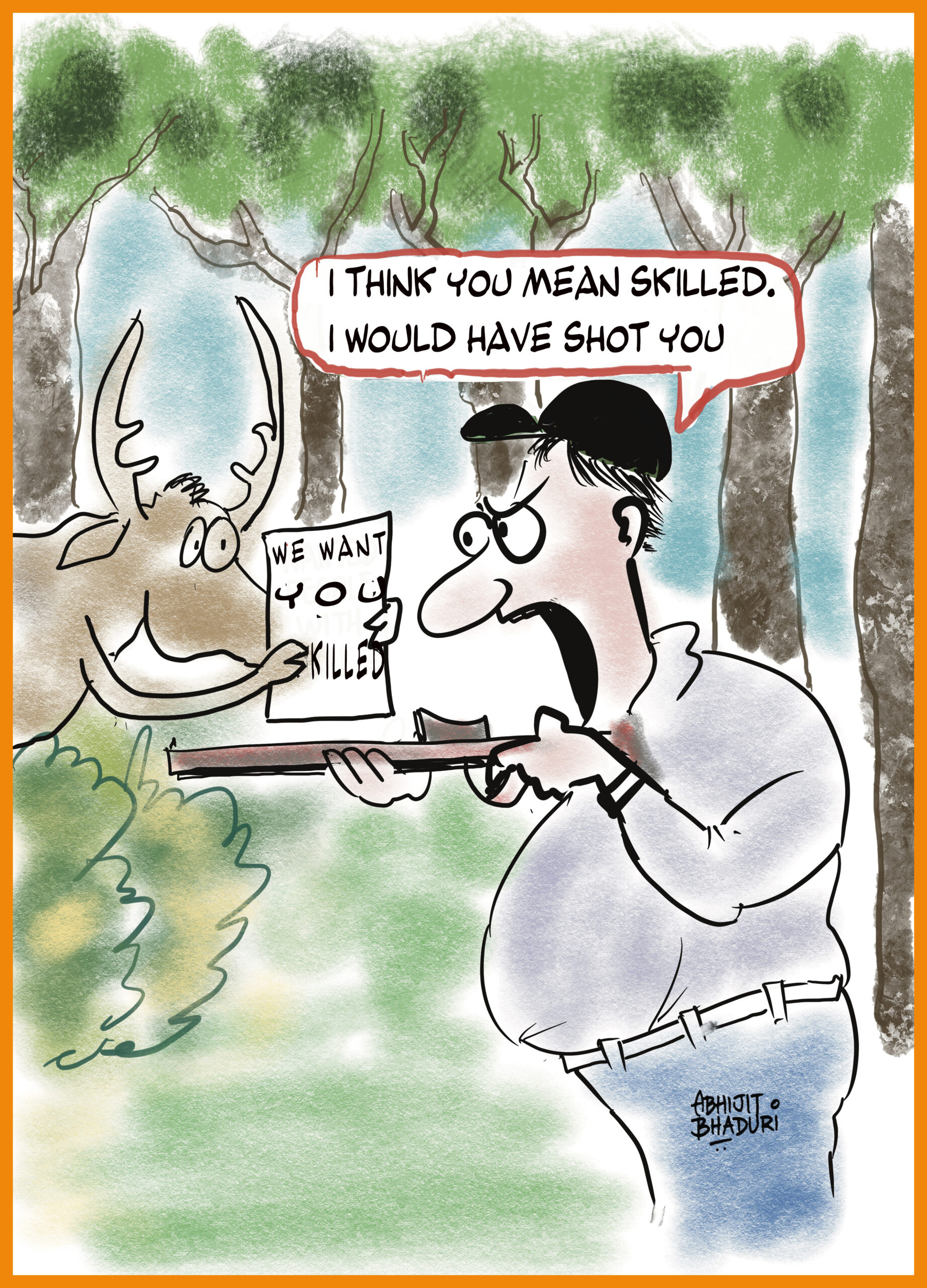
  • Hunt for skills, JOBS will find you

    Hunt for skills, JOBS will find you

    Cartoon of a hunter surprised by a deer holding a sign "We want you skilled," humorously highlighting the hunt for skills as JOBS will find you.

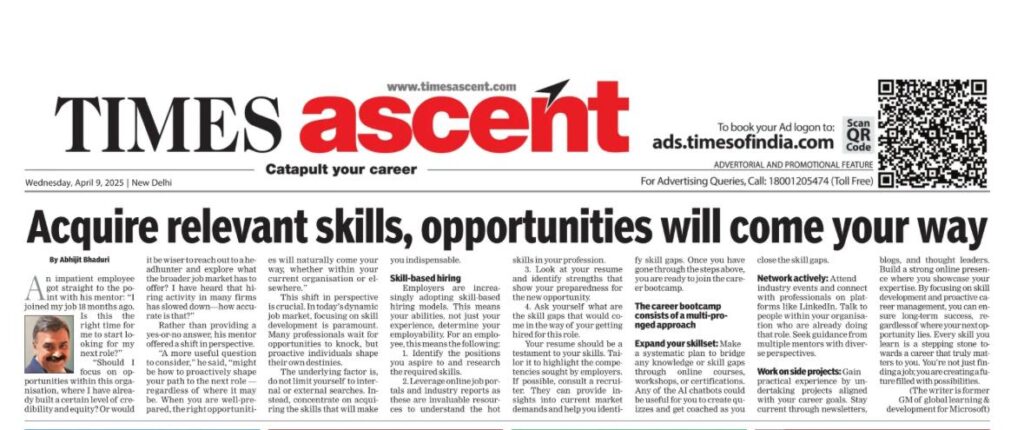
    He was impatient and skipped the niceties and the coffee and came c=straight to the point. He started with a volley of questions, “I joined this firm eighteen months back. Is it the right time for me to look for my next role? Is it better to look for my next role inside this organization where I have built a certain amount of equity? Or should I connect with the headhunter and explore what the world has to offer? I am told that not many firms are hiring right now is that correct?”

    Instead of answering directly, I countered, “A better question to ask might be to work out a path to your next role regardless of where it is? When you are prepared, you will attract the next opportunity whether that is with your current employer or a new one.”

    This shift in perspective is crucial. In today’s dynamic job market, focusing on skill development is paramount. Many professionals wait for opportunities to knock, but proactive individuals shape their own destinies. Don’t limit yourself to internal or external searches. Instead, concentrate on acquiring the skills that will make you indispensable.

    Skill-Based Hiring: The New Reality You Can’t Ignore

    Employers are increasingly adopting skill-based hiring models. This means your abilities, not just your experience, determine your employability. Identify the positions you aspire to and research the required skills. Online job portals and industry reports are invaluable resources to understand the hot skills in your profession.

    Look at your resume and identify strengths that show your preparedness for the new opportunity. Ask yourself what are the skill gaps that would come in the way of your getting hired for this role.

    Your resume should be a testament to your skills. Tailor it to highlight the competencies sought by employers. If possible, consult a recruiter. They can provide insights into current market demands and help you identify skill gaps. Now you are ready to join the boot camp.

    The Career Bootcamp – a three step plan

    1.  Expand Your Skillset: Make a systematic plan to bridge any knowledge or skill gaps through online courses, workshops, or certifications. Any of the AI chatbots could be useful for you to create quizzes and get coached as you close the skill gaps.

    2.  Network Actively: Attend industry events and connect with professionals on platforms like LinkedIn. Talk to people within your organization who are already doing that role. Seek guidance from multiple mentors with diverse perspectives.

    3. Work on Side Projects: Gain practical experience by undertaking projects aligned with your career goals. Stay current through newsletters, blogs, and thought leaders. Build a strong online presence on LinkedIn where you show case your expertise.

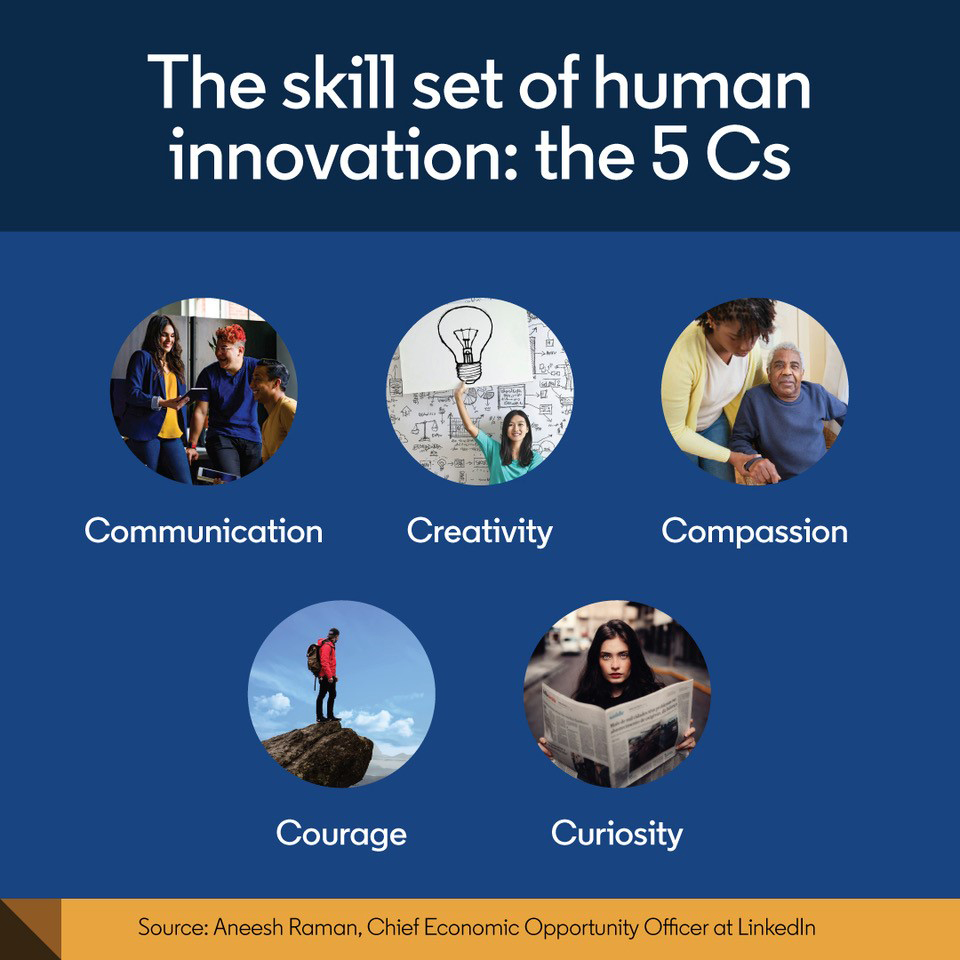
    At the recent Talent Connect India Virtual Show, the Chief Economic Officer for LinkedIn Aneesh Raman spoke about the 5Cs that drive human innovation.

    By focusing on skill development and proactive career management, you can ensure long-term success, regardless of where your next opportunity lies. Every skill you learn is a stepping stone towards a career that truly matters to you. You’re not just finding a job, you’re creating a future filled with possibilities!

    A version of this was printed by Times of India on April 9-2025. But this version has the cartoon!

  • The Scent of the Woman

    The Scent of the Woman

    Estee Lauder is a name synonymous with perfumes. Her success comes from understanding human psychology to build a brand.

    “Estée Lauder’s playbook – understand human psychology, create an experience, and make your weakness your strength. She would use the same strategy again and again to build a multi-billion-dollar empire. ”

    The year is 1963. The most prestigious department store in France, the Galleries Lafayette had a policy that they would never sell American products, especially perfume. After all, what could an American company teach them about fragrance?

    Estée Lauder managed to get into the store, not to meet the buyer, but to show her fragrance is to a sympathetic Sales girl.

    It is said that she dropped a bottle of a perfume – Youth Dew on the floor. The scent began to waft through the air as customers stopped to take the divine fragrance. Estee Lauder had broken through the glass sealing!

    If you know someone who would get inspired by this story, send them this newsletter. But don’t just forward it. Tell them why you believe she will get inspired.

    I enjoyed listening to this story out here. Check it out.

    Are you one in a million? Or even one in 8. 9 million?

    This is from LinkedIn

    The Rise of the Two Job Worker

    Source: Dr. Kruti Lehenbauer

    Younger professionals with fixed salaries and job insecurity prefer fewer work hours because they have personal demands and fewer growth opportunities. On the other hand, mid-to-senior professionals are willing to work more if it means earning extra income, improving their careers, or having fewer personal responsibilities—though they risk burnout. Younger and retired people prioritize free time, while those in their prime career years work longer, even if it doesn’t always make them happier. Business owners who try to balance work and life equally may still find that it doesn’t bring the most satisfaction.

    Read more from this post

    Governments innovate with RTPS

    Money is hard to find. It is all becoming digital and invisible. Governments have been innovating with Real Time Payment Systems (RTPS).

    India’s Unified Payments Interface (UPI) launched in 2016 has revolutionized a cash dependent economy like India. Cash accounted for 78% of POS value in 2016. Using digital wallets like PhonePe and Google Pay, UPI now dominates with 58% of POS and 64% of e-com transaction value in 2024. Cash use stood at just 15% in 2024 and is forecast to fall again by half, to 7%, by 2030. UPI has already spread beyond India. Read more

    Source: Global Payments Report 2025

    One day we will wonder why we needed paper money at all

    Thought for Food

    Why do so many people go hungry? Is it a production problem? You would think so. But actually it is a problem of wastage. It is also about getting the right amount of calories and about creating a food supply chain. Even when people get enough calories, they’re often missing the right nutrients and so malnutrition is another problem. Better storage and packaging, smarter supply chains, and flexible pricing models could significantly reduce spoilage and excess inventory.

    “Some of the world’s biggest food producers have the highest rates of undernourishment. Globally, we produce around 3,000 calories per person per day—more than enough to feed everyone—but a staggering one-third of all food is wasted. (In some rich countries, that figure climbs to 45 percent.) Distribution systems fail, economic policies backfire, and food doesn’t always go where it’s needed.”

    I looked at all these pictures of food & felt very guilty indeed

    Costco (which might seem like the pinnacle of U. S. consumption) stocks fewer than 4,000 items, compared to 40,000-plus in a typical North American supermarket.

    Bill Gates has written a gushing review of Vaclav Smil’s new book that addresses this precise problem It is called How to Feed the World.

    Dig Deeper

    Necropolis, Manganiyars and Cenotaphs

    That literally means the city of the dead. The word necropolis comes from Ancient Greece. It combines nekros (νεκρός) meaning “dead” or “corpse” polis (πόλις) meaning “city”. Did you know that the word nectar refers to the liquid that helps overcome death.

    Photo courtesy: Pradeep Joshi

    I bumped into this lovely first hand account of a necropolis in Hyderabad, India Pradeep Joshi’s photo captures the reflection in a bawri (step well).

    See a closeup of the calligraphy seen from an unusual angle at the Taj Mahal. Discover the music of Manganiyars. Here is what I wrote

    Read this https://abhijitbhaduri. com/2025/03/12/masusoleums-and-manganiyars/

    Thank you for reading and subscribing. If you enjoyed a story here, chances are your friends will enjoy it too. Tell them which story you thought they would enjoy when you forward this newsletter.

    PS: Come writers and critics

    Who prophesize with your pen

    And keep your eyes wide

    The chance won’t come again

    And don’t speak too soon

    For the wheel’s still in spin

    And there’s no tellin’ who

    That it’s namin’For the loser now

    Will be later to win

    For the times they are a-changin’

  • HR Needs Less MBA, More Anthropology—Here’s Why That’s a Good Thing

    HR Needs Less MBA, More Anthropology—Here’s Why That’s a Good Thing

    Ever wondered why employees trust Glassdoor , Blind , and Reddit, Inc. more than their own HR department? Or why leadership development programs always have to prove ROI, while compliance training gets an automatic green light? Or why HR still struggles to build employer brands, even though Marketing has been doing it for decades for customers?

    Two books by Gillian Tett that I found valuable – The Silo Effect (read a review here)

    HR has spent so much time trying to be like Finance, it’s forgotten what makes it uniquely valuable to business.

    It’s time for a new way of thinking—one that doesn’t measure success only in numbers, but in understanding people, culture, and behavior like an anthropologist.

    HR doesn’t need more spreadsheets. It needs more anthropology.

    Gillian Tett’s book The Silo Effect is a great read

    HR Shouldn’t Be a Club for HR Professionals

    Ever noticed how HR conferences are full of… HR people?

    It’s like a restaurant hosting a customer feedback session and only inviting the chefs.

    The Problem: HR sees itself as the voice of the employee, yet non-HR employees rarely engage with HR-led discussions.

    Why? The Silo Effect. HR professionals mostly talk to other HR professionals, reinforcing their own frameworks instead of embedding themselves in real employee experiences.

    The Anthropologist’s Solution:

    Instead of designing policies from a distance, HR should function like an ethnographer—sitting in on team meetings, shadowing employees, and observing how people actually work.

    If HR leaders spent a day each month working alongside different teams, they’d see challenges before they show up in engagement surveys.

    Diversity, Leadership, and Employer Branding—We Need a New Lens

    HR is obsessed with measurement. If it can’t be quantified, it’s treated as “soft” or optional.

    Leadership development? Takes too long to show results.

    Employer branding? Hard to measure impact.

    Diversity initiatives? Often seen as compliance instead of innovation.

    Yet, Marketing doesn’t hesitate to invest in brand-building, knowing that a strong brand attracts customers. HR should adopt the same mindset—a strong employer brand attracts top talent.

    What if HR measured employee sentiment as deeply as companies measure consumer sentiment? What if we had an “Employee Research” team, just like we have Market Research?

    It’s time to treat employees like customers—not just resources.

    Want a friend to join this newsletter? Send them this link https://bit. ly/3ZwsrZF

    Read: How to Decode Culture in your Organization

    Want to Innovate? Start With Employee Research

    We do consumer research, market research, competitive research.

    But where’s the team dedicated to researching employees—beyond surveys?

    What are unspoken workplace rituals that shape behavior?

    What “social silences” exist? (What issues are people afraid to bring up?)

    How do employees really feel about hybrid work, leadership, or performance reviews?

    Imagine if HR analyzed employees the way anthropologists analyze cultures—with deep observation, not just survey results. That’s where the real insights are.

    Final Thought: HR Needs to See Work Through Human Eyes Again

    If HR keeps acting like a policy and compliance function, employees will keep ignoring it.

    But if HR learns to think like an anthropologist—understanding people before trying to “fix” them—it can finally become the function it was always meant to be.

    Less MBA. More anthropology. More human.

    Scott Galloway’s Predictions at SXSW

    Consumers want certainty – not choice. This was the most insightful part of the talk. We spend 50 minutes every week deciding what to watch on Netflix. TikTok is the opposite. They are one channel and they know what you want and will show you only that. That gives back time.

    NVIDIA and Open AI will dominate. Nvidia has grown its earnings to justify its Market Cap, because Microsoft, Amazon, Google and Meta have all invested heavily in their chips. OpenAI is over valued. Byte Dance (of TikTok fame) is undervalued. Meta will make the most progress in AI because 9/10 people outside of China are on a Meta platform. Think of the data they have (about you!)Expect Shein to do an IPO. They offer 7000 new styles every day and make $2mn per employee while Zara makes $344 per employee. They do 100 new styles per day. Traditional retail does 100 new styles per week.

    Read more at abhijitbhaduri. com

    You can read a more detailed summary here

  • If upskilling is such a strategic priority, why is the L&D team losing out to this competitor?

    If upskilling is such a strategic priority, why is the L&D team losing out to this competitor?

    I have spent time in L&D teams in different organizations as an employee and as a consultant. If you have a Corporate L&D team, you know how they will hound you to complete the “mandatory training”. If upskilling is such a priority, then why has this competitor been winning for a while?

    The Employees Are Going Direct

    When Sam Altman was thrown out of OpenAI, he decided to bypass any PR firm and took to social media to share his views to 2 million followers. (more of that later in this newsletter). Zuckerberg is making reels to tell you about the new product launches. Is traditional PR too risk averse or does the employee and the shareholder want unfiltered but authentic communication? Read this

    Check this with your L&D Team

    If the employees had to pay to take a course developed by the company’s L&D team, would they get employees to sign up? Answer: No they won’t. Why don’t people complete the courses that L&D recommends and mandates? Answer: Adults HATE being mandated to do anything. But they are naturally curious.

    Employees aren’t waiting for L&D to assign them a course. They’re learning on their own terms

    Don’t blame short attention spans. People binge-watch stuff through the weekend

    Most corporate content is not timely. When it is available, it is not boring, devoid of humor and frankly uninteresting. Employees are learning from YouTube, Quora, Reddit and doing courses that will keep them relevant in the job market. Employees choose platforms that offer immediate answers, variety, and engaging delivery. Most corporate LMS platforms? Not so much.

    Two Ideas To Make Corporate L&D Employee Friendly

    1. Stop measuring course completion

    That is simply digital attendance. Clicking through slides isn’t the same as learning. Stop forcing people to learn. See reason 3 below for details.

    What to track

    Performance improvementsPromotions or internal mobilityPeer referrals and completion after referralReal-life application stories

    2. Your Real Competition Is YouTube (And It’s Winning)

    Employees choose platforms that offer immediate answers, variety, and engaging delivery.

    What to do

    Design learning like your audience expects: short, visual, modular, and binge-worthy. Ask yourself: would someone watch this voluntarily?

    3. Make it INTERESTING enough to make them want to learn

    Most Corporate L&D teams obsess about the principles of Instructional Design. They use ADDIE (Analysis, Design, Develop, Implement and Evaluate) to create content. The model has been in use since the 1950. Back then people did not have Netflix, YouTube, ChatGPT, TikTok and more to choose from. If it is not interesting, people will not listen to announcements on how to save their lives. Make your content interesting, relevant and authentic (in that order if you have to choose).

    47 MILLION people watched this video – including those who have never traveled by this airline.

    Who will help you make this content? No it is not the maker of this video, here is the group that really knows how.

    Click this link

    https://tinyurl. com/2szybpr9

    Click to subscribe to this newsletter https://bit. ly/3ZwsrZF

    Book Review: Brave New Words

    The big idea of this book: The promise of a “2 Sigma” improvement that could be possible for every student.

    What is a 2 Sigma Improvement?

    The “2 sigma improvement” refers to a fascinating concept in education. Imagine a classroom where students learn in a traditional way—lectures, group activities, and homework.

    Now, picture ONE student who gets one-on-one tutoring instead. Research by Benjamin Bloom showed that students who receive personalized tutoring outperform about 98% of their peers! It’s like going from being an average student to being one of the top achievers.

    AI tutoring platforms transcend novelty by enhancing education. They free teachers from mundane and repetitive tasks like grading, allowing personalized interactions to inspire confidence. That also means that teachers must master generative AI to create tailored plans for all learners.

    There is one criticism I have for the book and a video of Sal Khan

    Click to subscribe to this newsletter

    I spent a week at a Writers Colony

    I have never been to a Writers Colony ever before. I was seriously delighted to get an invitation to be at one. This is a place called Dairy Hollow, Arkansas

    Tucked away almost an hour and a half away from the nearest airport, it is a wonderful place where you could go to complete your novel. Or start a new book like I did. I met some terrific people there. Attended a poetry reading session by some local poets. I read out an old poem of mine. And then one of the resident writers invited me to join him at New Delhi cafe. It is the only restaurant in the town that serves Indian food. And is run by the one solitary Indian person in the town called Billo.

    This is one of the two dishes you must have. This samosa is made in a unique way. I had never had this version of a samosa ever before.

    Adam Grant speaks to Sam Altman

    Adma Grant interviewed Sam Altman. They spoke about

    The risks come with advanced AI, and how can we avoid them?

    How will AI change jobs and work in the future? This looks at how AI could replace some jobs while creating new ones, and how we can prepare for these shifts.

    How should we regulate AI? This asks how to balance encouraging innovation with responsible use, discussing how laws can ensure ethical AI development without slowing progress.

    It began with Adam talking about the outpouring of loyalty and support for Sam Altman when he was ousted by the Board of OpenAI.

    Are you suprised at how fast this has happened, Adam asked, “Humans are already losing faster (to AI) than I hoped. We are already behind on creativity, empathy, judgement and persuasion.”

    Over time the whole economy transforms. And we will find new things to do, says Sam.

    Leave me a comment and tell me what you liked about the conversation between them.

    Till the next week, goodbye

    Stay in touch

    AbhijitBhaduri@live. com

  • Oscar Prediction: Adrian Brody

    Oscar Prediction: Adrian Brody

    I predict that Adrian Brody will win the Oscar tonight for his role in The Brutalist. When I watched the film I thought this was a film about how to be resilient in the face of terrible setbacks. Adrian Brody’s career is a testament to resilience, reinvention, and long-term thinking. From his Oscar-winning role in The Pianist (2002) to his likely triumph tonight for The Brutalist, Brody has navigated the unpredictable terrain of Hollywood with strategic patience.

    In The Brutalist, Brody plays an architect who, after fleeing fascist Europe, builds a career under an employer who exploits and torments him.

    This character’s journey is a striking metaphor for careers in any industry—where talent alone is not enough, and one must endure setbacks, power struggles, and reinvention to succeed.

    I could imagine Adrian Brody’s employer getting a one star rating on Glassdoor with lots of comments about harassment and beyond. Through all of it, he does not lose faith in his work. Adrian Brody delivers a haunting performance in The Brutalist, portraying an architect trapped under the thumb of a domineering employer who believes he owns him. With quiet intensity, Brody conveys the suffocating weight of exploitation, balancing defiance with the grim reality of survival. His character’s resilience shines through in subtle gestures—small acts of rebellion that hint at an unbreakable spirit. As the film unfolds, his struggle becomes a powerful meditation on artistic integrity versus oppressive control. Brody’s performance is a masterclass in restrained agony, making his eventual reckoning all the more impactful.

    Adrian Brody

    Brody himself experienced this after his early Oscar win. Instead of capitalizing on instant fame, he took unconventional roles, waiting for projects that aligned with his artistic vision. This aligns with Clark’s central message: Careers are no longer straight lines. Success requires playing the long game—building strategic relationships, focusing on long-term goals, and enduring periods of uncertainty. I predict he will get the Oscar. What do you think?

    ——————————————————————–

    The Long Game by Dorie Clark: Three Big Takeaways

    Dorie Clark’s The Long Game is all about strategic career thinking. It teaches us how to build long-term success rather than chasing short-term wins.

    Here are three powerful takeaways:

    1. Create White Space for Strategic Thinking

    In today’s fast-paced world, we often prioritize urgent tasks over important ones. Clark argues that creating “white space” in our schedules—time for deep thinking—allows us to step back, reassess our goals, and make smarter career moves. Without reflection, we risk getting stuck in a cycle of busyness without real progress.

    2. Play the Long Game by Saying No

    Success isn’t about doing more; it’s about doing the right things. Clark emphasizes the power of saying no to distractions and short-term rewards that don’t align with long-term goals. By being selective, we create opportunities for deeper work, build expertise, and gain influence in our chosen field.

    3. Start with the End Goal and Work Backward

    Clark suggests defining your ideal career outcome first, then reverse-engineering your steps to get there. This approach prevents aimless wandering and ensures every decision moves you closer to success. Whether it’s writing a book, switching industries, or becoming a leader, small, consistent actions compound over time.

    I loved this book as a way to think about careers. Have you read it? Leave me a comment to let me know if you resonate with the ideas

    ————————————————————–

    Book Review: The Great Reset by Nigel Paine

    How do organizations learn? What is the sign that they have learned? What makes organizational learning happen? Nigel Paine’s latest book The Great Reset makes us wonder if have been solving it wrong all along.

    Critical Problem? Tame Problem? Wicked Problem?

    We try to solve WICKED problems like tame problems

    We’ve been getting it wrong. For decades, organizations have approached upskilling their workforce like it’s a straightforward challenge: identify skill gaps, create training programs, implement them, and measure success. Neat and tidy. But here’s the uncomfortable truth: organizational upskilling isn’t a tame problem with a clear solution path—it’s a wicked problem that defies conventional approaches.

    Nigel Paine’s book begins with three kinds of problems. There are

    (a) Critical Problems: a PR disaster or a product recall is a critical problem. Speed is of essence when you are solving a critical problem.

    (b) Tame Problems: These are problems that can be solved by experts. You need to follow the steps given in the manual and the problem will go away. Experts have the answers to these problems. Many technical problems are often tame problems that experienced managers excel in solving.

    (c) Wicked Problems: These are complex problems. It takes time to even define what is the problem that one needs to be solved.

    Captions are auto generated

    PlayMedia is loadingPlayPlayLoaded: 0%0:00Stream Type LIVERemaining time -0:00 1xPlayback speedPlayback speed0. 5×0. 75x1x, selected1. 25×1. 5×1. 75x2xTurn closed captions offShow captionsUnmuteTurn fullscreen onFullscreenMedia player modal window

    Organizational Learning

    The answer lies in misdiagnosis. We’ve been treating organizational learning as either a critical problem (requiring urgent expert intervention) or a tame problem (complex but solvable through established methods).

    Neither approach works because getting an organization to learn is a wicked problem—ambiguous, continually evolving, and deeply entangled with organizational culture, individual psychology, and market dynamics.

    Organizational Learning has some foundational elements: eg spaces – virtual and actual spaces for learning; finding ways to connecting ideas and people across traditional departmental boundaries and silos. Connecting people with diverse expertise and measuring the impact of learning initiatives are ways to build the organization’s ability to change itself. An organizational brain to improve its ability to solve problems is the final proof.

    Nigel Paine’s “The Great Reset,” accurately suggests that effective organizational learning isn’t about isolated training programs but rather creating an integrated neural network. For example, upskilling the business is a wicked problem requiring holistic, interconnected solutions rather than simplistic approaches. Upskilling challenge isn’t just about knowledge transfer—it was about shifting mindsets, addressing workflow barriers, aligning incentive structures, and navigating complex interpersonal dynamics among team managers.

    Nigel’s book as a terrific questionnaire that you could use as a starting point to understand how to get started on the journey of building an organization that learns.

    Bonus finding

    I learned about a new AI tool called Connected Papers (connectedpapers. com). It defines the field in connected circles of influence.  The more connections to that circle and the larger it is, the more central it sits in the canon. I expect to see this getting to the center of the canon. But then, how do we get more and more people to read this fantastic book is a WICKED problem to be solved.

    I got a chance to speak to Nigel about his fabulous book. This is the unfiltered Nigel Paine.

    __________________________________________________

    Thanks for reading. Do share it with one friend who will benefit from the ideas in this newsletter
  • Moving, Mehta (not Meta) and Most Admired

    Moving, Mehta (not Meta) and Most Admired

    When cinema first transitioned from silent films to talkies, directors struggled. They filmed movies as if they were just capturing a play—static cameras, actors enunciating as if the audience was in the last row of a theater. It took creative rule-breakers to realize that the camera could move, zoom, and frame scenes from a bird’s-eye or ant’s-eye view. That’s how cinema found its grammar.

    Moving homes feels the same. At first, we try to carry everything forward—every piece of furniture, every forgotten trinket, every impulse-buy that seemed like a great idea at the time. But true transformation happens when we let go, rethink, and embrace the new.

    1. Get Rid of What No Longer Fits

    If you haven’t used something in years, it probably doesn’t belong in your new home. That exercise bike doubling as a clothes rack? Those jeans from a decade ago you swear you’ll fit into again? Let them go. The same applies to how companies adopt AI. Many try to bolt it onto existing processes without questioning whether those processes even make sense anymore.

    2. Make Room for the New

    Moving is not just about packing boxes; it’s about making space—physically and mentally. Instead of stress, think of it as a reset button. Organizations need the same mindset with AI. Instead of fearing job losses, consider what new roles and efficiencies AI can create.

    3. Reimagine, Don’t Just Transfer

    Cinema evolved when directors stopped filming plays and started making movies. Your new home isn’t your old home in a different location. It’s a fresh start. Likewise, companies shouldn’t just add AI—they should rethink how work gets done.

    So, whether you’re moving homes or upgrading technology, don’t just carry forward the past. Reimagine the future.

    5Cs That Drive Innovation

    Talent Connect Asia has just wrapped, and I couldn’t agree more with LinkedIn’s Chief Economic Opportunity Officer, Aneesh Raman’s take on the five C’s of soft skills – a critical component to a successful workforce. If you missed his powerful keynote, don’t worry. You can still catch it in the replay of the TC India Virtual Show here.

    @LinkedIn Talent Solutions #TalentConnectIndia #TalentConnect

    Right now, we stand at the most consequential moment in our careers—the redefinition of human work. Throughout history, transformative technologies like the steam engine, electricity, and computing have shifted where and how we work. AI is the next great disruptor, marking the shift from the knowledge economy to the innovation economy—one where human creativity, empathy, and problem-solving take center stage.

    The Second-Order Effects on Individuals

    This transition reshapes not just jobs but how individuals grow, contribute, and find meaning at work. The innovation economy demands a new skill set—the Five Cs: Communication, Creativity, Compassion, Courage, and Curiosity. Unlike technical skills, these core human capabilities cannot be automated. They form the foundation of leadership, collaboration, and trust-building across diverse teams and industries.

    Read about the second order effects on individuals here

    Asking employees to take a pay cut to work from home is a bad idea

    I read about some employers taking away upto 25% pay for letting an employee work from home. The poll results are clear. Check out the comments here

    Several notable employers have experimented with location-based compensation or remote work trade-offs:

    Google implemented a location-based pay model where employees who relocated to less expensive areas faced pay adjustments. Facebook/Meta announced similar policies where remote workers’ salaries might be adjusted based on their location’s cost of living. VMware offered remote work options but with salary adjustments of up to 18% for employees moving to lower-cost areas. Reddit eliminated location-based pay differentials in 2021, moving to a national compensation structure. Stripe offered one-time bonuses for employees willing to relocate from high-cost areas, but with subsequent salary adjustments.

    The False Economy of Trading Salary for Remote Work

    My recent LinkedIn poll revealed 85% of professionals question why salary should be linked to work location at all. This highlights a fundamental disconnect in workplace values.

    While companies like Google and Meta implement location-based pay cuts, they misunderstand what remote work represents. Remote work isn’t a perk to “pay for” through salary reduction—it’s a different approach that often delivers equal or greater productivity.

    Progressive organizations recognize that value comes from outcomes, not location. They’re implementing results-based metrics rather than proximity-based management.

    What matters more to you: where work happens or the value you create? Share your experience with remote work compensation policies.

    The World’s Most Admired Companies

    Is there a company on this list that you feel does not belong here? Is there a company that should have ranked higher or lower?

    The Mehta Boys (on Amazon Prime)

    This is a movie I watched on Amazon Prime. This was the second movie I watched last week that involved an architect. And yeah … I spelt Adrien wrong. But I predicted that he will get the Oscar , but did not predict how long his speech would be.

    “The Mehta Boys,” directed by Boman Irani, is a poignant drama that delves into the complexities of a father-son relationship. The story is about Amay Mehta (played by Avinash Tiwary), an architect in Mumbai, and the relationship his father, Shiv Mehta (played by Boman Irani), following his mother’s demise. The film explores their emotional journey over a 48-hour period, highlighting themes of familial bonds, personal aspirations, and cultural identity.

    I loved the authentic portrayal of the father-son relationship. The nuanced depiction of the father-son dynamic is understated and that is what made this so engaging without any melodrama.