How do organizations learn? What is the sign that they have learned? What makes organizational learning happen? Nigel Paine’s latest book The Great Reset makes us wonder if have been solving it wrong all along.
Ask yourself what kind of a problem are you trying to solve
We’ve been getting it wrong. For decades, organizations have approached upskilling their workforce like it’s a straightforward challenge: identify skill gaps, create training programs, implement them, and measure success. Neat and tidy. But here’s the uncomfortable truth: organizational upskilling isn’t a tame problem with a clear solution path—it’s a wicked problem that defies conventional approaches.
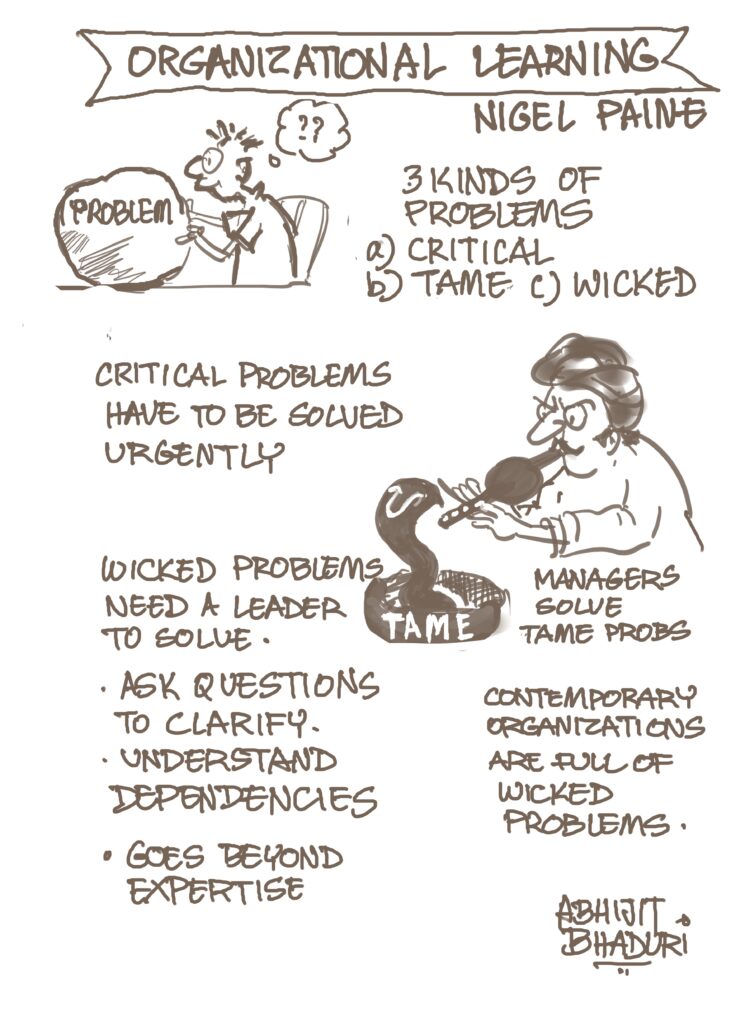
Nigel Paine’s book begins with three kinds of problems. There are
(a) Critical Problems: a PR disaster or a product recall is a critical problem. Speed is of essence when you are solving a critical problem.
(b) Tame Problems: These are problems that can be solved by experts. You need to follow the steps given in the manual and the problem will go away. Experts have the answers to these problems. Many technical problems are often tame problems that experienced managers excel in solving.
(c) Wicked Problems: These are complex problems. It takes time to even define what is the problem that one needs to be solved.
Organizational Learning
The answer lies in misdiagnosis. We’ve been treating organizational learning as either a critical problem (requiring urgent expert intervention) or a tame problem (complex but solvable through established methods). Neither approach works because getting an organization to learn is a wicked problem—ambiguous, continually evolving, and deeply entangled with organizational culture, individual psychology, and market dynamics.
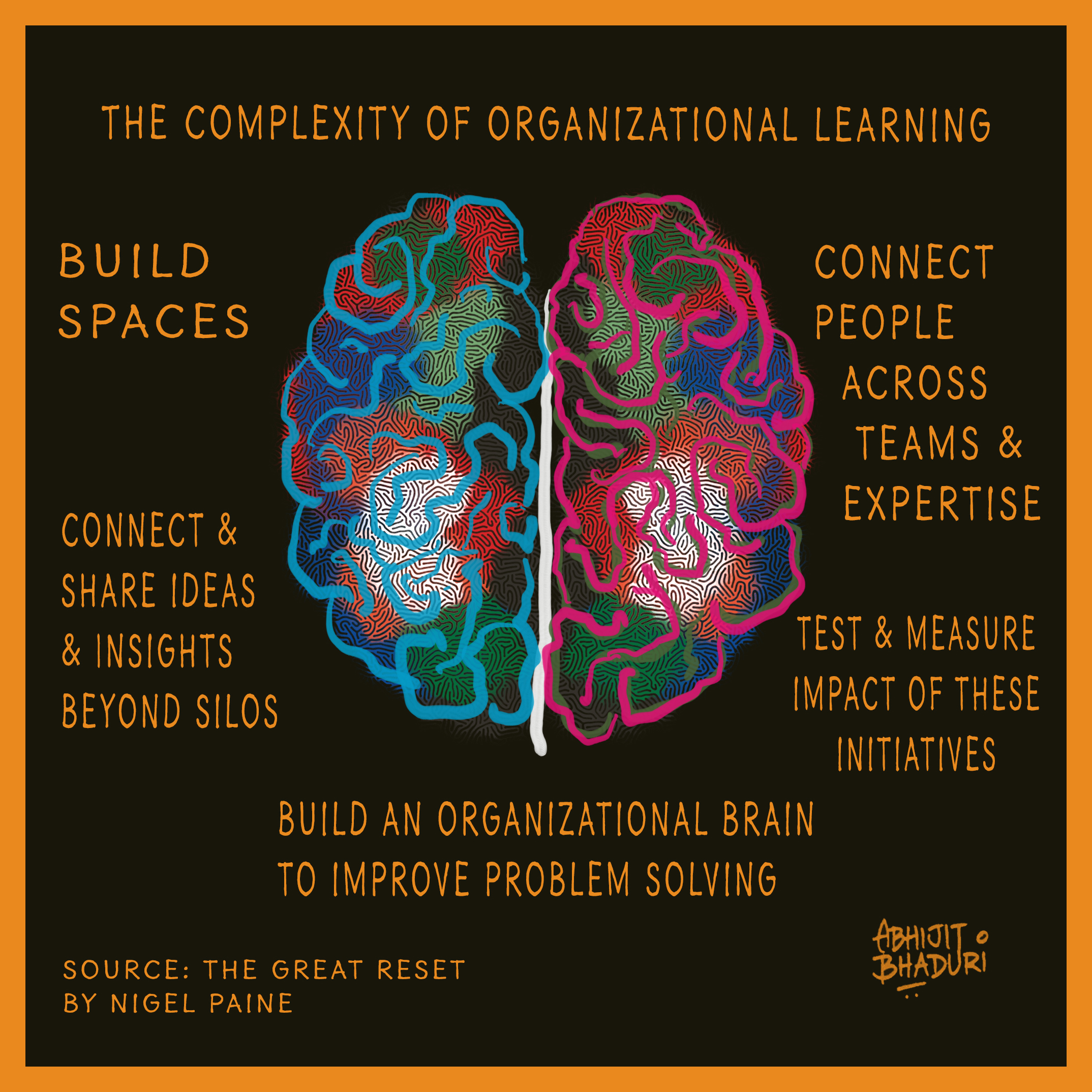
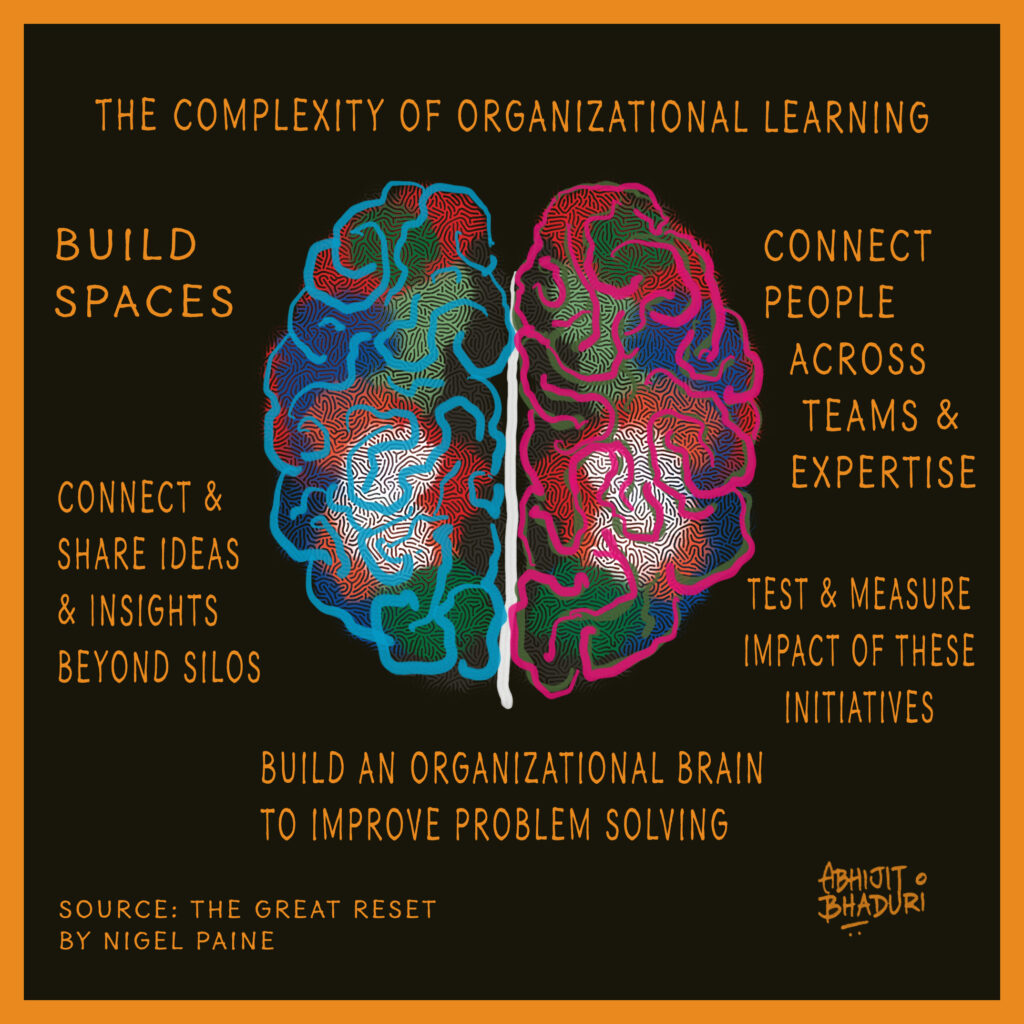
Organizational Learning has some foundational elements: eg spaces – virtual and actual spaces for learning; finding ways to connecting ideas and people across traditional departmental boundaries and silos. Connecting people with diverse expertise and measuring the impact of learning initiatives are ways to build the organization’s ability to change itself. An organizational brain to improve its ability to solve problems is the final proof.
Nigel Paine’s “The Great Reset,” accurately suggests that effective organizational learning isn’t about isolated training programs but rather creating an integrated neural network. For example, upskilling the business is a wicked problem requiring holistic, interconnected solutions rather than simplistic approaches. Upskilling challenge isn’t just about knowledge transfer—it was about shifting mindsets, addressing workflow barriers, aligning incentive structures, and navigating complex interpersonal dynamics among team managers.
“This book is based on three simple premises.
The first is that people are happier and more productive when they work together, help each other, and admit to and work on eliminating mistakes.
The second is that there is such a thing as an organizational brain. What makes us smart is our cellular connections, not the number of neurons. What makes organizations smart is not the number of people they employ, but how well and how frequently they are connected across the organization. The more constantly we make connections in our brain, the more it remains plastic and resilient. The more communities and connections in an organization the more resilient the organization will be, and the faster it can solve problems by drawing on everything it knows.
The third premise is that the better an organization plugs into its external environment the faster it will be able to react to changes in that environment. This means it will be better able to cope with turbulence and uncertainty.”
– Dr Nigel Paine
Nigel’s book as a terrific questionnaire that you could use as a starting point to understand how to get started on the journey of building an organization that learns.
Bonus finding
I learned about a new AI tool called Connected Papers (connectedpapers.com). It defines the field in connected circles of influence. The more connections to that circle and the larger it is, the more central it sits in the canon. I expect to see this getting to the center of the canon.
But then, how do we get more and more people to read this fantastic book is a WICKED problem to be solved.
I got a chance to speak to Nigel about his fabulous book