Due to the pandemic, new circumstances such as work from home and disrupted routines have emerged. Suddenly, the lines that used to distinguish the 9 to 5 managers at the office from the 5 to 7 parents at home have blurred.
– The Year in Search 2020 by Google
We have often heard that the pandemic accelerated the digital transformation journey of many organizations that would have otherwise taken 5 to 7 years. The world moved indoors. The playgrounds, malls, offices and educational institutions looked empty. The seminar rooms and meeting rooms in offices had no takers. The world had retreated to the safety of their home.
Meetings had to be done on Zoom. Sales had to be reimagined because there was no way the sales team could meet the customer in their office. People managers had to learn how to manage a remote workplace and yet engage the employee. HR had to figure out not only how to hire virtually but to also onboard, manage performance, develop and even separate an employee while complying with the law. The CEO had to learn how to do townhalls on Zoom. The way we communicate with devices is very different from the way we communicate in person.
Three shifts that will impact learning
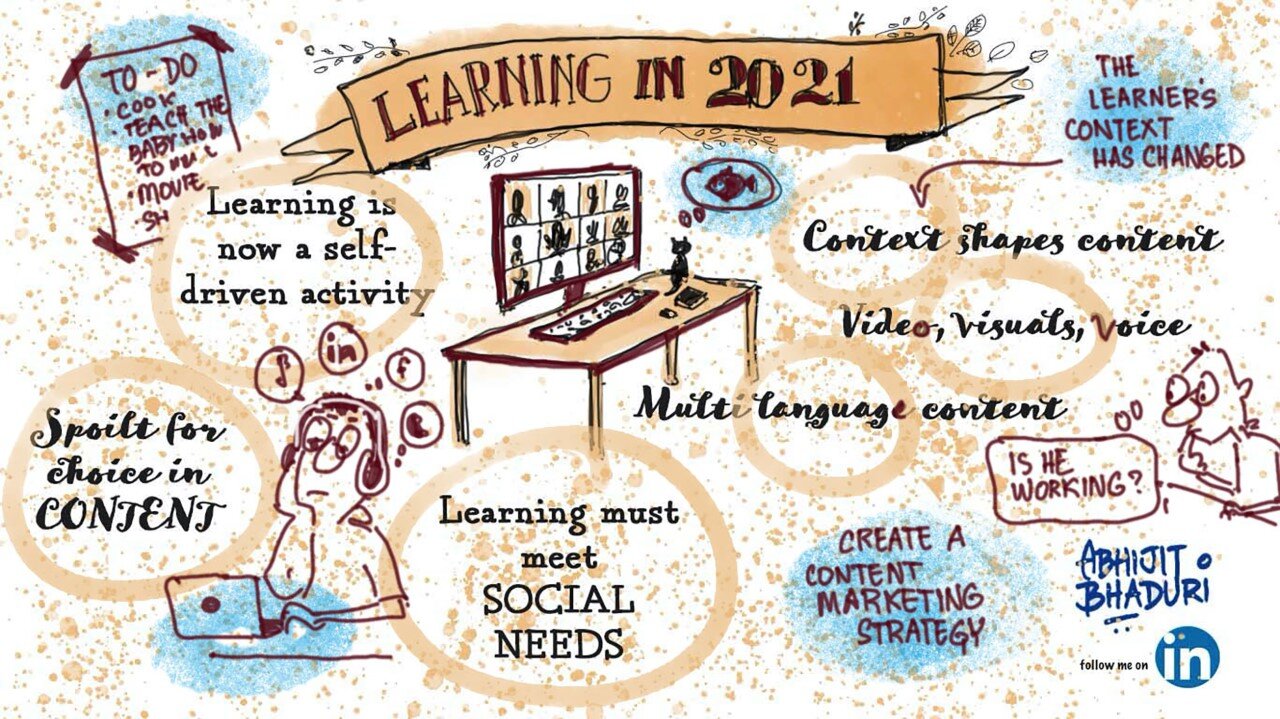
1. The new learner is autonomous: Learning in a virtual environment is far more dependent on the learner being autonomous. Online courses are notorious for abysmally low levels of completion. The learning and development teams must leverage technology to figure out what engages each individual. Hard skills eg coding, tech etc can be better learned online. Soft skills are infinitely harder to learn online because they need feedback that is often built on non-verbal cues. Non-verbal cues are harder to decode in virtual settings. Facilitators and speakers will have to understand how communication and since speaking happen in the virtual world.
2. Designing a learning experience that can claim mindshare : Research shows that there are 80+ apps installed on the average smartphone. The average smartphone user spends 3 hours and 10 minutes each day using their device. About 2 hours and 51 minutes of this time is spent on apps (apps account for roughly 90% of smartphone usage). The app has to be really well designed to compete with the apps designed by Netflix, Amazon, Facebook, Google, (or their equivalent in your part of the world) etc. Those apps that involve ecommerce, news and entertainment already have grabbed mindshare of your employees. The learning app must have content that is relevant and engaging enough to compete for the learner’s mindshare.
3. Make learning social: The isolation created by the lockdown has made most learners crave for social contact. Learning content design can be a great way to meet this need. Allow learners to share their expertise with peers in the form of web-based or user-generated content posted on topic-based discussion boards. Other learners interested in similar skills can follow these boards to learn and even contribute to the topic – much like a social platform. Every new segment must incorporate a quiz, a poll, a video clip, an audio segment that keeps the learner engrossed.
Focus on the big three areas for 2021
1. Context shapes content strategy
When we visit a new city, we may all have different ideas that we will use to make sense of the city’s layout, the history, culture, the stories, the trivia, encounter with locals and much more. In order to design such an experience, we need to know everything about the individual. The kind of work the person does, their role in relation to others in the team, their prior knowledge, their social connects etc.
The Organizational Network Analysis of a fintech startup revealed that new hires needed almost two years before they picked enough tacit knowledge and history before they could be effective. Lack of written procedures meant that the new hire would need to constantly find someone who could contextualize things for the person. The learning experience design for these two cohorts would have to be significantly different. The context of the learner is the first step in designing a learning experience.
2. Video, visuals, voice and vernacular
It is predicted that in 2022, more than 80% of consumer internet traffic will be driven by online video. And this trend is expected to accelerate due to the rise in digital adoption during the pandemic. There is a shift to TV screens as people enjoy watching content on the big screen. Overall watch time of online video has increased, with YouTube on TV growing by 80% year-on-year (YoY) in March 2020.
Creating content in local languages can significantly increase content consumption. Local language content increases consumption by 17% in Hong Kong and Taiwan. In Indonesia, it increases engagement by 34%. Voice assistants can be used to be used to curate and personalize the learning experience.
3. Market the learning experience
Have you heard of Walt Disney? Of course, you have. The Walt Disney Company spent $3.15 billion on promoting their products in 2019 in the United States. They spent 4.3 billion U.S. dollars on advertising worldwide, in the same period. They study the consumer’s buying behavior and their shifting tastes. When it comes to learning and development, we do not make any effort to persuade the learners. We assume that simply sending an email announcing a learning opportunity is enough to get the employee to drop everything else and start learning.
2021 is the year organizations must wake up to the reality that the learner is very different from what they assume about the learner.
This has been published in HRM Asia Feb/Mar 2021 Issue, page 24-25: https://hrmasia.com/feb-mar-2021/