Day: December 16, 2020

  • Book Review: Let’s Build a Company

    LetsBuildACompany1.jpg

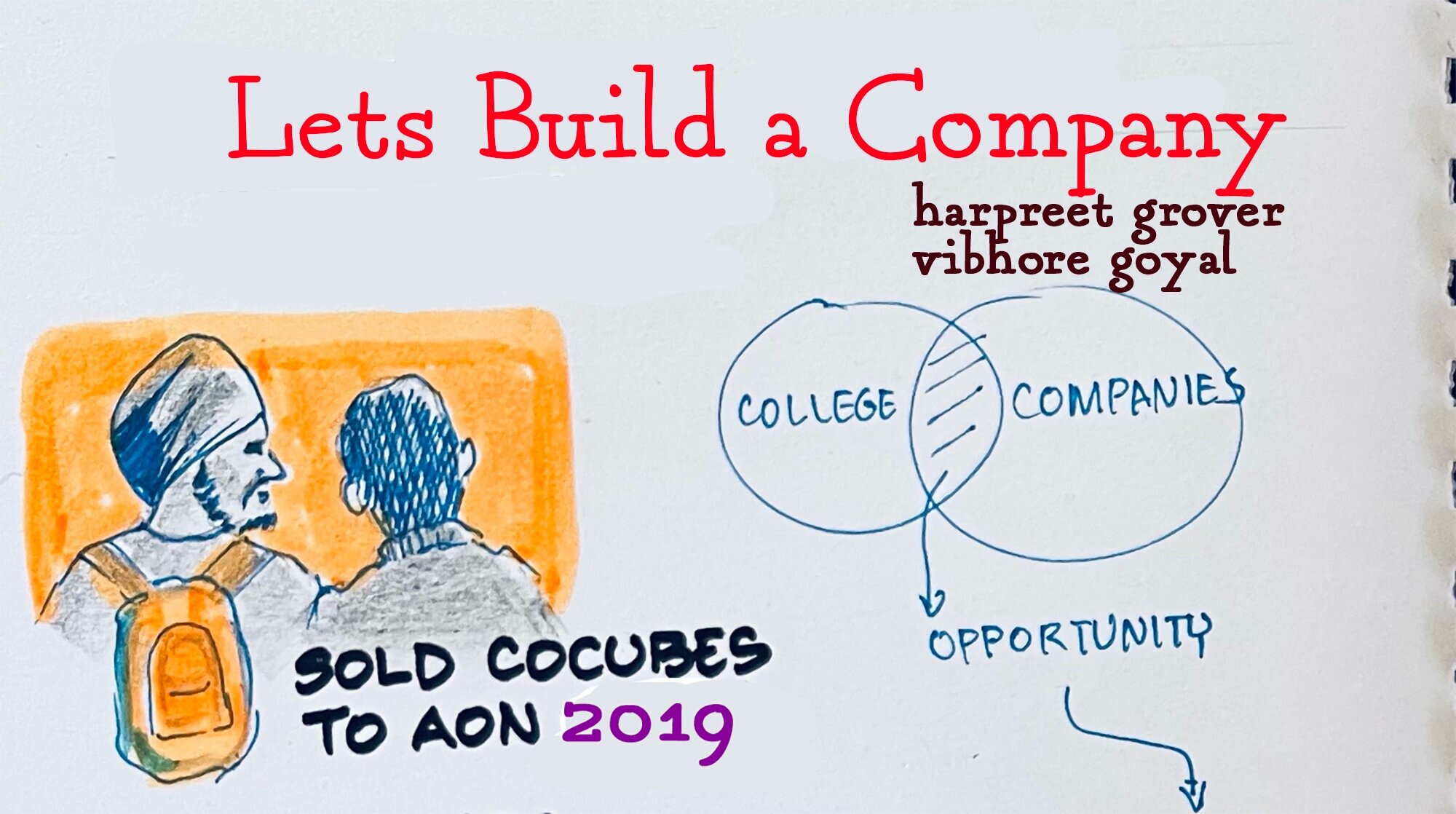
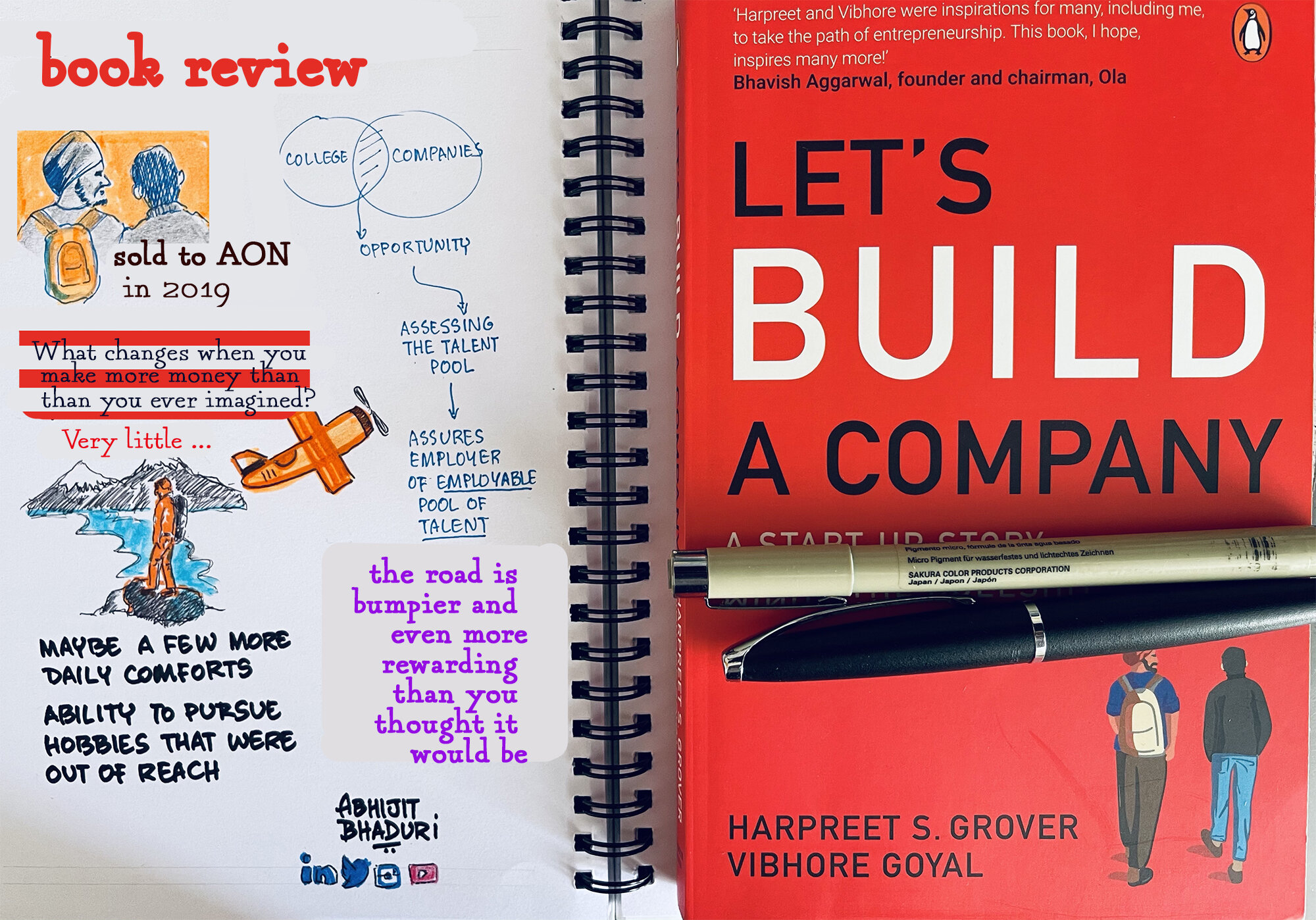
    Two room-mates at IIT Mumbai met, fought and took a few detours in their career. Then decided to build a company. The year was 2007 That company was called CoCubes. They sold their startup to Aon for a tidy sum in 2016 and exited in 2019. How did their life change after making more money than they ever dreamt of? It did not. Beyond some creature comforts like flying business class. And maybe being able to indulge in personal passions like mountaineering or getting a private pilot’s license.

    Let’s Build a Company is the story of building a company and the lessons learnt. Harpreet Grover and Vibhore Goyal have shared their journey.

    Change the market or optimize it?

    They wanted to work with colleges (placement officers) and connect them to companies. They were solving the access to the talent pool. The talent pool had low employability. That made it inefficient for a company to go to a college and find the employable students. They created their own assessment to identify the students who crossed the threshold. Looking back, they believe now, they should have changed the market by working with the students and not the college. Identifying the market that is large enough is a skill. But the markets change. What is a tiny market could change drastically because of technological shifts (eg access to smartphones and cheap data) and social shifts (entrepreneurship as a viable option).

    What I liked about the book

    The book talks about their desire to build an organisational culture that would attract talent. They take pains to explain how much of a struggle it is to solve things end to end. This is not something that schools and colleges teach. Parents do not teach this either. Don’t spend it on a fancy office. It sends the wrong signal to those who applying to you for a role.

    The Biggest Asset: People

    I started reading this section with a little bit of cynicism. The first few chapters about raising funds and running out of funds or flying down to meet a client to convince them not to exit was not different from what any entrepreneur does. The differentiation comes in the way the startup makes people decisions.

    I loved the way they explain their thumb rules about hiring. This is probably the biggest take away for me. A fancy office signals to a candidate that it is business as usual. In a start-up the investor’s money is like jet fuel. Use it to build the product faster, not to have a fancy office. Stay hungry and don’t hire people who are not hungry to succeed.

    >
    You need a person who is comfortable with ambiguity, who is comfortable with things that are broken, who likes fixing stuff.

    Most startup founders are terrific at building a product or service. They are not focused on building the organization. Most startups do not invest in a CHRO whose role is beyond recruitment and payroll. Things like creating the culture or communicating with every single employee when things are going south is tough. Have a coach they recommend. If you are in a hurry, this is the section you should read. The section on people decisions on how to hire the leadership team and how to do performance management etc are fabulously crafted. For me that was what made the book worth reading. I wish the entire book was about that. that is when they really shine through with an individual point of view and challenge many traditional perspectives. I loved the somewhat irreverent humour that comes through.

    Many of the other chapters talk about individual perspectives or challenges that did not hold my interest. Autobiographical sections or stream-of-consciousness writing is hard to get impressed by, unless the adversities or circumstances are exceptionally overwhelming. Middle class Indians are rarely at those crossroads. Those are the sections I skipped.

    After selling the pace to Aon, what were the changes they noticed? The CoCubes employees noticed that things were slower, hikes in salary were modest. Legal decisions took more time. Both the founders are doing something different today.
    ———

    If you have read the book, let me know what you think of it. Leave your comments below.
    LetsBuildACompany 2.jpg

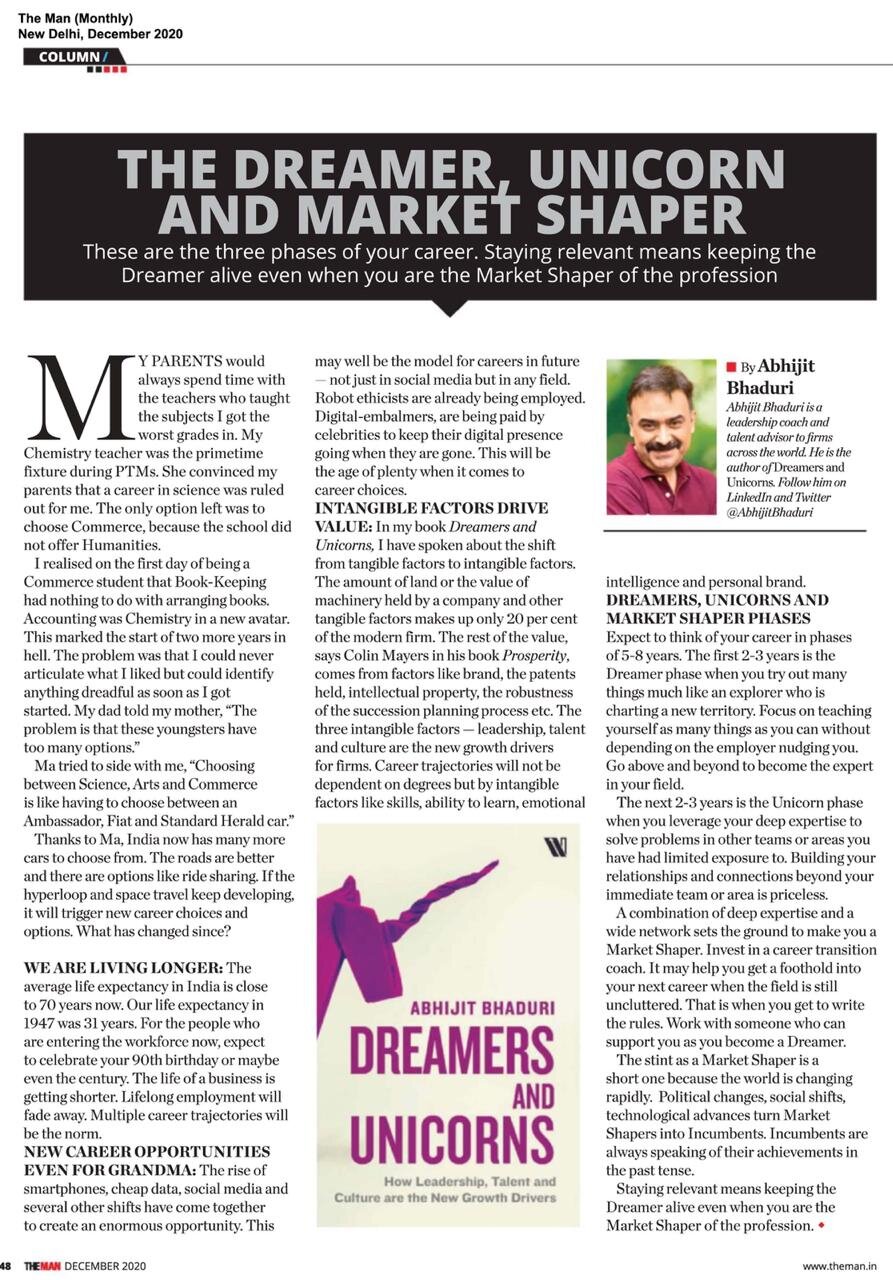
  • The Dreamer, Unicorn and Market Shaper Phases of Careers

    These are the three phases of your career.  Staying relevant means keeping the Dreamer alive even when you are the Market Shaper of your profession

    Listen to the audio version of the article

    My parents would always spend time with the teachers who taught the subjects I got the worst grades in. My Chemistry teacher was the primetime fixture during PTMs.  She convinced my parents that a career in science was ruled out for me.  The only option left was to choose Commerce, because the school did not offer Humanities.

    I realised on the first day of being a Commerce Student that Book-Keeping had nothing to do with arranging books.  Accounting was Chemistry in a new avatar. This marked the start of two more years in hell.  The problem was that I could never articulate what I liked but could identify anything dreadful as soon as I got started.  My dad told my mother, “The problem is that these youngsters have too many options.”

    Ma tried to side with me, “Choosing between Science, Arts and Commerce is like having to choose between an Ambassador, Fiat and Standard Herald car.”

    From a time when career choices were limited, we are now in the age of abundance.

    From a time when career choices were limited, we are now in the age of abundance.

    Thanks to Ma, India now has many more cars to choose from.  The roads are better and there are options like ride sharing.  If the hyperloop and space travel keep developing, it will trigger new career choices and options.  What has changed since?

    My+Post+%2855%29.jpg

    • NEW CAREER OPPORTUNITIES EVEN FOR GRANDMA:  The rise of smartphones, cheap data, social media and several other shifts have come together to create an enormous opportunity.  This may well be the model for careers in future – not just in social media but in any field.  Robot ethicists are already being employed.  Digital-embalmers, are being paid by celebrities to keep their digital presence going even after they are gone.  This will be the age of plenty when it comes to career choices.

    • INTANGIBLE FACTORS DRIVE VALUE:  In my book Dreamers and Unicorns, I have spoken about the shift from tangible factors to intangible factors.  The amount of land or the value of machinery held by a company and other tangible factors makes up only 20 per cent of the modern firm.  The rest of the value, says Colin Mayers in his book Prosperity, comes from actors like brand, the patents held, intellectual property, the robustness of the succession planning process etc.  The ability to build trust is a vital part of the leader’s skills. The ability to build trust matters just as much for the employees.

      The three intangible factors – leadership, talent and culture are the new growth drivers for firms.  Career trajectories will not be dependent on degrees but by intangible factors like skills, ability to learn, emotional intelligence and personal brand.

    TheMan.jpeg

    DREAMERS, UNICORNS AND MARKET SHAPER PHASES: Expect to think of your career in phases of 5-8 years.  The first 2-3 years is the Dreamer phase when you try out many things much like an explorer who is charting a new territory.  Focus on teaching yourself as many things as you can without depending on the employer nudging you.  Go above and beyond to become the expert in your field.

    The next 2-3 years is the Unicorn phase when you leverage your deep expertise to solve problems in other teams or areas you have had limited exposure to.  Building your relationships and connections beyond your immediate team or area is priceless.

    A combination of deep expertise and a wide network sets the ground to make you a Market Shaper. Invest in a career transition coach.  It may help you get a foothold into your next career when the field is still uncluttered.  That is when you get to write the rules.  Work with someone who can support you as you become a Dreamer.

    The stint as a Market Shaper is a short one because the world is changing rapidly. Political changes, social shifts, technological advances turn Market Shapers into Incumbents.  Incumbents are always speaking of their achievements in the past tense.

    Staying relevant means keeping the Dreamer alive even when you are the Market Shaper of the profession.

    Written for TheMan magazine, Dec 2020