Generalists vs specialists – who has a greater chance of success?
Which path is a recipe for success – a generalist’s or a specialist’s? What is the right age to make a career choice? Should one choose early and take a distraction free path? Or should one try out a sampling of possibilities before deciding?
Children in Armenia start thinking about their careers at a very young age — around six months or so. The ceremony is called “agra hadig” or “atam hatik.” In many parts of India, there are similar rituals performed.
As part of the ritual, objects symbolizing different professions are arrayed in front of a child: a microphone for an entertainer, a stethoscope for a doctor, scissors for a tailor or money for a banker. Whichever object the baby chooses first is thought to be a sign of where the child’s professional aptitude lies.
“I don’t know”
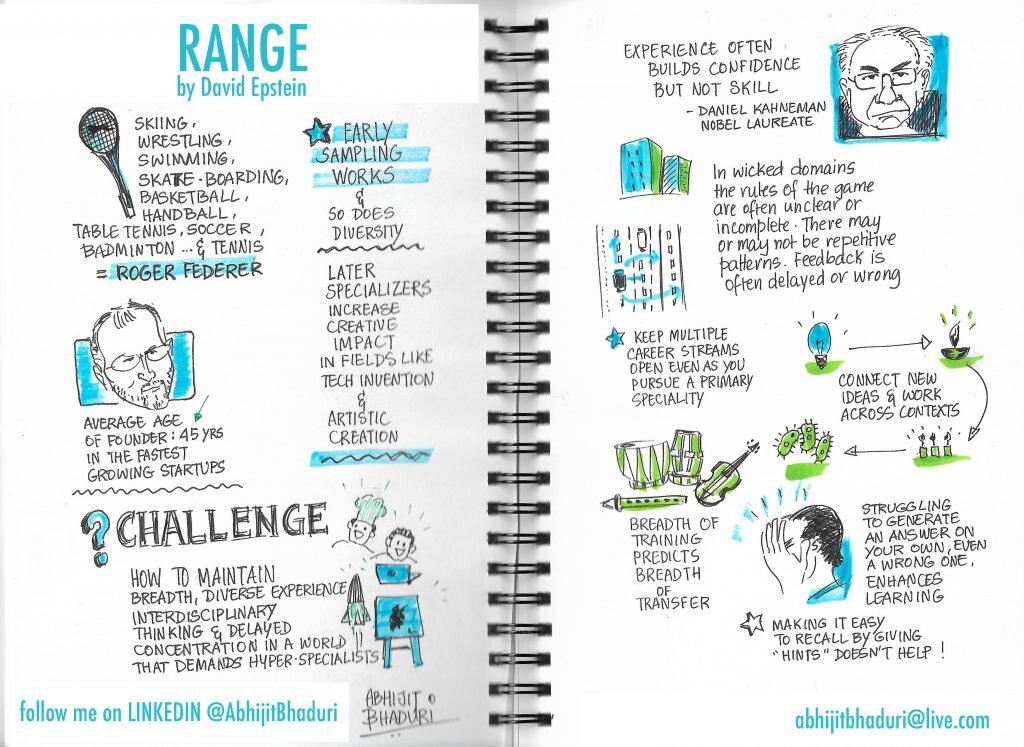
Imagine a kid who starts off trying every sport possible. From skiing, wrestling, swimming, skate-boarding, basketball, handball to table tennis and soccer. Did I mention tennis? Yes, that too. What would you advise such a kid?
Most people would say, “Make up your mind, will you?”
The kid I am talking about is Roger Federer. He attributes his success to sampling all these sports. It built his athleticism and hand-eye coordination.
Generalists vs Specialists
If you ignore Mark Zuckerberg, what would be the average age of the founders of the fastest growing successful startups? It is 45 years. Does that surprise you? It surprised me for sure. Why are these successful entrepreneurs late specializers?
From artistic creation to technical invention, having diverse experiences seems to be the key to a successful career. So does that mean, the world does not need specialists? Of course not.
Several problems need an interdisciplinary perspective. They are too complex to be solved by an individual. But how do we maintain breadth, diverse experience, interdisciplinary thinking and delayed concentration in a world that demands hyper-specialists?
Efficient, yes but…
Generalists vs specialists is not a new debate. There are areas where specialists have an advantage. Specialists do well in fields where there is one clear path to success. Tiger Woods symbolizes the specialist path to success. Many parents often view an early head start as an advantage.
Early specializers jump off to an earnings lead after college. But later specializers make up for it by finding work that better fits their skills and personalities.
When the Nobel Laureate Daniel Kahneman probed the judgments of highly trained experts, he often found that experience bred confidence but not skill. Specialization worked well in chess players, poker players and firefighters. Specialists do not do well as predictors of financial or political trends. Nor are they good at predicting human behavior. Specialists do well in settings where patterns repeat and feedback is immediate and accurate.
Wicked problems
The world often hands us what are called “wicked problems”. These are settings where the rules of the game are unclear or incomplete. The patterns do not repeat and feedback is often delayed or misleading. The world is increasingly beginning to sound close to that description.
In these settings the late specializers often thrive. They keep multiple career streams open even as they pursue a primary specialty. The ability to connect new ideas and work across contexts is a key predictor or success says David Epstein in his book Range
Learning from experience
Specialists often learn from experience. Think of the manner in which “coaching classes” operate. They take the questions that have appeared in previous years and then create similar problems that they make the students repeat ad-nauseum. The coaching classes are successful because many entrance examinations to prestigious institutions depend on doing well in such tests. These are tests which favor those with higher cognitive capabilities.
What is the largest prime number below 200? The entrance to Engineering colleges, Management Institutes etc are all heavily skewed in favor of those who can answer the questions instantaneously. Given adequate time, most people can solve such problems that show up in these entrance exams. Why then is employability an issue for so many smart educated people?
Learning without experience
When people start working, they have to work with people who do not always agree to the ideas offered. The best ideas very often do not guarantee success. Working with people is one of those “wicked” challenges. It is hard to find patterns that repeat. What works with one manager does not work with the other. A colleague who seemed so amiable one day could have betrayed you the next day.
All of us can learn from experience if the future is much like the present. How do we learn without experience? That is what learning agility is all about. This is where having a breadth of experiences is an advantage. It enables people to take ideas from one discipline and apply it to another context.
A quick look at the resumes of several CEOs reveals that most of them were not class toppers.The skills needed to do well in a test is not a predictor of success in a different setting.
Inspiration is everywhere
The field of bio mimicry uses nature as inspiration for design. Researchers have managed to mimic the biomechanics of a gecko’s feet in a pair of climbing pads capable of supporting a human’s weight.
Behavioral economics was formed at the intersection of psychology and economics. When traditional economics failed to explain human behavior in the real world, Daniel Kahneman wondered if we were putting too much emphasis on our assumption that human beings are rational. Maybe it is time for Human Resources principles to questioned.
Generalist and Specialist
What can you do to thrive in such a world? Do not make it an either or choice between being a generalist or having a specialization. Try to read something about a different field every day. Listen to music from another country. Read magazines that cater to different hobbyists. From motor-cycle racing to polymers, there are fascinating ideas everywhere. Try and find ways to apply those ideas to your world. Try out cuisine you never have. Learn about words that have no equivalent in your language.
The future does not belong to the generalist or the specialist. It belongs to the curious mind.
——-Written for Business Line dated August 15, 2019.
What are the nine dimensions of culture employees care about? <read this>