Day: May 27, 2019

  • Courage and Inspiration: The New Leadership Standard 

    Courage and Inspiration: The New Leadership Standard 

    Courage.jpg

    When Fortune published its 2019 list of the greatest leaders, they curated a list of people who are making an impact in business, government, philanthropy, and the arts.These leaders come from countries all over the globe. They are men and women who are transforming the world. Their vision is inspiring others to do the same.

    Leadership is a subject that fascinates everyone. We often wonder what makes the leader so very different from us. Do they really march to a beat different from what we hear?

    Courage

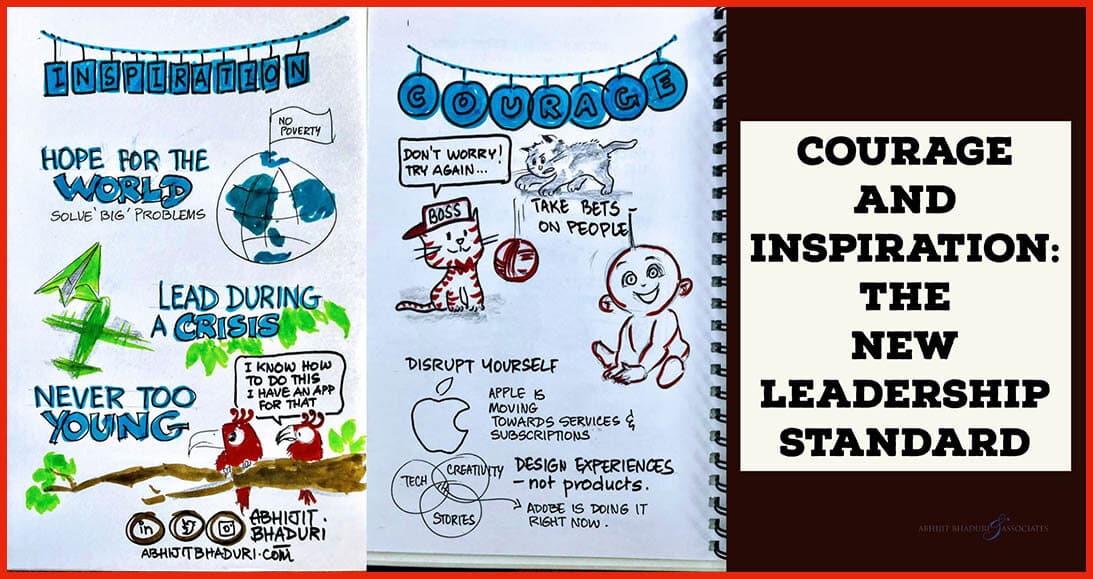
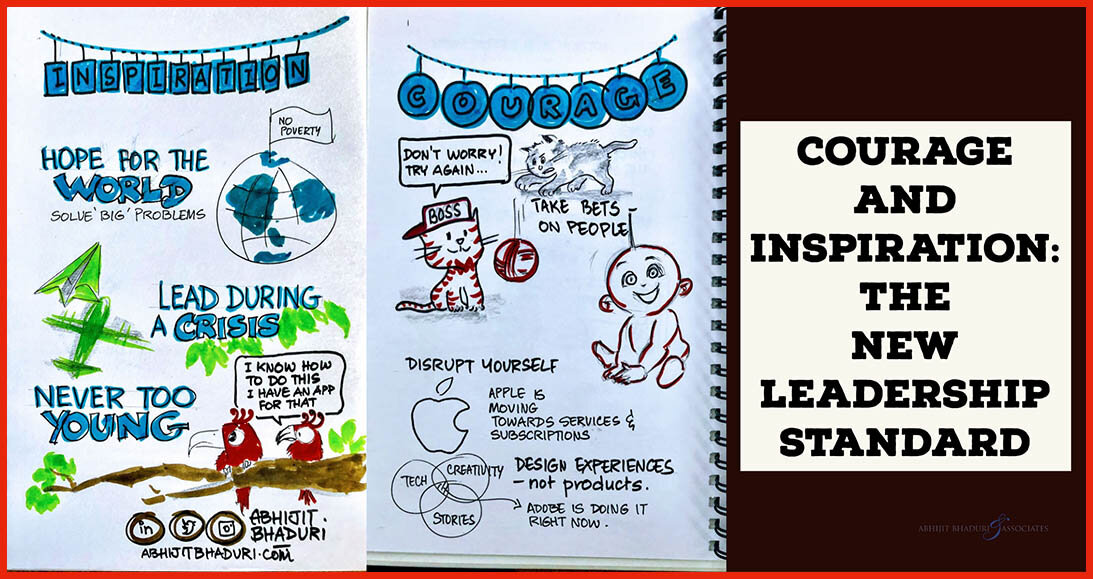
    Being a leader needs courage. It means making bold choices and take big risks. It often means having the courage to pursue the idea despite naysayers. Is it easier to take a bold bet when you are successful or is it easier if the stakes are low? If the decision needs an extraordinary amount of courage, it is a test of leadership. 

    1. Courage to Take Bets on People

    When Ed Catmullof Pixar made “Incredibles” he took a bold bet. Disney was already successful. Yet he decided to move from 2D animation to creating 3D animation through code. He took a bet on a director whose last movie was a giant failure. Don’t miss this note on Creativity Inc by Ed Catmull <click here>

    2. Courage to Reimagine the Business

    In more recent times, Tim Cook, CEO of Apple, is steering the $900 billion behemoth away from slowing iPhone salesand toward a business model based on services and subscription revenue.

    3. Courage to Design Experiences

    Shantanu Narayen, CEO of Adobe did the same when he turned the software-on-CD seller to a cloud-based subscription service. He is famous for saying that customers buy experiences not products. Adobe is once again reinventing the business by bringing in Artificial Intelligence to the business of designing customer experiences. They blend technology with creativity, design and storytelling to create the magic.

    Inspiring Others

    Being able to create a movement is one of the most powerful ways in which leaders drive change. They do this by being role models. They do this by their day to day actions. This is not about using hierarchy and power to get others to follow. It is about creating a pull for their vision and values. Leaders help others see the world through the way they make choices. Their priorities, advice, and personal example makes people hopeful.

    1. Hope for the World

    At the top of Fortune’s list for 2019 are Bill and Melinda Gates who have donated more than $45 billion to build some of the most successful international, private-public partnerships ever formed: They helped developing countries immunize 700 million children against preventable diseases. Besides they are leading the fight against AIDS, Tuberculosis and Malaria.

    2. Leading During a Crisis

    Jacinda Ardern, the 38-year old Prime Minister of New Zealand had already broken new ground as a pregnant woman—and then a new mother who was leading a nation. Her ability to empathize with the victims and then drive support for the ban of the semi-automatic weapon was a case study in leadership during a crisis.

    3. Never Too Young

    The most inspiring name on the 2019 list of leaders is Greta Thunberg. She is a 16 year old student activist who is campaigning for climate change. On Twitter page she describes herself as “a 16-year-old climate activist with Asperger [syndrome]”. Her work on climate change earned her a nomination for the Nobel Peace Prize in 2019. Making her a year younger than Malala who won it at the age of seventeen.

    These leaders have all shown courage because many of their decisions puts themselves at extreme risk of failure. The greater the vision, the bigger is the scale of impact but it also means that the possibility of personal failure is very high. Shouldn’t we be holding our leaders inside organizations to these new standards?

    A version of this was published in the May 2019 issue of People Matters

  • Creating Compelling Content – The New Leadership Requirement 

    Creating Compelling Content – The New Leadership Requirement 

    Compel.jpg

    Compelling content, Skill BuildingThe internet connection is playing havoc. I register a complaint with my service provider at 9 in the morning. I am sitting there waiting for paint to dry. My work comes to a standstill. The technician shows up after numerous follow up calls at 7pm. He takes one look at the connection and says that he has been trained in the old technology and has no clue about how to fix my problem.  Why has the company assigned you to this task if you are not trained on the new technology? I am on the verge of a breakdown. Looking at my desperation, the technician uses one lifeline. He phones a friend who is trained in this tech. The friend tells him that he is in the middle of a farewell party and will take some more time. As we wait for his friend to show up, he explains to me that the new provider (he whose name has three lettersoffers extra money and poaches all technicians. My provider has responded by stopping all investments in training these technicians He explains the strategy to me, “If there are no trained technicians, then the competitor has no one left to hire. They will be forced to train their new hires and my employer will then poach them.” “When the Titanic is sinking, do not stop investing in swimming lessons.” I tried to translate that without success.  “This friend of mine who is coming to fix your problem, is also joining that company. He is attending his own farewell and will come over after that. Compelling content, Skill Building

    40 million learners

    Yesterday, Google released their annual “Year in Search — India: Insights for brands for India. There is a new Bharat that is experiencing what it means to be connected to the world. 40 million new users go online every year, making it the fastest market worldwide. Low-cost smartphones, combined with affordable data packages, have propelled digital far beyond the big cities. The result — 400 million Indian consumers are now online. When we need information, we Google it. When the new learners want to learn something they choose video.  

    The Google report goes on to say,  Indian consumers love video, and not just for entertainment. They use it to search for, learn about, review, and research products before making purchase decisions. It’s estimated that there’ll be 500M online video users by 2020. It’s no surprise, then, that video watch times are exploding across categories and verticals. In the auto category, for instance, we found that 80% of auto buyers watch YouTube videos to find answers and reviews before making their purchase. Other users are turning to video to educate themselves, with watch time for science and hobby videos growing 3X year-on-year (YoY).  

    Video and Voice 

    Compelling content, Skill BuildingVideo and voice are engaging the new learnerBusinesses have to create content that is interesting. If it is not interesting, the content is not consumed. There is a 270% growth in voice queries (YoY) in India. Nine out of every 10 new internet users in the country will likely be an Indian language speaker. These trends have three sharp implications for organizations. 

    1. Teach the leaders to create compelling content on videos. 
    2. Leverage commute time. Create amazing podcasts that people tune in to. 
    3. Make content creation on video and voice a precondition for promoting someone to a managerial role.  

    The company’s videos will not be consumed automatically unless they are better than the ones on YouTube. The CEOs podcast will not be downloaded unless it is more interesting than all the other podcasts that draw millions of listeners. It is not just about creating useful content alone but making useful content that fascinates the learner. That is a tall order for the leaders. ==========Written for the Planet Ganges blog <read it here